Top Easter Candies by State: What's in America's Easter Baskets?
Some states lean chocolate-heavy. Others have strong feelings about marshmallows. Our study reveals who’s craving what, and which states have the biggest sweet tooth.
Easter is one of the few holidays where it’s socially acceptable to build an entire basket around chocolates, marshmallows, and aggressively pastel sweets. For a few weeks each spring, grocery store aisles transform into a glittering shrine to foil-wrapped bunnies, candy-coated eggs, and treats you won’t see again until next year.
This spring takeover is big business. Americans spend more than $3 billion on Easter candy annually, making it one of the biggest candy-buying moments of the year outside of Halloween.1 2
But does everyone reach for the same sweets? Or does your zip code quietly determine whether your basket leans chocolate-heavy, marshmallow-forward, or full of something a little more controversial?
To find out, we analyzed search trends leading up to the holiday and uncovered clear regional favorites, a few surprising loyalties, and some states that appear to take their Easter candy very seriously.
From the biggest sweet tooth hotspots to the treats that dominate state by state, here’s what the data says about America’s Easter cravings.
Jump to:
Key takeaways
- The Great Lakes pack the fullest Easter baskets. Michigan ranks No. 1 in Easter candy search interest, with Ohio, Wisconsin, Illinois, and Minnesota also landing in the top ten. No other part of the country loads up quite like that.
- Wyoming finishes last. It lands at the bottom of the rankings, with Hawaii and D.C. not far ahead. Some regions go all-in on Easter sweets. Others, less so.
- America debates Peeps every year — and then buys them anyway. They’re the No. 1 Easter candy nationwide and win more states than any other sweet — nearly 1 in 3. For something people claim to hate, they’re searched an awful lot.
- Chocolate bunnies are tradition — not obsession. They rank near the top nationally, but almost no state crowns them its favorite. Everyone respects the bunny. But do they love it?
- Pennsylvania produces both Hershey chocolate and Peeps — and at Easter, it chooses Peeps. The marshmallow staple ranks No. 1 in the same state that helped define American chocolate.
- Jordan almonds are weirdly dominant for a candy that can be mistaken for decoration. They rank near the bottom overall nationally, yet still come out on top in six states — including California.
- Easter looks like chocolate — it eats like jelly beans. From the Southeast (Alabama, Georgia, North Carolina) to the Upper Midwest (Minnesota, Wisconsin) and even Colorado and Maryland, jelly beans claim the top spot. The bunny survives the weekend. The jelly beans don’t.
- Coastal states have a soft spot for fish. Connecticut, New York, New Hampshire, and Oregon all elevate Swedish Fish to the top — a fitting choice for states with saltwater access.
- Maine is the only state to crown Cadbury Creme Eggs — even though the candy ranks dead last nationally. Every candy finds its people.
States with the biggest (and smallest) Easter sweet tooth
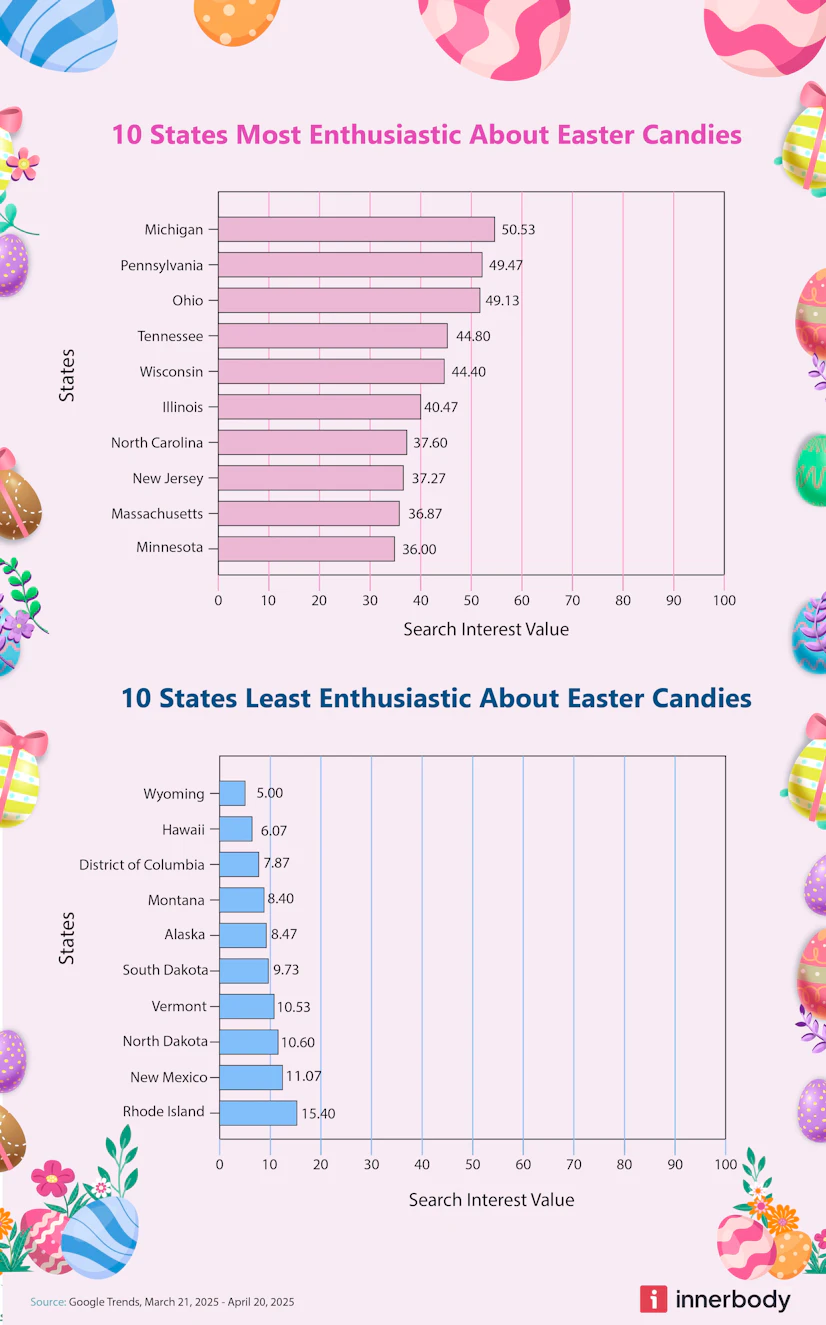
Image by Innerbody Research
Michigan takes the top spot in our rankings, with Pennsylvania and Ohio close behind. Zoom out, and the pattern is hard to miss: states surrounding the Great Lakes show up in force.
Here are the ten places with the highest overall Easter candy interest:
- Michigan
- Pennsylvania
- Ohio
- Tennessee
- Wisconsin
- Illinois
- North Carolina
- New Jersey
- Massachusetts
- Minnesota
Once you move beyond the top three, two influences start to stand out: candy infrastructure and cultural tradition.
The Great Lakes cluster is especially strong. Ohio, Wisconsin, Illinois, and Minnesota all land in the top tier, forming one of the tightest regional groupings in the dataset. That’s not random.
The Midwest — particularly the Chicago area — has long been one of the historic centers of American candy manufacturing. Chicago became a confectionery powerhouse in the early 1900s, earning a reputation as a national candy hub.3 Ferrara began producing candy there in 1908 and today makes brands like Nerds and SweeTarts. Tootsie Roll Industries is also headquartered in the city. In places where candy helped shape the local economy, brand loyalty runs deep.
Pennsylvania’s position near the top makes similar sense. The state is home to both The Hershey Company and Just Born, the maker of Peeps. Few places are more closely associated with American candy production — and in Pennsylvania’s case, the Easter aisle feels close to home.
But manufacturing isn’t the only factor to consider. Several Southern states — including Tennessee and North Carolina — also rank highly. Pew Research Center data shows both the Midwest and the South report higher rates of Christian affiliation than the Northeast and West.4 Because Easter remains a significant religious holiday in those regions, traditions around baskets, egg hunts, and seasonal candy purchases often carry more momentum.
Taken together, manufacturing history and cultural emphasis help explain why states across the Great Lakes and parts of the South consistently show elevated interest. In these regions, Easter candy isn’t incidental. It’s expected.
However, not every state got the memo.
Here are the ten states with the lowest overall Easter candy interest:
- Wyoming
- Hawaii
- District of Columbia
- Montana
- Alaska
- South Dakota
- Vermont
- North Dakota
- New Mexico
- Rhode Island
Unlike the Great Lakes cluster at the top, the lowest-ranking states skew rural and wide-open. Wyoming, Montana, Alaska, and the Dakotas are better known for space than sprawl. If your backyard stretches for acres, an Easter egg hunt might last until Memorial Day.
Then there are outliers like Hawaii and the District of Columbia — places with heavy tourism and transient populations.5 6 In D.C., half the search traffic might belong to people planning brunch, not baskets. In Hawaii, the beach probably wins the weekend.
Here are the full rankings of all states and the District of Columbia:
| States | Search Interest Score | |
|---|---|---|
| 1 | Michigan | 50.53 |
| 2 | Pennsylvania | 49.47 |
| 3 | Ohio | 49.13 |
| 4 | Tennessee | 44.80 |
| 5 | Wisconsin | 44.40 |
| 6 | Illinois | 40.47 |
| 7 | North Carolina | 37.60 |
| 8 | New Jersey | 37.27 |
| 9 | Massachusetts | 36.87 |
| 10 | Minnesota | 36.00 |
| 11 | Florida | 35.33 |
| 12 | Louisiana | 34.93 |
| 13 | Virginia | 34.73 |
| 14 | Utah | 34.33 |
| 15 | Texas | 33.73 |
| 16 | Maine | 32.80 |
| 17 | Indiana | 32.67 |
| 18 | Connecticut | 31.33 |
| 19 | Washington | 31.20 |
| 20 | California | 30.33 |
| 21 | New York | 29.60 |
| 22 | Missouri | 29.13 |
| 23 | New Hampshire | 28.93 |
| 24 | Colorado | 28.60 |
| 25 | South Carolina | 27.07 |
| 26 | Iowa | 26.33 |
| 27 | Maryland | 26.13 |
| 28 | Oregon | 25.33 |
| 29 | Alabama | 25.00 |
| 30 | Georgia | 24.47 |
| 31 | Kentucky | 24.33 |
| 32 | Delaware | 23.93 |
| 33 | Arizona | 23.67 |
| 34 | Idaho | 21.00 |
| 35 | West Virginia | 20.40 |
| 36 | Kansas | 19.27 |
| 37 | Arkansas | 19.00 |
| 38 | Mississippi | 17.80 |
| 39 | Nebraska | 16.13 |
| 40 | Nevada | 15.53 |
| 41 | Oklahoma | 15.40 |
| 42 | Rhode Island | 15.40 |
| 43 | New Mexico | 11.07 |
| 44 | North Dakota | 10.60 |
| 45 | Vermont | 10.53 |
| 46 | South Dakota | 9.73 |
| 47 | Alaska | 8.47 |
| 48 | Montana | 8.40 |
| 49 | District of Columbia | 7.87 |
| 50 | Hawaii | 6.07 |
| 51 | Wyoming | 5.00 |
Top Easter candies nationally (and some not so widely loved)
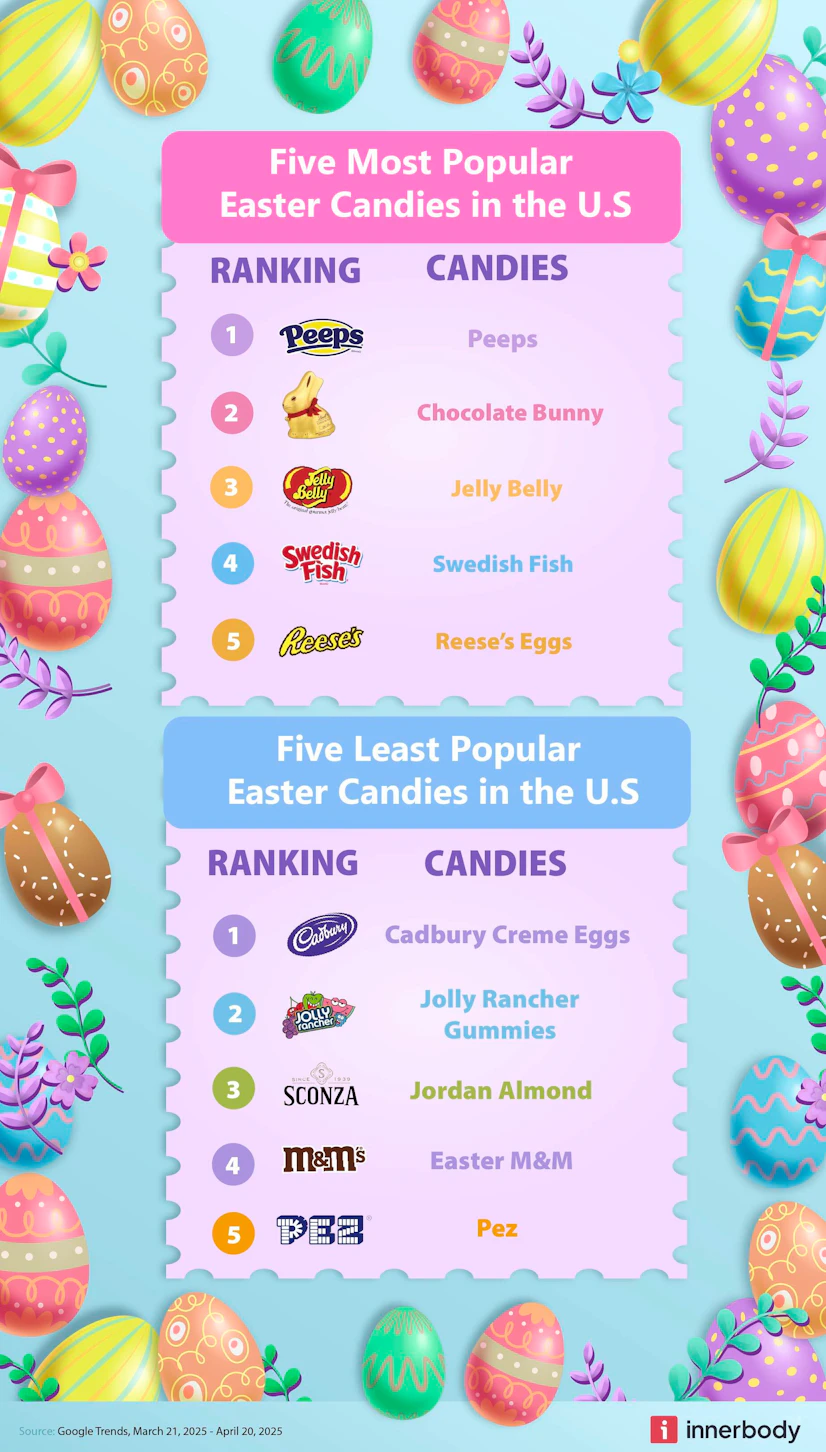
Image by Innerbody Research
When we combine search data across all 50 states and D.C., a clear hierarchy emerges — and yes, the internet’s most polarizing marshmallow takes the crown.
Peeps rank No. 1 nationally, drawing roughly 50% more interest than chocolate bunnies. For a candy that gets roasted annually on social media (and blown up in some microwaves), they remain the most searched Easter treat in the country. Love them or question their texture — they’re at the top of Americans’ candy-loving minds come Easter.
Behind Peeps, the results settle into more traditional territory. Chocolate bunnies land at No. 2, followed by Jelly Belly jelly beans and Swedish Fish. Chocolate still dominates the visual of Easter — but fruit-flavored candy is clearly not playing backup.
A few mid-tier surprises stand out. Reese’s Eggs, Robin Eggs, and Cadbury Mini Eggs cluster tightly in the middle of the rankings, suggesting strong but divided loyalty among chocolate fans. No single egg rules them all.
And then there’s the bottom of the list.
Cadbury Creme Eggs finish last nationally. For a candy that dominates seasonal displays each spring, the overall search interest is surprisingly modest. Jolly Rancher Gummies and Jordan almonds also land near the bottom.
National averages, though, only tell part of the story. Because once you break it down by state, loyalties get a lot more specific.
Mapping top Easter candies by state
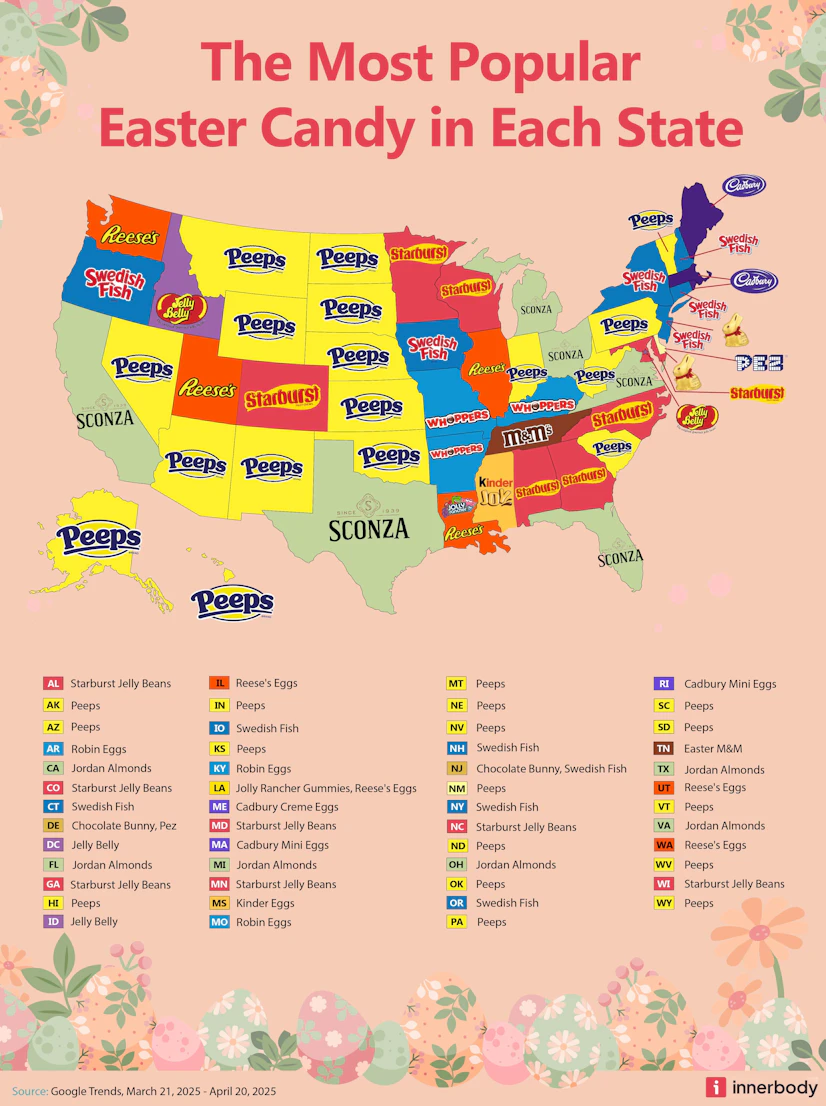
Image by Innerbody Research
Here is what the map above makes clear:
The Peeps empire
Seventeen states crown Peeps, making them the single most geographically dominant Easter candy in the country. The pattern isn’t random: Peeps form a wide interior belt stretching from Kansas and Oklahoma through West Virginia, up into Pennsylvania — where they’re made.
Peeps are produced by Just Born in Bethlehem, Pennsylvania, a company that has been manufacturing the marshmallow chicks since the 1950s.7 That Pennsylvania ranks them No. 1 feels less like a coincidence and more like hometown loyalty. It’s also notable that this happens in the same state that built Hershey into a chocolate empire — and yet, at Easter, marshmallow wins.
Across much of the interior U.S., Peeps function as the default Easter candy — instantly recognizable, unmistakably seasonal, and hard to confuse with anything else in the aisle.
The jelly bean wave
When you combine Starburst Jelly Beans and Jelly Belly, nine states put jelly beans at the top — including Alabama, Georgia, North Carolina, Minnesota, Wisconsin, Colorado, and Maryland.
Jelly beans have been associated with Easter since the 1930s, when their egg-like shape made them a natural seasonal symbol.8 Over time, they evolved from traditional anise-flavored sweets into the fruit-forward versions that dominate today.
The states crowning jelly beans span the Southeast and Upper Midwest — regions that also rank highly in overall Easter enthusiasm. In these places, Easter may look like chocolate, but it tastes like fruit.
The Jordan almond surprise
Nationally, Jordan almonds sit near the bottom of the rankings. On the map, they tell a different story. In California, Florida, Michigan, Ohio, Texas, and Virginia, they’re surprisingly the biggest candy topic.
Jordan almonds trace their roots to European sugared almonds traditionally handed out at weddings and baptisms.9 In several of these states — where Italian-American and Latino traditions remain visible — sugared almonds still appear at christenings, quinceañeras, and wedding receptions.
A candy that looks obscure on the national stage turns out to carry cultural familiarity in specific regions. At Easter, those roots show.
Coastal states prefer fish
A quieter but visually satisfying pattern: Swedish Fish dominate in Connecticut, New York, New Hampshire, and Oregon — with Iowa as the lone inland outlier.
Swedish Fish were introduced to the U.S. market in the 1950s and became a staple of American gummy candy culture.10 The coastal clustering may be a coincidence — but it’s a fitting one.
From the Atlantic to the Pacific, fish rise to the top.
Maine goes its own way
One state stands entirely alone: Maine is the only state to crown Cadbury Creme Eggs.
Despite finishing last nationally, the fondant-filled classic finds a loyal home in New England. On a map shaped by patterns, Maine opts out.
The chocolate bunny paradox
And then there’s the chocolate bunny.
Nationally, it ranks near the top. On the map, it rarely gets the top nod.
Chocolate bunnies have defined Easter imagery for more than a century — molded, wrapped, and center-stage in seasonal displays.11 But state-level loyalty tells a different story. The bunny is respected. It just doesn’t dominate.
The geography of Easter candy
Together, the map reveals something the national rankings can’t: Easter candy loyalty isn’t evenly distributed. It forms belts, clusters, and outliers. Some regions rally around the marshmallow tradition. Others lean fruit-forward. A few choose sugared almonds.
And some states — like Maine — simply do their own thing.
Methodology
To identify the most popular Easter candies in all 50 states and the District of Columbia, we analyzed Google Trends search data. Focusing on the month leading up to Easter, we examined geographic patterns in searches for generic terms related to Easter candy along with search patterns for candies released or strongly associated with Easter — candies that demonstrated particularly pronounced spikes in search during this period (notably, the 14 specific candies highlighted in this report).
For each state, we identified which terms generated the highest relative search interest. We then combined those results to calculate a total search interest score for each state. Using the same dataset, we also determined which Easter candies generated the highest and lowest overall interest nationwide.
Fair use statement
Innerbody Research is committed to providing objective information and data-driven insights to help readers better understand trends related to health, lifestyle, and everyday interests. We invested significant time and effort into creating this report to explore how Easter candy preferences and seasonal enthusiasm vary across the United States.
We hope to reach as many people as possible by making this information widely available. As such, you’re welcome to share this content for educational, editorial, or discussion purposes. We simply ask that you link back to this page and credit Innerbody Research as the source.
Sources
Innerbody uses only high-quality sources, including peer-reviewed studies, to support the facts within our articles. Read our editorial process to learn more about how we fact-check and keep our content accurate, reliable, and trustworthy.
NRF (National Retail Federation). (2025, April 8). Consumers to Spend $23.6 Billion on Easter.
NRF (National Retail Federation). (2025, September 18). NRF Consumer Survey Finds Halloween Spending to Reach Record $13.1 Billion.
University of Chicago Library. (n.d.). Sweet Home Chicago: The History of Chocolate and Candy Making in Chicago.
Pew Research Center. (2025, February 26). Religious Landscape Study (RLS) 2023-24.
Hawaii Tribune-Herald. (2026, February 1). Hawaii visitor arrivals end 2025 well below pre-pandemic peak.
Schoening, E. (2025, August 27). D.C. Expects 5% Drop in International Visitors This Year. Northstar Meetings Group.
Just Born Quality Confections. (n.d.). Our History.
Davis, K. (2024, March 26). How did the jelly bean get into the Easter basket? The Morgan Messenger.
Ghazal, M. (2016, March 30). Scholar traces history of Jordan almonds. The Jordan Times.
Woitier, C. (2022, October 3). The Untold Truth Of Swedish Fish.
Fiegl, A. (2010). Why Are Chocolate Easter Bunnies Hollow? Smithsonian Magazine.
READ THIS NEXT



Copyright © Innerbody Research 1997 - 2025. All Rights Reserved.