Nutrafol vs. Hers
We compare the two brands’ hair loss treatments in terms of effectiveness, safety, cost, and other key consumer decision factors.

Photo by Innerbody Research
At least 30 million American women have at least one thing in common: hair loss.1 If you’re among them, you already know how much it can affect your self-perception and confidence.
But you have solutions at your disposal. Take Nutrafol and Hers, two leading health and wellness brands. While one is a supplement company, and the other is a telehealth platform, their common denominator is that they both offer hair loss treatments. Hers’ focus on prescription medications may mean its products have stronger scientific support, but Nutrafol’s supplemental approach has its merits, especially for people who can’t tolerate prescriptions or prefer botanicals to lab-derived drugs.
With all that in mind, let’s see how Nutrafol and Hers compare.
Nutrafol vs. Hers at a glance
Both Nutrafol and Hers have their share of strengths and weaknesses. The chart below lays out the box score, so to speak. Take note that some categories hold more weight than others.
| Nutrafol | Hers | |
|---|---|---|
| Effectiveness | Advantage | |
| Safety | Advantage | |
| Cost | Advantage | |
| Return policy | Advantage | |
| Website UX | Advantage | |
| Customer support | Advantage |
At this time, you have the best chances of finding a safe, effective, and affordable hair loss treatment at Hers.

Unless you are adamant about using only nutritional supplements, Hers provides an array of treatments that come with a higher degree of evidence that they will work.
If nutritional supplements are the only approach you’re comfortable with, then Nutrafol is likely the best option you’ll find anywhere, but the treatments from Hers provide greater clarity about reliable effectiveness and safety. They’re more affordable as well. Some of Hers’ hair loss and hair care products can be found elsewhere, such as the company’s storefront on Amazon, but the best approach is to go directly to Hers and fully explore your options there; Hers’ prescription services won’t be available elsewhere.
Jump to:
Why you should trust us
Over the past two decades, Innerbody Research has helped tens of millions of readers make more informed decisions about staying healthy and living healthier lifestyles.
Nutrafol and Hers are two brands we’ve covered before, and hair loss is an area with which we’ve become deeply familiar. So, for this review, we expanded on our existing knowledge and reacquainted ourselves with the companies’ products to understand exactly how they measure up. All told, we’ve invested several hundred research hours into understanding which treatments offer consumers the greatest chances of restoring hair.
Additionally, like all health-related content on this website, this guide was thoroughly vetted by one or more members of our Medical Review Board for accuracy and will continue to be monitored for updates by our editorial team.
How we evaluated Nutrafol and Hers
To compare Nutrafol with Hers, we pitted the two brands against each other in these six categories:
- Efficacy: How likely are the company’s treatments to reverse the effects of hair loss?
- Safety: Which company’s products pose the least risk of harm to the user?
- Cost: In general, which company offers the more affordable treatment options?
- Website user experience: When it comes to browsing products, which company’s website is more user-friendly and intuitively designed?
- Customer support: If you have a question or need help, which company’s support channels are more expedient and seamless?
Each of the following subsections covers one evaluative criterion and explains how we made our decision.
Effectiveness for hair loss
Advantage: Hers
Most people looking at Hers or Nutrafol for hair loss are likely seeking a treatment for androgenetic alopecia, the most common form of pattern balding. In women, it typically manifests as general hair thinning and/or a widening part caused by elevated levels of the enzyme 5-alpha reductase, an increased proportion of the hormone dihydrotestosterone (DHT), and an abundance of androgen receptors in the scalp.2 3
Dealing in prescription-strength treatments, Hers has the clear advantage over Nutrafol in terms of effectiveness against androgenetic alopecia. The prescription-strength treatments in question are among the most used and most effective options for androgenetic alopecia:
- Finasteride: inhibits 5-alpha reductase and therefore prevents the conversion of testosterone into DHT.24 Because DHT is a causative factor in androgenetic alopecia, preventing its formation can eliminate a major cause of hair loss.
- Minoxidil: thought to work by increasing the flow of blood and nutrients to the hair follicles, thereby stimulating active growth.23 Research has shown that both minoxidil alone and in combination with finasteride can significantly increase hair counts and diameters. Combination therapy may even reduce serum DHT levels.4 Additionally, minoxidil potentially treats other types of hair loss, such as telogen effluvium and alopecia areata.10 11
Nutrafol, however, shouldn’t be discounted. Although its supplements can’t reasonably outperform a well-studied and FDA-approved medication, their active ingredients (e.g., saw palmetto and ashwagandha) have well-established properties for blocking DHT or reducing other hair loss factors, such as stress.5 6
Safety
Advantage: Hers
Hers earns the safety ribbon for two reasons:
- Its active hair loss ingredients are FDA-approved. As such, they’ve each withstood a comprehensive drug development process that supplements aren’t subject to. The process involves four distinct stages, including safety testing and post-market safety monitoring, so users have fairly strong assurances they’re safe from severe systemic effects except in rare instances.7
- Its most troublesome prescription ingredient, finasteride, is available only in a topical formulation. The topical route of administration minimizes the risk of sexual dysfunction and depression associated with oral treatment.20 29
That’s not to say that Nutrafol is inherently dangerous. For most people, its products pose little risk. But it does mean that Nutrafol’s formulations haven’t undergone the same stringent testing as minoxidil and finasteride, so the degree of risk is theoretically higher.
Cost
Advantage: Hers
You might think that a prescription would cost more than a supplement, but that isn’t the case here. Hers’ main solution for female-pattern hair loss is minoxidil, which has generally trended downward in price since it became available as a generic approved for over-the-counter sales in the mid-1990s. While exact pricing may vary, a Hers hair loss treatment starts at around $12 per month with a multi-month commitment. The price entails an up-front payment that covers the length of your treatment plan, but it’s still tough to beat such a long-term bargain.
Most Nutrafol products are significantly more expensive. Any one of its main oral supplements is either $79 on a subscription or $88 (plus $6.95 shipping) as a one-time purchase. Even the least expensive items in the catalog (shampoos and conditioners) cost more than the monthly equivalent price of any Hers product.
Nutrafol does have a better return policy than Hers, though. We discuss its coverage and caveats under “Nutrafol vs. Hers for cost.”
Website user experience
Advantage: Nutrafol
Website user experience (UX) encompasses everything on a web page that affects how you feel as you interact with a website. Is it a pleasant time, more or less? Is it easy or hard, slow or fast, to find the information you want? That's all UX.
Neither Nutrafol nor Hers has a good UX, but Nutrafol is just less bad. Nutrafol’s primary advantage is that it clearly lists prices on each product page, whereas Hers has you go through a whole questionnaire rigmarole and register an account before getting close to anything like a cost estimate.
In fairness, site functionality is now fairly equal between the two brands. Hers has made meaningful updates since we last checked in. Now you don’t have to scroll past animations, user testimonials, and marketing copy in the first two-thirds of the hair loss page before you reach the product links.
Still, for anyone trying to figure out whether Hers is a viable option for their increased shedding, its opaque pricing may cause additional hair loss through stress and rending. If nothing else, the attendant frustration may be enough to drive prospective customers to another brand, such as Nutrafol.
Customer support
Advantage: Nutrafol
Both Nutrafol and Hers offer online chat support, which we love to see; compared to telephone and especially email, it drastically reduces the response time and allows each party to convey their question or answer as clearly as possible. With Hers, however, the rub is that online chat support is only for existing patients. If you’re only a prospective customer, you’ll have to submit your question through the query portal and then wait for an email. (Of course, you have to find the query portal first. Here’s a link so you don’t have to go hunting for it.)
Nutrafol’s chat feature doesn’t have any such obstacle. You can activate the chat from any page on the company website, and after entering “agent,” you’ll connect with a representative. Just make sure you’ve deactivated any ad blockers on the Nutrafol site, and note that the connection interval may be longer during times of high customer support volume.
What are Nutrafol and Hers?
Nutrafol is a health brand that specializes in hair loss treatments. Hers (the sibling company to Hims) is a telehealth platform that includes hair loss in its treatment catalog. Hair loss is their shared point of commercial interest.
Apart from that, they’re very different companies. Nutrafol deals in supplements, so its treatments are driven by botanical ingredients and aren’t subject to FDA approval before hitting the market.8 Hers, however, uses pharmaceutical-grade ingredients in addition to nutrients and botanicals; its formulations aren’t FDA-approved, but the minoxidil and finasteride used in the formulations are.
The companies differ in their consumer-end processes as well. Buying a Nutrafol product is an ordinary online commercial transaction: select your items and input your payment information. But with Hers, you must first verify your identity and have a medical provider review your treatment plan before you can move forward with the purchase.
Nutrafol vs. Hers for women’s hair loss
Hers is the better option for most women because its prescription-strength ingredients, minoxidil and finasteride, provide the best odds of reversing various types of hair loss: androgenetic alopecia, alopecia areata, telogen effluvium, and anagen effluvium.9 10 11 12 They appear in most of Hers’ hair loss products either together, alone, or in combination with various nutrients:
- Hair Blends Postmeno Serum: minoxidil and finasteride for postmenopausal women
- Hair Blends Serum: minoxidil with biotin, ketoconazole, and vitamin B5
- Minoxidil Solution: stand-alone topical minoxidil in either a 2% or a 5% concentration
- Oral Minoxidil: once-a-day minoxidil pills
- Biotin + Minoxidil Gummy: a green apple–flavored gummy with biotin and minoxidil
- Biotin + Minoxidil Chew: a citrus-flavored chewable version of the gummy
- Hair Vitamins + Minoxidil: a chewable with minoxidil, biotin, vitamin C, B5, B6, and zinc
The Postmeno Serum is especially promising because it leverages the androgen-blocking power of finasteride in women whose decreasing estrogen levels make their bodies more susceptible to the relative abundance of DHT, the key biological mechanism behind androgenetic alopecia. In 2018, this very sort of treatment was put to the test in a randomized, double-blind, controlled study on 30 postmenopausal women with female-pattern hair loss. In it, the subjects received either a 3% minoxidil solution or a combination of 0.25% finasteride and 3% minoxidil. After 24 weeks, while both subject groups yielded increased hair counts and diameters, the combination group had significantly lower serum DHT levels.4
What about Nutrafol? The company’s primary hair loss treatments for women are four oral supplements formulated to block DHT via botanical ingredients:
- Nutrafol Women: for women aged 18–44 with thinning hair
- Nutrafol Women’s Balance: for women aged 45 and older
- Nutrafol Women’s Vegan: for vegan women aged 18–44
- Nutrafol Postpartum: for women with thinning hair in the first year after giving birth
The botanicals in question aren’t as robust as minoxidil or finasteride, but they’re excellent in their own right:
Saw palmetto
Saw palmetto is the star ingredient in most of Nutrafol’s supplements. It blocks DHT uptake and keeps DHT from binding to androgen receptors in the scalp.5 Consequently, DHT has a decreased impact on your hair follicles.
Ashwagandha
Curcumin
Pea sprout extract
The ingredient amounts, however, are hidden behind proprietary blends. So, though we know that something like ashwagandha is effective at doses as low as 240mg, we can only speculate as to whether Nutrafol’s supplements deliver that much of the ingredient per dose.13
On the other hand, to validate efficacy, we can consult clinical research that has specifically used Nutrafol. In 2021, for example, a randomized, double-blind, placebo-controlled study of perimenopausal, menopausal, and postmenopausal women with thinning hair found that subjects who received Nutrafol Women’s Balance saw “significantly increased” hair counts compared to placebo.25 A similar study in 2024 administered Nutrafol Women’s Vegan and found that a “significant proportion of subjects reported improved hair quality, appearance, texture, and volume.”26 It’s true that these studies were conducted and written by Nutrafol-affiliated researchers, but their methods appear sound.
Which company has an edge in safety?
Each company’s active ingredients pose some risk of side effects. Saw palmetto, for example, can cause headaches and is potentially unsafe for women who are pregnant or breastfeeding, while finasteride can decrease libido, cause depression, promote irregular menstruation, and lead to birth defects in male babies.20 29 21 27 Looking at just these two sets of adverse events, you might be inclined to think Nutrafol is safer than Hers.
On the contrary, Hers is generally the safer option for two reasons:
- Its key active ingredients have withstood the gauntlet that is the drug development process. This process entails multiple stages of clinical research, FDA review and approval, and ongoing surveillance to ensure consumer safety. In contrast, dietary supplements, such as those by Nutrafol, can be sold to consumers without undergoing such oversight, and only after they’ve hit the market are they subject to FDA regulation.7 8
- It offers finasteride only in a topical formulation, and the topical route of administration minimizes the risk of the adverse events we’ve mentioned.22
Note that in our comparative review of Nutrafol vs. Hims (Hers’ sibling brand), it was Nutrafol that won on safety. That’s because Hims offers finasteride in oral form, which significantly increases the risk of side effects. Because the oral form is absent through Hers, so too is the higher risk level.
Nutrafol vs. Hers for cost
If low cost is a priority, then Hers is the one you want. In 2026, the company offers five prescription-strength treatments for hair loss, each at a more affordable long-term cost than a comparable Nutrafol alternative:
- Hair Blends Postmeno Serum: starting at $35 per month
- Hair Blends Serum: starting at $35 per month
- Minoxidil Solution (2% or 5%): starting at $12.67 per month
- Oral Minoxidil: starting at $29 per month
- Biotin + Minoxidil Gummy: starting at $35 per month
- Biotin + Minoxidil Chew: starting at $35 per month
- Hair Vitamins + Minoxidil: starting at $35 per month
To be clear, Hers does not offer true month-to-month pricing. Rather, you have to commit to at least three months of treatment and pay the cost of your commitment up front. That amounts to at least $38–$105 to get started. But still, even the high end of an up-front three-month payment is just $17–$26 more than a single month’s supply of a Nutrafol supplement ($88 one-time, $79 on subscription).
Hers also sells nonprescription shampoo-and-conditioner sets, as well as a biotin gummy. Each costs $32 as a one-time purchase, and as low as around $13–$30 per month as a subscription depending on your purchase volume and delivery interval. Compare that to the $44 you’ll spend with Nutrafol on either a shampoo or a conditioner, or the $49 price tag of Nutrafol’s topical serum.
The only products in Nutrafol’s catalog that are less expensive than a Hers treatment are the Hair Wellness Boosters, but they’re purchasable only alongside one of the supplements, not as stand-alone items.
Insider Tip: Hers’ conditioners are compelling because they contain argan oil, which may help guard against oxidative stress.28 The other nonprescription products are less promising.
Which company has better website UX?
For some people, website UX doesn’t matter: if a company has a product they want, they’ll deal with some degree of frustration to get it. For others, it’s an important convenience factor that determines whether a particular brand is worth the trouble.
People in the latter camp may find Nutrafol to be the better option. While its website design is far from intuitive, it’s a little more user-friendly than the situation at Hers.
The greatest design flaw on the Nutrafol site lies in placing content below the fold. The term below the fold refers to information that has been positioned lower than the reader’s immediate view. It originates from print newspapers, on which the bottom half of the front page matter wouldn’t be visible to customers browsing a newsstand. The idea is to keep the most important content above the fold. With that in mind, examine this screenshot of Nutrafol’s Product dropdown menu:
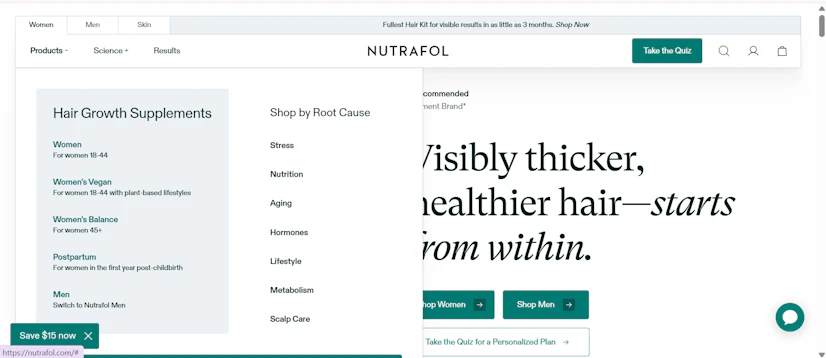
Photo by Innerbody Research
Look way down at the bottom. Does it look like there’s more content below “Scalp Care?” In fact, there is: it’s the See All Products navigation link. That’s an important link, yet it’s completely out of view on a 14in laptop screen. In our testing, we couldn’t even scroll down on the menu; we had to zoom out to 80% on the browser just to access it.
But once you reach the products page, the experience sails smoothly. There’s no clutter on the page, the product links are condensely laid out, and each product page clearly indicates the one-time and subscription prices.
We can’t say the same about the Hers website. To explain, we’ll begin by showing you the front page:
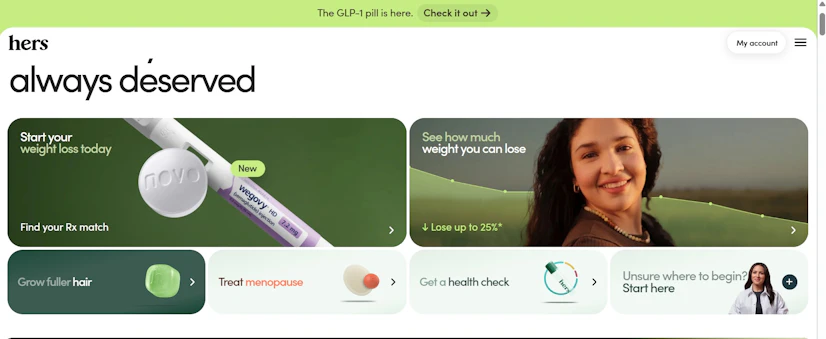
Photo by Innerbody Research
We think it’s reasonable to expect that clicking the “Grow fuller hair” link would take us to a product page that lays out all the hair loss treatment options, but that isn’t what happens. Instead, it takes us to a questionnaire about our hair type, hair loss experience, and other such matters. While this navigation flow makes sense, given that Hers is a telehealth company, it also presents an obstacle to anyone who wants a rundown of their options before putting time and effort into what’s essentially an onboarding process.
To Hers’ credit, its hair loss product page has undergone welcome updates. Previously, you had to scroll halfway down the page, past a mess of testimonials and marketing copy, to reach the product links. Now, though, the product links are well within the first quarter of the page.
Finding pricing info is still a pain, however. For the prescription options, you’ll need to complete Hers’ onboarding questionnaire, with all of its unnecessary animated transitions, and register an account before you reach the pricing rundown.
The bottom line is this: Nutrafol minimizes your time from check-in to checkout, with a tolerable bump in the road, whereas Hers requires a greater commitment and a lot more patience.
Customer support
In evaluating customer support, our chief point of comparison was each company’s online chat feature. Both are convenient, both are effective, but only with Nutrafol is the feature accessible to everyone.
To access Hers’ chat support, you have to be a patient. Otherwise, your only mode of contact is the query portal on the Contact page. Then you have to wait for a response, which may arrive days afterward. Making things even more frustrating is that you won’t find the Contact page link anywhere on the Hers front page; instead, you have to click the “Customer Help Center” link near the bottom to reach a page that does contain the Contact link. There’s no reason to obscure such an important part of the website behind two layers of linkage.
But Nutrafol? Its chat link is in the lower right-hand corner of the screen on every page. Just get past the AI assistant, and you’re on your way to being connected to a live agent.
Insider Tip: Nutrafol’s chat support begins with an AI assistant. Enter “agent” to bypass it.
Final thoughts
In terms of effective treatments, Hers is the company you probably want to go with. Unless you’re unable to use prescription-strength products, Hers’ minoxidil and/or finasteride products will give you the best odds of reversing the effects of hair loss, and at a friendlier price point.
Nutrafol, for its part, offers some of the most compelling supplemental products that address the root causes of androgenetic alopecia, so it’s worth considering as an alternative. It also provides a more user-friendly website that better values the consumer’s time.
If you’re on the fence between prescription-strength and supplemental treatments, we urge you to discuss options with your doctor. They can help you further weigh the pros and cons of each treatment path.
Sources
Innerbody uses only high-quality sources, including peer-reviewed studies, to support the facts within our articles. Read our editorial process to learn more about how we fact-check and keep our content accurate, reliable, and trustworthy.
MedlinePlus. (n.d.). Androgenetic alopecia. MedlinePlus.
Cleveland Clinic. (2023). Female pattern baldness. Cleveland Clinic.
Ho, C. H., Sood, T., & Zito, P. M. (2024). Androgenetic alopecia. StatPearls [Internet].
Suchonwanit, P., Iamsumang, W. & Rojhirunsakool, S. (2019). Efficacy of topical combination of 0.25% finasteride and 3% minoxidil versus 3% minoxidil solution in female pattern hair loss: A randomized, double-blind, controlled study. American Journal of Clinical Dermatology, 20, 147-153.
Evron, E., Juhasz, M., Babadjouni, A., & Mesinkovska, N. A. (2020). Natural hair supplement: Friend or foe? Saw palmetto, a systematic review in alopecia. Skin Appendage Disorders, 6(6), 329-337.
Hall-Flavin, D. K. (2023). Can stress cause hair loss? Mayo Clinic.
U.S. Food & Drug Administration. (2018). The drug development process. FDA.
U.S. Food & Drug Administration. (2024). Dietary supplements. FDA.
White, L. (2024). Treatment of hair loss with minoxidil. American Academy of Family Physicians.
Fiedler-Weiss, V. C. (1987). Topical minoxidil solution (1% and 5%) in the treatment of alopecia areata. Journal of the American Academy of Dermatology, 16(3, pt. 2), 745-748.
Perera, E., & Sinclair, R. (2017). Treatment of chronic telogen effluvium with oral minoxidil: A retrospective study. F1000Research, 6, 1650.
Saleh, D., et al. (2024). Anagen effluvium. StatPearls [Internet].
Office of Dietary Supplements. (2024). Ashwagandha: Is it helpful for stress, anxiety, or sleep? ODS.
Peyravian, N., et al. (2020). The inflammatory aspect of male and female pattern hair loss. Journal of Inflammation Research, 13, 879-881.
Trüeb, R. M. (2009). Oxidative stress in ageing of hair. International Journal of Trichology, 1(1), 6-14.
Yang, Y., et al. (2023). Curcumin-zinc framework encapsulated microneedle patch for promoting hair growth. Theranostics, 13(11), 3675-3688.
National Center for Complementary and Integrative Health. (2025). Saw palmetto. U.S. Department of Health and Human Services.
Drugs and Lactation Database. (2025). Turmeric. LactMed [Internet].
Grothe, T., Wandrey, F., & Schuerch, C. (2020). Short communication: Clinical evaluation of pea sprout extract in the treatment of hair loss. Phytotherapy Research, 34(2), 428-431.
National Center for Complementary and Integrative Health. (2020). Saw palmetto. NCCIH.
Oliveira-Soares, R., André, M. C., & Peres-Correia, M. (2018). Adverse effects with finasteride 5 mg/day for patterned hair loss in premenopausal women. International Journal of Trichology, 10(1), 48-50.
Piraccini, B., et al. (2021). Efficacy and safety of topical finasteride spray solution for male androgenetic alopecia: A phase III, randomized, controlled clinical trial. Journal of the European Academy of Dermatology and Venereology, 36(2), 286-294.
Messenger, A. G., & Rundegren, J. (2004). Minoxidil: Mechanisms of action on hair growth. British Journal of Dermatology, 150(2), 186-194.
McClellan, K. J., $ Markham, A. (1999). Finasteride: a review of its use in male pattern hair loss. Drugs, 57(1), 111-126.
Ablon, G., & Kogan, S. (2021). A randomized, double-blind, placebo-controlled study of a nutraceutical supplement for promoting hair growth in perimenopausal, menopausal, and postmenopausal women with thinning hair. Journal of Drugs in Dermatology, 20(1), 55-61.
Sivamani, R. K., et al. (2024). A prospective, multi-center study to evaluate the safety and efficacy of a vegan nutraceutical to improve hair growth and quality in females following a plant-based diet. Journal of Drugs in Dermatology, 23(8), 661-668.
Mayo Clinic. (2025). Finasteride (Oral route). Mayo Clinic.
Sharifi, N., et al. (2022). Argan oil as a pretreatment of human hair before exposure to oxidative damage: Attenuated total reflectance and protein loss studies. Journal of Cosmetic Dermatology, 21(10), 5010-5017.
Gupta, A. K., et al. (2025). Finasteride use: Evaluation of depression and suicide risk. Journal of Cosmetic Dermatology, 24(3), e70102.

Copyright © Innerbody Research 1997 - 2025. All Rights Reserved.