Here’s What Happened When I Took Innerbody Labs Testosterone Support Supplements for 12 Weeks
Testosterone Support more than doubled my free and total testosterone. Here’s a full accounting of my experience before, during, and after, with detailed T-boosting results.

Photo by Innerbody Research
I was part of the team that developed Innerbody Labs Testosterone Support after spending years digesting the scientific literature on the topic and reviewing other companies’ often lackluster testosterone boosters. And, like a ton of early-middle-aged men, I’m confronting the realities of declining testosterone levels. So, when the opportunity arose for me to try it for myself, with concurrent blood testing from Maximus Tribe — one of our favorite testosterone-testing companies — I jumped at the chance.
Over the course of 12 weeks, I cataloged what it was like to take Testosterone Support, including the best and worst parts of the experience. And the results did not disappoint. In fact, they lined up with what we intended this supplement to achieve based on all of the clinical research that guided the process of formulating it.
Jump to:
Establishing a baseline
I had long suspected that my testosterone levels were lower than optimal. Even at my physical peak, I could never seem to get over the hump in the gym, seeing marginal gains after months of hard work. Over the past several years, I’ve had the opportunity to review around a dozen testosterone-testing services from various companies, and the results confirmed my suspicions:
my testosterone was suboptimal — not necessarily clinically low enough to warrant prescription intervention, but about as close to that as I could get. According to a 2002 review concerning the diagnosis of male hypogonadism (clinical low testosterone), a healthy average range for men would be around 300ng/dL-1,000ng/dL.1 I was at 347 ng/dL, good enough for about the 10th percentile of men (meaning 90% of men have a better number).
My free testosterone (a measure of usable circulating testosterone in the blood) was even worse. At just 69pg/mL, I represented the 2nd percentile; 98% of men had more free testosterone available for everything from strength training and fat loss to sexual performance.
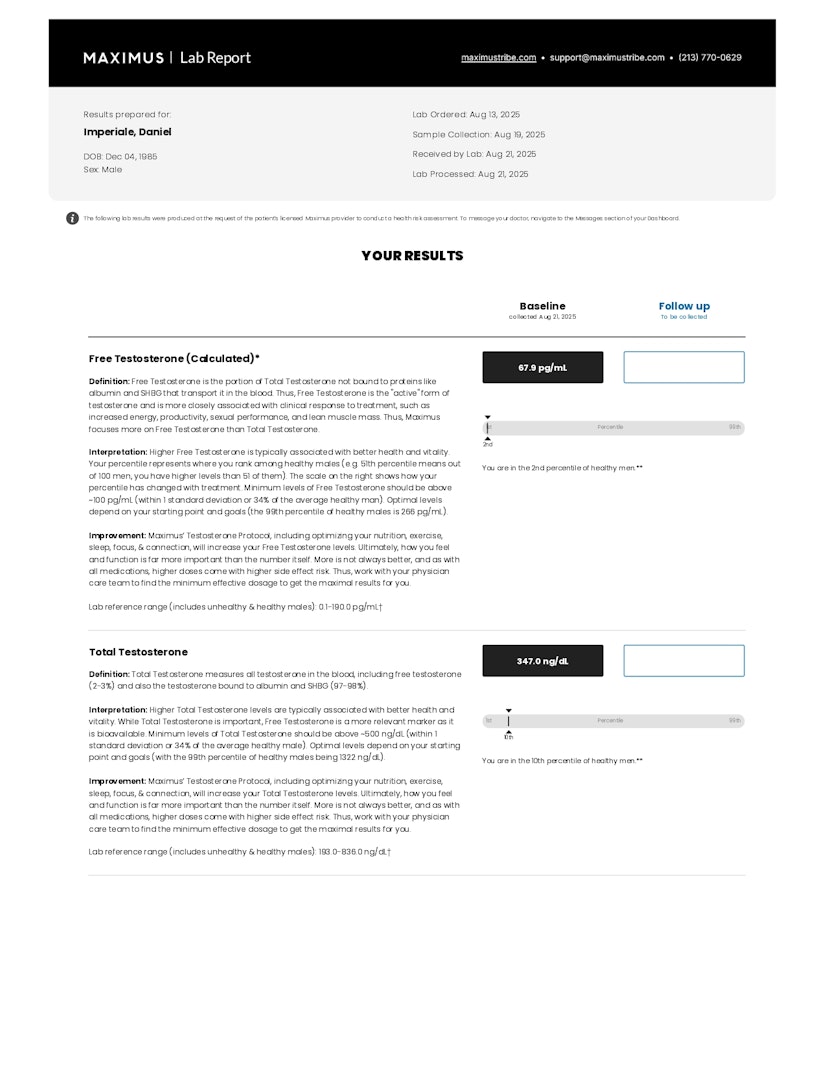
Photo by Innerbody Research
Considering that the average man loses at least 1% of his testosterone production with every year of age past 40, and that my 40th birthday is fast approaching, that number could only get worse.2 So intervention seemed wise, even in the eyes of every medical professional with whom I shared these results.
My baseline test was more than just total testosterone, however. Free testosterone, luteinizing hormone, and other markers are also critical before and during the experiment. So, we made sure to test for these and others through Maximus Tribe, one of the best providers of at-home testosterone tests on the market.
Here were my baseline testing results:
- Total testosterone: 347ng/dL
- Free testosterone: 69pg/mL
- Vitamin D: 37ng/dL
- Luteinizing hormone: 6.9IU/L
- Follicle-stimulating hormone: 2.5IU/L
- Estradiol: 15pg/mL
- Sex hormone-binding globulin: 34.4nmol/L
- Alanine aminotransferase: 28U/L
- Total prostate-specific antigen: 0.9ng/mL
In addition to these parameters, I kept an eye on my body weight and my strength performance in a specific set of dumbbell workouts, which started out here:
| Weight | Reps | |
|---|---|---|
| Single-arm curls | 20lbs | 12 |
| Two-handed overhead tricep extensions | 20lbs | 12 |
| Lateral raises | 10lbs | 12 |
| Bent-over rows | 40lbs | 12 |
| Squats | 40lbs | 12 |
| Straight-leg deadlift | 40lbs | 12 |
Symptomatically, I wasn’t suffering from anything associated with hypogonadism — at least I didn’t think I was. My libido and sexual performance were steady, my energy levels were pretty good, and my general health was okay, as well. That said, my daughter started day care the previous fall, and she brought plague after plague upon our household, rendering my wife and me sick at least once per month from August of 2024 to April of 2025.
That period of protracted illness was initially one reason why I waited to begin my Testosterone Support experience after the supplement’s launch back in 2024. That consistent dip in general wellness could very well have been tied to the poor testosterone results I’d had for a couple of years, which ultimately motivated me further to try the supplement in earnest myself.
About me and how I incorporated supplements into my routine
There are a lot of things to consider when evaluating the effectiveness of a testosterone supplement, and since this is just one person’s account, it’s less a scientific test than an anecdote. But I still wanted it to be as useful and illustrative as possible for men reading it. Toward that end, I'll describe my lifestyle, the pertinent factors I kept generally consistent, and how I incorporated Testosterone Support into my regimen.
Dose and timing
I stuck to the recommended dose of four capsules every morning for the duration of the 12-week experiment. On rare occasions when traveling, I might have taken that dose later in the morning or even in the early afternoon, but I almost always took it before 10 a.m.
Diet
While dietary habits can certainly influence testosterone levels, my diet before this experiment was relatively consistent. I ate at or around maintenance calories, typically around 90% plant-based with the occasional chicken breast or Greek yogurt. I have a massive sweet tooth, and Halloween fell toward the end of the experiment, so there was a spike in refined sugar for a few days around then. Ultimately, my diet wasn’t anything special, and it shouldn’t have influenced my results in a meaningful way. We wanted to leave it as-is and allow me to eat realistically, so you could too.
Exercise
As with my diet, exercise is relatively dialed in. I typically perform some moderate strength training for about 30 minutes 3-4 times per week. I also have a little under-desk bike that I pedal absent-mindedly while working, which adds up to a few dozen kilometers each week. We know that strength training has been shown to increase testosterone, so we made sure that I didn’t put in too much work with the weights (though, as we’ll discuss later, my exercise performance steadily improved over 12 weeks).3
Sleep
I have a 2-year-old. Need I say more? Well, if I do, suffice it to say that sleep was the big wild card in the experiment. Some weeks, I’d get seven straight nights of eight-hour rest. Other weeks would see broken nights with the kiddo up at 3 a.m. for no reason other than to have a book read to her. If anything could have derailed this experiment, it would have been our otherwise perfect daughter.
My 12-week Innerbody Labs Testosterone Support experience
We knew what the science said about the efficacy of each ingredient in Testosterone Support, so we had plenty of data on eventual increases in testosterone and improvements in other areas of health. But which outcomes would I feel first? When would I feel the difference? Would it even be palpable, or could I get all the way through with improved biomarkers but no meaningful change in my day-to-day life?
Well, the journey provided numerous data points that we hope demonstrate how the supplement might help you if you’re in a similar situation. So, let’s take a look at my experience week after week.
Week 1
I didn’t expect much to happen in week one, so I focused on how the dose made me feel on the GI side. Adverse GI effects are incredibly common in supplement trials, and while studies of the individual ingredients in Testosterone Support didn’t report too many of them, the effect of those ingredients in combination was an unknown.
Sure enough, I found that I became ever so slightly nauseated if I took all four capsules on an empty stomach. If I split the dose (two capsules in the morning and two in the afternoon), I had no nausea. But I’m forgetful after lunch, so I decided to take the full dose in the morning with food. Again, no GI discomfort, so I was good to keep going.
Week 2
Getting into the rhythm of it now, I kept a bottle of Testosterone Suppert in my home office, another in the kitchen, and a third in the basement near my weights. Still, on day three of this week I forgot my daily dose. What made me realize the lapse was actually a noticeable change in my stress levels, which struck me as a decent indicator that the acute stress-reducing effects of ingredients like ashwagandha and tongkat ali had been helping me over the past few weeks of taking the supplement.4 5 Better after the next day’s dose.
Week 3
Still targeting maintenance calories here, but I let myself dip into a deficit for a few consecutive days to see if it would have any negative effect on strength performance, and none was observed. I had two nights cut short by our toddler waking up around 2 a.m., but still felt refreshed the next morning on both occasions. Possible sleep improvements underway.
Week 4
I was feeling pretty good in the slight caloric deficit, so I stayed there for the rest of week 4. Yet I maintained my weight and consistently improved in each of my workouts, either in reps, weight, or both (final numbers are in our results section). That implies that I was simultaneously burning fat and building muscle despite the deficit.
Weeks 5 and 6
These weeks were a steady cruise control similar to week 4, though without the caloric deficit. I returned to maintenance calories and continued to see improvements in energy and strength performance. I also found my sleep was deepening, as I could remember more details from my dreams (a sign of improved sleep).6
Week 7
This marked just past the halfway point, and while it progressed much as the previous weeks did, there was one outlying event. One day, at around 11 a.m., I got a little queasy. It wasn’t the supplement (I had taken it with breakfast and had never experienced related GI discomfort more than 45 minutes post-dose). This felt more like I was coming down with something that wanted to start in my stomach. I lay down, fell asleep, and woke up several hours later feeling absolutely fine. Isolated, this could be a one-off incident, but I’ll soon describe a similar occurrence that leads me to believe this is evidence of immunity support provided by the supplement.
Week 8
At this point in the journey, I was seeing some real results in my workouts. My energy levels were on point, and I was pushing through sets with vigor. I had again increased in either reps or weight in every exercise I was tracking within the experiment, but my body weight had dropped a few pounds, indicating continued recomposition (more muscle, less fat).
Week 9
This was a big week. With a flight to LA for a wedding on Wednesday, I tweaked something in my cervical spine on Monday morning. Desperate, I went to the chiropractor who could see me the soonest. He made things worse. I got the help I needed just before I flew out of town, but my workout routine ground to a halt as I recovered. Still, I managed to travel out West and back without getting sick, which is rare for me and possibly more evidence of an immune boost from Testosterone Support.
Full disclosure: While traveling, I also took Innerbody Labs Sleep Support to help stave off jet lag and ensure proper sleep throughout the trip. This increased my daily doses of five ingredients that are also in Testosterone Support: vitamins D and K, copper, ashwagandha, and zinc.
Week 10
To start this week, I was still unable to work out until the inflammation around my upper back subsided. I was close, but I wouldn’t return to my workouts in full form until near the end of the week. My wife and I had also made a point to dine at a lot of our old favorite spots in LA, and we had a couple of very late nights with very dear friends, which combined with my inactivity to tick my weight back up on the scale. This time, it wasn’t new muscle.
Week 11
After a couple of sessions, I was able to return to the weights and reps I was hitting before my injury. But this week also brought Halloween with it, which meant some excess calories, almost all from unhealthy fats and refined sugar. Still, I found myself more in control of those cravings this year than in years past. Perhaps it was due to the mood-elevating ingredients in Testosterone Support, which may have prevented old stress-eating habits from taking over.
Week 12
At the start of week 12, I was fresh out of candy and ready to finish strong. Strangely, this was also when I had a similar experience to the extremely brief, hours-long illness I endured in week 7. This time, I felt significantly run-down in the early afternoon, rested for a few hours, and felt fine again after that. It was these two experiences — in weeks 7 and 12 — that led me to believe there’s some immunity benefit to Testosterone Support, at least for me. Remember, we have a toddler who offers a steady stream of viral exposure, and the months before taking Testosterone Support were marked by frequent illnesses that would begin just like this. Both of these episodes felt like the beginnings of an illness that might otherwise have lasted at least a day or two, but neither lasted more than a few hours.
For the rest of the week, I ticked up the weights or the reps once again on every workout. My sleep was deep and my mornings were alert, my daily stresses felt more manageable, and my weight had dropped again after my brief West Coast indulgence. Now, with the experiment finished, I had only to take my follow-up testosterone test and await the results.
My results after 12 weeks on Innerbody Labs Testosterone Support
After 12 weeks of consistent supplementation with Innerbody Labs Testosterone Support, it was time to draw a little more blood and get some results. I collected my sample at exactly 12 weeks and at roughly the same time in the morning as I had drawn blood for my baseline. I even used the same testing company (Maximus Tribe) so the results would be as close to an apples-to-apples comparison as possible.
Here’s a look at the top page from the follow-up report:
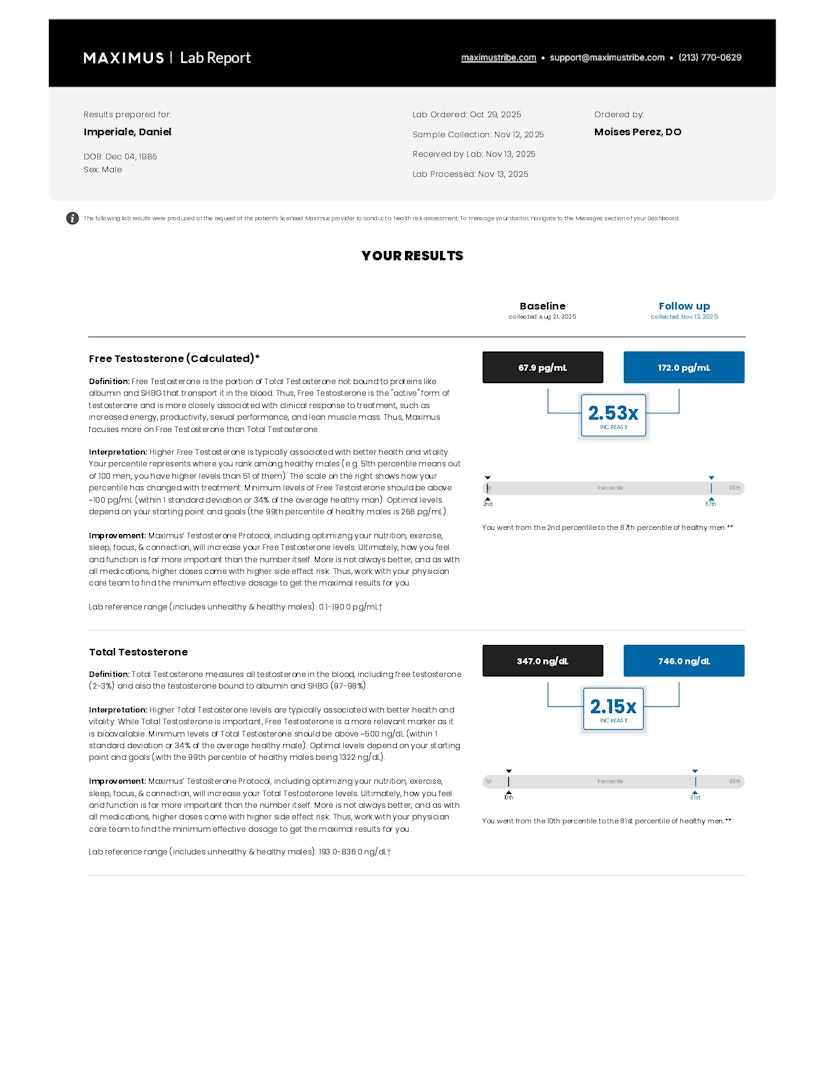
Photo by Innerbody Research
As you can see, my total testosterone more than doubled, and my free testosterone rose more than 2.5 times its baseline number.
Here’s a complete breakdown of the results from my follow-up testing:
| Baseline | Follow-up | |
|---|---|---|
| Total testosterone | 347ng/dL | 746ng/dL |
| Free testosterone | 69pg/mL | 172pg/mL |
| Vitamin D | 37ng/dL | 32ng/dL |
| Luteinizing hormone | 6.9IU/L | 11.2IU/L |
| Follicle-stimulating hormone | 2.5IU/L | 3.8IU/L |
| Estradiol | 15pg/mL | 40.6pg/mL |
| Sex hormone-binding globulin | 34.4nmol/L | 32.3nmol/L |
| Alanine aminotransferase | 28U/L | 18U/L |
| Total prostate-specific antigen | 0.9ng/mL | 1.2ng/mL |
That’s a 2.15x increase in total testosterone and a 2.53x increase in free testosterone. This outcome is pretty consistent with research into specific ingredients in Testosterone Support that bore similar results. The Innerbody team was confident my experience would bear positive results, but I was still gratified to see such a definitive validation of our hard work.7
Now, some of these changes aren’t especially important to my experience. Take vitamin D, for example. We conducted this experiment as the weather was turning cold and the days were getting shorter, so we hoped for relatively stable D levels, and that’s what we saw. Other numbers might not be as important to you, like PSA, but my father is a prostate cancer survivor, so I wanted to make sure I didn’t see a spike in total PSA. And we didn’t, which is great.
Alanine aminotransferase (AA) is something we actually hadn’t thought much about before the experiment began, but it’s a measure of liver health.8 Higher numbers typically correlate with stress or damage in the liver, and we saw a 35% drop in AA, indicating that the four-capsule dose of Testosterone Support not only didn’t stress the liver but instead appeared to have improved it. Again, this isn’t a result that would surprise us, but given all of the misinformation surrounding ashwagandha and liver safety concerns, I think it’s worth mentioning here.
How Testosterone Support improved my physical performance
I’m no bodybuilder. I didn’t have a six-pack before the experiment, and I didn’t develop one over the course of those 12 weeks. That wasn’t the goal (though I have communicated to the team that I’m open to it for future experiments!). That said, even with a couple of weeks spent in a slight caloric deficit and another couple of weeks spent recovering from an upper back injury, I still managed to improve my strength numbers in every move I tracked.
Here’s a breakdown of my strength training performance at baseline and at follow-up:
| Weight x reps baseline | Weight x reps week 12 | |
|---|---|---|
| Single-arm curls | 20lbs x 12 | 30lbs x 10 |
| Two-handed overhead tricep extensions | 20lbs x 12 | 30lbs x 12 |
| Lateral raises | 10lbs x 12 | 20lbs x 10 |
| Bent-over rows | 40lbs x12 | 60lbs x 15 |
| Squats | 40lbs x 12 | 60lbs x 12 |
| Straight-leg deadlift | 40lbs x 12 | 60lbs x 15 |
With the exception of lateral raises, which saw a 100% increase in weight, I increased the rest of my exercises by a stout 50% over the course of 12 weeks. After speaking with several health and fitness experts and embarking on a yearslong training program of her own, Hilary Achauer wrote in the New York Times that around a 5% increase in weight each week is ideal.9 After 12 weeks, that should have been about a 60% increase. But I took two weeks off for injury and spent another two in a caloric deficit, meaning I kept pace with this ideal, and even slightly surpassed it with the help of Testosterone Support.
Final takeaway
Based solely on my knowledge of the science behind Testosterone Support’s individual ingredients, I had been quick to recommend it to anyone who might have benefited from it. But by around weeks 4-5 of this experiment, I became even more evangelical about it.
The Zen philosopher D.T. Suzuki once said (and I’m paraphrasing, I’m sure) that “enlightenment is like everyday ordinary existence, just two inches off the ground.” And that’s been my experience with Testosterone Support. My life isn’t drastically different in one specific way or another. But I am noticeably stronger, noticeably better rested, noticeably less stressed, and noticeably more alert. And the accumulation of those advantages has been profound.
Sources
Innerbody uses only high-quality sources, including peer-reviewed studies, to support the facts within our articles. Read our editorial process to learn more about how we fact-check and keep our content accurate, reliable, and trustworthy.
Vermeulen, A., & Kaufman, J. M. (2002). Diagnosis of hypogonadism in the aging male. The Aging Male: The Official Journal of the International Society for the Study of the Aging Male, 5(3), 170-176.
Stanworth, R. D., & Jones, T. H. (2008). Testosterone for the aging male; Current evidence and recommended practice. Clinical Interventions in Aging, 3(1), 25-44.
Riachy, R., McKinney, K., & Tuvdendorj, D. R. (2020). Various factors may modulate the effect of exercise on testosterone levels in men. Journal of Functional Morphology and Kinesiology, 5(4), 81.
Lopresti, A. L., Smith, S. J., Malvi, H., & Kodgule, R. (2019). An investigation into the stress-relieving and pharmacological actions of an ashwagandha (Withania somnifera) extract: A randomized, double-blind, placebo-controlled study. Medicine, 98(37), e17186.
Talbott, S. M., Talbott, J. A., George, A., & Pugh, M. (2013). Effect of tongkat ali on stress hormones and psychological mood state in moderately stressed subjects. Journal of the International Society of Sports Nutrition, 10, 28.
Brand, S., Beck, J., Kalak, N., Gerber, M., Kirov, R., Pühse, U., Hatzinger, M., & Holsboer-Trachsler, E. (2011). Dream recall and its relationship to sleep, perceived stress, and creativity among adolescents. Journal of Adolescent Health, 49(5), 525-531.
Wankhede, S., Mohan, V., & Thakurdesai, P. (2015). Beneficial effects of fenugreek glycoside supplementation in male subjects during resistance training: A randomized controlled pilot study. Journal of Sport and Health Science, 5(2), 176-182.
Wang, D., Zhou, Y., Xiang, L., Chen, Y., & Feng, X. (2024). Alanine aminotransferase as a risk marker for new-onset metabolic dysfunction-associated fatty liver disease. World Journal of Gastroenterology, 30(25), 3132-3139.
Achauer, H. (2024). If you want to get stronger, routine is the enemy. The New York Times.

Copyright © Innerbody Research 1997 - 2025. All Rights Reserved.