eHarmony vs. Match
We try two of the longest-running online dating platforms to see how they compare in key areas like cost, features, and user experience.

Photo by Innerbody Research
In a 2022 survey of more than 6,000 adults, the Pew Research Center found that 30% of respondents participated in online dating. Among people aged 18-29, it was 53%.1 Another survey, a year later, revealed that 17% of adults over the age of 50 have also tried online dating.14 With that kind of audience, it can feel as though your best chance for romance lies in a website or mobile app.
What makes it more daunting is the sheer number of platforms to choose from. Some sources say there are upwards of a thousand online dating services. We’re sure many of you can name at least half a dozen of them off the cuff. In such a saturated market, you can easily feel overloaded by choice.
If you are feeling overwhelmed by your options, you might consider one of two platforms that have stood the test of time: eHarmony and Match. They’ve thrived in the market for nearly 30 years and continue to attract memberships.
In this comparative review, we discuss the key differences between eHarmony and Match, identify their areas of excellence, and help you pick the option that’s right for you.
As for which one is best — while that ultimately depends on your goals, we’ve found eHarmony to be the more consistently decent platform between the two, whereas Match is often unusable and the company is less than honest about the availability of its features. Still, Match has its merits, which we discuss throughout this guide.
Summary of recommendations
Jump to:
Why you should trust us
Over the past two decades, Innerbody Research has helped tens of millions of readers make more informed decisions about staying healthy and living healthier lifestyles. In that time, our testing team has used numerous dating sites and apps to compare their services. Social connectivity and rewarding relationships are central to health and longevity.
For this analysis, we tried to use a methodical approach similar to our work in other wellness areas. We began by identifying the key differences between eHarmony and Match and weighing them against common goals among online dating populations. We also studied the scientific literature on topics such as romantic compatibility, consulted publications on relevant subject areas, and used each platform ourselves so we could provide accounts of the experience based on practical knowledge.
How we evaluated eHarmony and Match
We judged the two platforms across criteria that are likely to influence consumer choices:
- Dating goals: Can the platform meet the needs of most online daters?
- Cost: Which one is more affordable, considering all subscription tiers?
- Features: What features are available, and do they facilitate the online dating experience?
- User experience: How easy or enjoyable is it to use the platform?
- Customer support: If you have a problem, how quickly and easily can it be resolved?
In the following sections, we explore how eHarmony and Match squared up in each category.
(Note: We’d wanted to include a "user base" criterion — statistically, your chances of finding romance are higher in a larger dating pool — but official numbers on user bases aren't readily available, and the numbers we did find told us nothing about active versus inactive accounts.)
Dating goals
Winner: Match
In the 2022 Pew survey we referenced earlier, respondents’ main motivations for using an online dating platform were:1
- To find a long-term partner: 44%
- To date casually: 40%
- To have casual sex: 24%
- To find new friends: 22%
In other words, even though a sizable minority of people seek long-term partnerships, a majority of daters (64%) are in it for lower-commitment arrangements.
Currently, Match’s brand infrastructure is better suited for that kind of dating, whereas eHarmony’s brand centers around long-term romance. In fact, we’d describe Match as the quintessential “general dating platform”: it caters to just about everyone, so you can hop on and ride no matter what your goals are.
But because it does cater to such a wide audience, Match is also not our recommendation for people looking for serious relationships. If you’re part of the 44% seeking long-term love, your prospects are better with eHarmony, which prides itself on connecting singles based on their compatibility. While you could certainly use eHarmony for casual dating, that isn't the foundation on which the company has constructed its reputation, so assume you'll have a harder time facilitating casual hookups with the eHarmony user base.
Cost
Winner: Match
Match’s highest-cost subscription plan is the 12-month Platinum for $239.88. eHarmony’s lowest-cost option is the six-month Premium Light for $356.95. Do the math, and you’ll find that Match is around $117 less. The price difference is almost enough to purchase another three months of Match Platinum, or to put toward a decent date.
The difference is starker when you start looking at Match’s lower tiers — Bronze and Silver — but we’re ignoring them here. Frankly, they offer no real enhancements over free membership, so they aren’t really comparable to eHarmony Premium (more on that later).
Also, keep in mind that we’re strictly comparing costs here, not value. Given our negative experiences with Match as a platform, we believe eHarmony represents a more sensible investment.
Features
Winner: eHarmony
With either company, upgrading to a paid subscription is the only way to gain features that serve any use to an online dater. But eHarmony is better in this area because it has more features and doesn’t misrepresent them to prospective customers.
eHarmony allows every Premium member to do the following:
- Read/reply to messages
- View unblurred photos
- Receive regularly updated matches
- Search matches by distance
- Complete a detailed personality profile
Apart from one or two negligibly useful features, the only appreciable differences between Premium Light, Plus, and Unlimited are the number of photos you can see and the number of matches you can message. Otherwise, every paying member gets access to these features.
On the other hand, Match takes a convoluted and frustrating approach to its features. Bronze and Silver members can’t do anything that would be worthwhile for a prospective dater, not even chat with others. Only starting at the Platinum tier can members both write and read messages. It’s the one truly useful feature the platform has, and Match restricts it to the top general subscription level.
Meanwhile, Match seems to do everything it can to obscure the fact that messaging isn’t available to everyone. Rather, it outright misrepresents the feature’s accessibility, claiming that even free members can communicate with others. That’s a cooked-up claim that we’ll discuss in more detail later on.
User experience
Winner: eHarmony
The eHarmony platform is fairly straightforward. It pretty clearly outlines the limitations of free membership and the features you get by paying for a Premium subscription. Should you choose to upgrade to Premium, you get the features you were promised. It’s a matter of basic functionality and transparency — the least we can ask of an online dating service.
Match fails to meet that minimum standard. As soon as you begin researching whether Match is a good dating platform, the frustrations begin, as the company has done a superlative job of obscuring key information that would influence a user’s decision to upgrade to Premium. Here's a short list of details you'll have a very hard time clarifying:
- What features do free users get? The Match website abounds with inconsistencies, and user testimonies we've read further contradict the website copy.
- What features are available at different subscription tiers? Ditto the above.
- What are the subscription tiers? At first, it was shockingly difficult to tell how many tiers were even available — Standard versus Premium? Bronze, Silver, Platinum, and Diamond?
Then, when it comes to finally using Match, the platform just might not let you. We had several testers sign up for Match — in multiple testing sessions — but none of them could get it to work. Most of them were blocked within a few hours (in one case, minutes), and others couldn’t get past the phone number verification stage. No clear reason why. We followed the sign-up instructions to the T and were careful not to defy the terms of service, yet Match denied us access.
Based on user testimonials from various sources, we’ve found that these issues aren’t uncommon. Reviewers on the Better Business Bureau website and Trustpilot have frequently complained about them.
eHarmony gave us no such problems. We made just one account that remained active throughout our research and testing. Then, when the time came to scrub it from the web, we could do so easily, within seconds.
Customer support
Winner: eHarmony
Because Match gave us so many obstacles to basic functionality, each of our testers had good reason to contact customer support. They also sent several emails asking which features corresponded with which subscription levels. We received exactly one response to one email about subscription levels (no responses to our functional problems), and all it said, in effect, was “look on the website.” (This information is not clearly outlined on the website.)
With eHarmony, though our testers had no real reason to contact the support team, they contrived a question anyway (“What are the differences between the three Premium subscription levels?”). We received an answer the next day, one that sufficiently answered our question.
So, between Match’s total lack of helpfulness and eHarmony’s prompt attention to our query, we obviously have to give the advantage here to eHarmony.
What are eHarmony and Match?
eHarmony and Match are both online dating platforms with several superficial qualities in common. They:
- Are accessible via desktop and mobile
- Require users to be at least 18 years old and unmarried
- Use SMS to verify identities
Match is actually the platform that ushered in the first generation of online dating. Registered in 1995, it went live at the head end of the dot-com boom and could attribute its early success to two factors:
- Large user base: Match was (and continues to be) a large social network dedicated to dating. It gave users access to a large pool of dating prospects, setting the template for the online dating platforms that would follow.
- Diverse, women-oriented user base: As explained in a 2019 piece published in The Atlantic, Match took off by marketing toward women and diverse demographics, including LGBTQIA+ communities.2
Currently, Match is one of several online dating platforms owned by Match Group, whose portfolio includes Tinder, OkCupid, Hinge, Meetic, and Plenty of Fish.
eHarmony arrived on the scene five years after Match, in 2000. Its principal brand differentiator was (and is) its emphasis on long-term relationships. While many Match users might've been seeking fleeting fun, eHarmony stood apart by courting users focused on finding “the one.”
Neither eHarmony nor Match was the first dating site to hit the nascent World Wide Web — that distinction goes to Kiss.com in 1994 — but they were the only ones among the first-generation platforms to last. Today, they continue to be two of the most well-known and widely used online dating services in the world.
How eHarmony works
eHarmony has a comprehensive startup process. You begin by completing an 80-question compatibility quiz that covers ground normally unexplored by other dating sites — for example:
- Why you're single
- How you like to dress
- Whether you're a morning person or a night person
- Whether you sleep with the window open
- What you think about marriage
- Hypothetical situations (e.g., "You're alone at a party. What do you do?")
- Preference tests (e.g., which arrangement of shapes appeals to you most?)

Photo by Innerbody Research
The quiz takes 10-20 minutes to complete. eHarmony may reject your registration if your answers don’t align with the brand’s standards (e.g., you’re married, or your quiz responses suggest dishonesty). This vetting process helps ensure sincere dating intentions.
If you aren’t rejected, eHarmony uses your quiz responses to cultivate a pool of potentially compatible partners. Your dating prospects are limited to this cultivated pool.
From there, your user experience depends on whether you stick with the free version of the platform (Basic membership) or upgrade to one of the three paid sub-tiers (Premium Light, Plus, or Unlimited).
A Basic membership just lets you browse your pool, explore profiles, and send Likes. To facilitate actual dating, you need a Premium membership. We provide a more in-depth examination of eHarmony’s Premium membership in a section comparing key features later in this review.
How Match works
Match's startup process is technically simpler and usually faster than eHarmony's. After specifying your location, gender, and desired age range for matches, you provide a few personal details — DOB, name, email address, and body type — and then answer a series of straightforward questions about you and your dating preferences:
- Have you ever been married?
- Do you have/want kids?
- What's your highest education level?
- Do you smoke/drink?
- What's your ethnicity?
- What's your religion?
- What are your interests?
- Would you date someone with kids?
- Does your ideal partner want kids?
- What type of partner are you looking for?

Photo by Innerbody Research
Then you add topics to your profile (e.g., "My go-to party joke"), specify your core values (e.g., loyalty, integrity, friendship), upload at least one photo, and then verify your account with a code texted to your phone. Some parts you can skip and return to later; others, namely the photo upload, are required to complete registration.

Photo by Innerbody Research
(We said the process is technically simpler compared to eHarmony. But in reality, registration might not go smoothly. If your experience is anything like ours, you’ll encounter a roadblock with account verification. We discuss the matter further in a section about user experience later in this guide.)
Like eHarmony, Match doles out platform features based on the user's membership tier. With free membership, you can get curated matches, view profiles, and send one Intro per day. (On Match, an Intro is an attention-grabbing message to someone you're interested in.) What you can't do is read the messages people send you, even though Match advertises that you can. Also, you're limited to viewing a limited number of profiles per day among your recommended matches.
Also like eHarmony, the free version is really just an opportunity to stand on the sidelines and decide whether to play the game. To participate in the platform’s dating scene, you must upgrade to a Premium membership. Again, you can learn more about the finer points of Match Premium membership in our "key features" section later.
Brand controversies
eHarmony and Match have taken a few hits to their reputations over the years. Below, we discuss the controversies most relevant to helping you choose one platform over the other.
Safety (Match)
Historically, Match hasn't been one to conduct background checks on the people using its service, which led to several legal cases in the early 2010s. The first case was filed in 2011 by a woman who was sexually assaulted by a man she'd met through Match.3 Several more cases came to light in Great Britain, where a man had used Match to meet and sexually assault five women between 2011 and 2014.4
To promote user safety, Match partnered with a background-checking service called Garbo in 2021, but the partnership ended in 2023.5 Match currently does not offer background checks, only some safety tips on its website.
Same-sex dating (eHarmony)
eHarmony initially didn't offer same-sex matches. The company's founder, Neil Clark Warren, a clinical psychologist, claimed the exclusionary practice was due to his ignorance about the subject, saying same-sex relationships were a “different match” that eHarmony's algorithm wasn't calibrated for.6 Also, he didn't think it was appropriate to include same-sex matches in the algorithm since eHarmony was chiefly for people seeking marriage, and most states didn't recognize same-sex marriages during the company's early years. That being said, Warren is an evangelical who's on record as being against same-sex marriage, which casts doubt on his other reasoning.7
Discrimination lawsuits followed. In 2009, as part of the settlement for one such case, eHarmony launched a counterpart site for same-sex relationships called Compatible Partners.8 Compatible Partners officially went kaput in 2019, when eHarmony itself began offering same-sex matches.
Exaggerated success claims (eHarmony)
In the early 2010s, eHarmony ran advertisements that claimed it was the number one dating platform for “Most Marriages,” “Most Enduring Marriages,” and “Most Satisfying Marriages.” Competitor Match challenged the claims, and the National Advertising Division (NAD) subsequently came in to investigate. The NAD agreed with Match's challenge, finding that the survey results on which the claims were based weren't sufficiently substantiated.9
Aside from what we've described here, eHarmony and Match have had problems with how they’ve marketed their services to trap users in hard-to-cancel subscriptions. For Match, at least, the problems are ongoing and a major point of contention for its users. We discuss the subscription-trapping issue in the next section.
Subscription traps
A subscription trap, in the broadest sense, is a business practice that lures people into paying for a subscription only for the users to see they've been deceived. Here, "deceive" can mean a few things that eHarmony and Match have been guilty of:
Manipulating users into subscriptions
In 2019, Match faced a lawsuit filed by the Federal Trade Commission (FTC) alleging the company had used fake ads to trick people into buying subscriptions between 2013 and 2016. The trickery entailed sending advertisements in the form of private messages to non-subscribing (free) members. The messages conveyed that someone was interested in dating the non-subscriber, who then had to subscribe to see who the sender was. The messages came from scammers, and the FTC alleged that Match knowingly used the fraud to its own benefit.10
In 2023, eHarmony faced its own court action for manipulative behavior. The action came down from a watchdog group called the Australian Competition & Consumer Commission (ACCC). It concerned the company's advertising that users with Basic memberships could have two-way communications with other users, even though such a feature isn't available at the Basic tier. Users were effectively tricked into paying for Premium memberships to use a feature they'd been promised would be free.11
Misrepresenting subscription policies
The ACCC also found that eHarmony had given a false impression that its premium memberships ended after six, 12, or 24 months. In reality, the subscriptions were renewed automatically, sometimes at higher rates.11
With Match, the issue related to an offer where a user could get a six-month subscription for free if they didn't “meet someone special” within the subscription's time frame. The problem is, the offer was valid only if the user satisfied very specific criteria that weren't made clear at the beginning.10
Inhibiting or misrepresenting cancellations
The previously mentioned 2019 FTC lawsuit against Match describes a “tedious” and “confusing” process for users who want to cancel their subscriptions. It was frustrating enough that many users opted to give up their cancellation effort, while many of those who thought they'd completed the process later realized they actually hadn't.10
In the court action against eHarmony, the ACCC explains that users were tricked into thinking they could try out a paid membership for a month or cancel their subscription soon after sign-up if they had second thoughts. In either case, they couldn't. Rather, it appeared that eHarmony had tried to impress a sense of low financial obligation on the consumer to increase the odds they would pay for a premium membership.11
Expanding on the above, we want to circle back to what we touched on earlier: Match continues to deceive consumers. We’ve mentioned that Match advertises free messaging even though the feature isn’t really available at all membership tiers. In later sections (“eHarmony vs. Match for cost” and a section comparing key features), we examine how Match also obscures information that consumers would need to make informed decisions about buying a subscription — not just about features but also about pricing.
We’ve found eHarmony to be more truthful about its Premium memberships. Its pricing information is no less easy to find, unless you sign up for a free account. You’ll encounter some oily website copy about messaging capabilities between users, but eHarmony is mostly honest about the features it advertises.
eHarmony vs. Match for long-term relationships
Principally for two reasons, eHarmony is the better dating platform for people seeking long-term relationships, including ones leading to marriage:
Target audience
In cultivating a user base that’s interested primarily in serious romance, eHarmony has ensured that its users have at least one relationship goal in common: the desire to find a long-lasting love-based connection. New registrants can be rejected from the platform if they don’t align with eHarmony’s standards for its user base.
Comprehensive compatibility assessment
A 2010 study published in Sexual and Relationship Therapy found that established (married or cohabiting) couples had significantly higher compatibility scores compared to randomly paired couples. These findings led the researchers to conclude that “among established couples, those that are more similar are more satisfied with their partner.”12
Compatibility is at the heart of eHarmony's matching algorithm. The 80-question quiz that kicks off your sign-up, which covers a broad array of factors (personal qualities, values, and beliefs), is designed to uncover the characteristics of your ideal partner and cultivate a more refined dating pool for you.
In contrast, a platform like Match is more general in nature. Its sign-up questionnaire doesn’t really touch on user psychology, and it isn’t meant to screen out people who aren’t suitable for the platform. The result is a user base with myriad relationship goals and an algorithm based on qualities that have less bearing on long-term compatibility.
eHarmony vs. Match for casual dating
For the same reasons that eHarmony is superior for long-term relationships, Match is the better option for people interested in casual dating — if only by default. By placing less emphasis on lifelong compatibility and broadly welcoming users regardless of their dating goals, Match doesn't constrain members to finding “the one.” Instead, it allows them to define their own paths in romance, which, for the majority of online daters, means casual, fleeting fun.1
Match also poses a lower barrier to entry compared to eHarmony. Though the basic eligibility requirements are the same — at least 18 years old and unmarried — Match's initial user assessment pertains mostly to self-reported personal qualities, preferences, and interests. There's no risk of rejection because of answer inconsistencies, and the whole sign-up process should take maybe five minutes (in contrast, eHarmony’s compatibility quiz can take up to 20 minutes).
Then, when it comes to browsing prospects, you're not restricted to a pre-selected dating pool. You're free to browse outside of your algorithm-selected matches and test out your luck in love however you see fit.
eHarmony vs. Match for cost
Before we go further, we want to note that neither eHarmony nor Match makes it easy to find pricing information. It’s shut away from view until you sign up as a free user and take the initial steps to upgrade your account. Seeing as users need a premium upgrade to get basic dating functionality from either platform, we think that obscuring the information qualifies as low-level deception.
With that out of the way, we can say that Match is much less expensive than eHarmony. Premium subscriptions start at $19.98 at the Bronze level and go up to $239.88 at the Platinum level. In contrast, eHarmony’s lowest-cost subscription is $356.95, and its costliest option is $843.65.
All that's an oversimplification. The companies’ respective pricing structures are complex, not least because each tier is further segmented into three subscription term lengths. Let’s look at some tables to visualize.
How much is an eHarmony Premium subscription?
eHarmony has three Premium sub-tiers: Light, Plus, and Unlimited. Each is available in either six-, 12-, or 24-month terms. You can pay the total cost up front or divide your payment into two, three, or four equal installments.
The following table lays out eHarmony’s first-time-user costs (although payments aren’t monthly, we’ve included monthly cost breakdowns, rounded to the nearest cent):
| Premium Light | Premium Plus | Premium Unlimited | |
|---|---|---|---|
| 6 months | $356.95 ($59.49 per month) | $411.95 ($68.66 per month) | $439.45 ($73.24 per month) |
| 12 months | $458.85 ($38.24 per month) | $504.85 ($42.07 per month) | $573.85 ($47.80 per month) |
| 24 months | $702.65 ($29.28 per month) | $796.65 ($33.19 per month) | $843.65 ($35.15 per month) |
In most cases, these prices are lower than they were just a year ago, though still much higher overall compared to Match. Also, remember that these are first-time-user costs, so they include a discounted rate for new registrants. Renewing members may end up paying a little more at each level.
How much is a Match Premium subscription?
For most users, Match separates its Premium subscription tiers into Bronze, Silver, and Platinum. Your term options for each are three, six, and 12 months. By default, you owe the total amount for your subscription at the time of purchase, but there’s a Buy Now Pay Later option that lets you pay in four installments.
This table outlines the costs of Match membership (again, we’ve included monthly cost breakdowns):
| Bronze | Silver | Platinum | |
|---|---|---|---|
| 3 months | $19.98 ($6.66 per month) | $89.97 ($29.99 per month) | $119.97 ($39.99 per month) |
| 6 months | $29.94 ($4.99 per month) | $134.94 ($22.49 per month) | $179.94 ($29.99 per month) |
| 12 months | $39.84 ($3.32 per month) | $179.88 ($14.99 per month) | $239.88 ($19.99 per month) |
(Apart from the 12-month Silver level, which used to be $180, these prices haven’t changed since last year. Even the price of 12-month Silver can hardly be said to have dropped.)
There’s a fourth tier called Diamond that’s available only to users in Texas, Oklahoma, New York, New Jersey, and Connecticut. We'd like to tell you how much a Diamond subscription costs, but that information is nowhere to be found on the Match website, and our attempts to get pricing information through customer support have been fruitless. That being said, a Reddit post from early 2025 revealed the following price points at the time, with a 35% discount:
- $22.74 for one week (normally $34.99)
- $48.74 for one month (normally $74.99)
- $107.22 for three months, or $35.74 per month (normally $164.97, or $54.99 per month)
- $136.46 for six months, or $22.74 per month (normally $209.94, or $34.99 per month)
Whether these prices still apply, we can’t say for sure. (And you’ll notice some subtle mathematical discrepancies, like $22.74 times six somehow amounting to $0.02 higher than it should be.)
You also have the option for a one-month Premium membership at a lower total up-front cost (e.g., $9.99 for Bronze), but Match doesn’t make clear whether it’s available at every tier.
One last thing about Match: You need a Platinum subscription to access any truly practical features. As you’ll see later, Bronze and Silver are hardly better than a free membership.
Comparing refund policies
eHarmony and Match both have limited refund policies that allow subscribers to cancel their new premium accounts within three days for a full return of expenditure.
On either platform, the policy applies only to subscribers in the following 12 states:
If you live outside of those states, you’re out of luck if you want a refund.
How their key features stack up
If you stick to the free version of either platform, here's what you can do:
eHarmony Basic membership
You can view your prospective dating pool and click on profiles, but all user photos are blurred. If you find a prospect you like, you can send a Like to express interest, and others can do the same with you. There's no limit on how many matches you get.
Match free membership
You can get curated match recommendations (photos unblurred), view other profiles (photos blurred), and send one Intro per day. The Intro is the extent of your messaging capability at this level. A Premium user might send you a message, but you can’t read it.
That's why we say you need a paid subscription before either platform becomes a practical tool for finding a date.
eHarmony Premium features
Currently, all of eHarmony’s Premium members have access to these features:
- Reading and replying to messages
- Viewing unblurred photos
- Receiving regularly updated matches
- Filtering matches
- Searching matches by distance
- Completing a detailed personality profile
One of the key differences between the tiers, features-wise, is how many matches you can message. Premium Light allows you to message 15 matches per month; Premium Plus, 30 matches; and Premium Unlimited, unlimited matches. Another difference is that Premium Light users can view only one unblurred photo per profile, whereas the other two tiers allow unlimited photo viewing. Besides these, there’s the ability to see which users have viewed your profile (starting at Premium Plus) and to filter by new members first (Premium Unlimited only).

Photo by Innerbody Research
Match Premium features
With Match, as we've said, the availability of features is convoluted, and the two lower tiers aren't exactly useful for dating. Here’s a table breaking down the whole complex affair (where necessary, we’ve renamed Match jargon in lay terms):
| Bronze | Silver | Platinum | |
|---|---|---|---|
| Daily recommendations | |||
| Send one free intro a day | |||
| Send unlimited likes | |||
| Unlimited recall of profiles previously skipped | |||
| See who likes you | |||
| Read messages | |||
| Unlimited search | |||
| Send unlimited intros | |||
| Advanced search filtering | |||
| View “message read” receipts | |||
| See who has viewed your profile |
One thing you can conclude from this table: Bronze and Silver are practically useless. You may be able to strike up interest with another member, but how are you supposed to arrange a date if you can’t read their messages?
In other words, you pretty much need a Platinum membership to have a real shot at dating through Match.
(It bears repeating that Match doesn’t honestly convey that you need a Platinum membership to message other users. The way its web copy reads, you’d think the feature was available at the Bronze level.)
By the way, we’ve left a few features off this table, because they’re either gimmicky, reserved for the clandestine Diamond tier, or both (e.g., even more advanced search filtering for Diamond members, or sending “Super Likes” to get “priority placement” in other members’ recommendations). We’ve also left out add-on/extra-cost features (e.g., “Private Mode,” for limiting your profile’s visibility only to members you’ve communicated with) because, frankly, we don’t see what value they provide.
User experience: eHarmony vs. Match
eHarmony is straightforward and low-fuss. The compatibility quiz takes a while to complete, but our testers found some enjoyment in it; at times, it encouraged them to think about their relationship values in novel and illuminating ways. The comprehensive thoughtfulness of the intake quiz sets the table for what eHarmony intends to provide: a potentially more meaningful, deeper, and long-lasting bond with a romantic partner. If you take your time with it and provide answers based on your own self-reflection, then dating outcomes could be very successful.
After finishing the quiz, you should find that Basic membership is exactly as advertised. You can click on profiles with blurred-out images and send Likes.
Our Match experience was underwhelming at best and maddening at worst. It started well enough with the registration process, which involves answering questions about yourself (e.g., height, build, religious beliefs), specifying your dating preferences, and designating certain qualities as “must-haves” in a dating prospect.
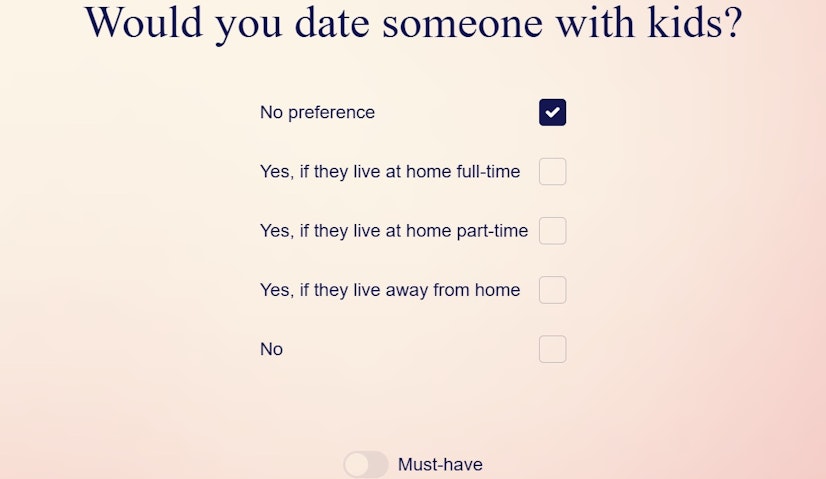
Photo by Innerbody Research
It can even get a little fun with the Topics section, which our testers enjoyed as an expressive outlet.
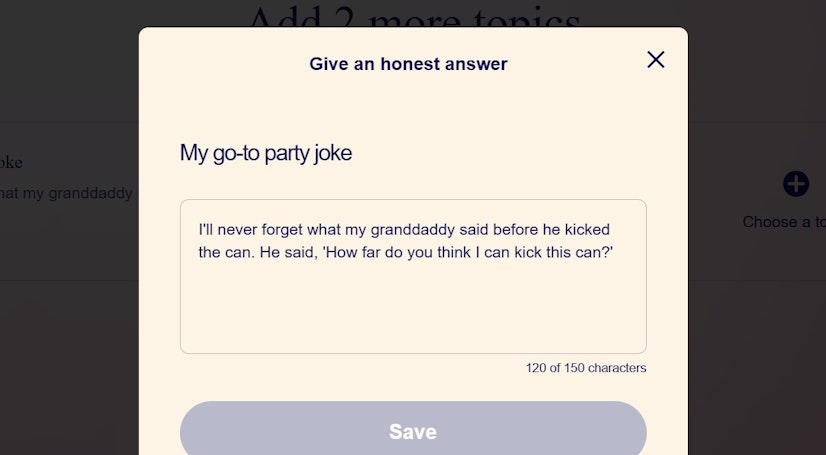
Photo by Innerbody Research
But elsewhere in the registration process, our testers noted some frustrating limitations. For example, at one point, you’re asked to select your interests — an important area where you can find common ground with a match, or things to talk about as you get to know them — but you’re restricted to selecting just eight items across ten categories. Each tester struggled to distill themselves into such a small package, and they felt that having to deselect items to meet the limit meant misrepresenting themselves on the platform. It’s understandable why Match sets a limit at all (to prevent people from gaming the algorithm by selecting as many interests as they can), but eight felt like an awfully low cap.

Photo by Innerbody Research
Then (and this is no understatement) their accounts just wouldn’t work. Let us explain.
After registration, new users must verify their account with a code texted to their phone. This step helps ensure that people aren’t creating multiple accounts for deceptive purposes, as most people probably have access to just one phone number. You’d think this would be a simple process, but in our most recent testing, no one on our team could get a verification code. Clicking the “Continue” button on the verification page did all of nothing. Curiously, one tester could click around the site for a couple of days before they were prompted for verification, whereas the other testers immediately hit the verification roadblock during registration.
And because no one could verify their account, they also couldn’t access the necessary settings page to delete their accounts after their testing.

Photo by Innerbody Research
In our previous testing, verification wasn’t an issue; rather, the main problem was account blocking. Whether it was within days, hours, or even minutes, our initial experience with Match in 2024 led to every one of our testers being unable to access their accounts. No reason was given, not even when we reached out to customer support. Now, on the cusp of 2026, our testers were unable to verify their accounts. Entering a phone number and clicking “Continue” did all of nothing.
From what we’ve read of Match customer testimonials, verification and account-blocking problems aren’t uncommon, even among paying subscribers. That’s why, throughout this review, we’ve had to hedge any kudos we’ve given Match: it may have some advantages over eHarmony, but what good are those advantages if the platform is unusable?
eHarmony vs. Match for customer support
The first time around, neither eHarmony nor Match gave us anything in terms of customer support. More recently, eHarmony showed itself to have the more helpful support team.
From both platforms, we wanted to see whether a support agent would clarify the different subscription tiers and associated features. And from Match, specifically, we also needed help surmounting the account-blocking and verification issues.
With Match, we tried numerous times to get answers from customer support about our concerns. In our initial testing, we waited nearly a week for even a single response, but each attempt came to nothing. Our most recent testing was more successful only in that we got a response — again, after nearly a week — but the agent didn’t even try to answer our question; pretty much, all they said was “look on the website” (which, let us reiterate, does not provide clear information regarding the issue we asked about).
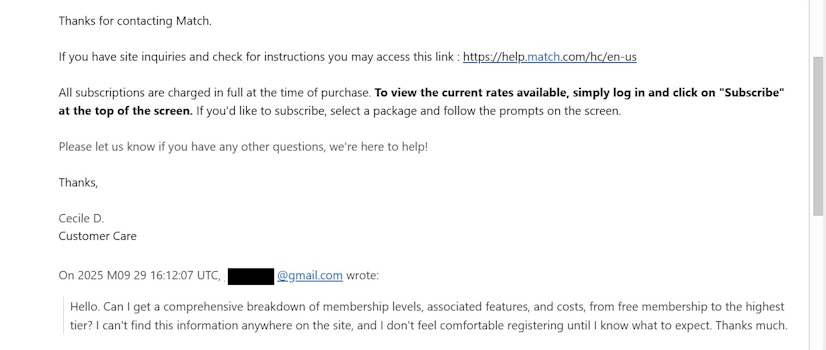
Photo by Innerbody Research
The team was a little more responsive when we emailed them about deleting our profiles (remember, in our most recent testing, the account verification issue kept us out of our accounts), but they were just as ineffective. Several days after the agent said our accounts were fully deleted, the profiles were still very much active.
In contrast, eHarmony recently gave us a lengthy response to our question within 24 hours (a major improvement from its showing in our initial testing, when the support team didn’t bother to respond at all). You can see in the image below just how much time and care the agent gave in satisfying our inquiry.

Photo by Innerbody Research
We had no reason to ask anything else of eHarmony’s support team, as we never encountered problems with verification codes or blocks. And when the time came to delete our profiles, that was easily done in the Data & Settings page of our accounts.
Online dating FAQ
Sources
Innerbody uses only high-quality sources, including peer-reviewed studies, to support the facts within our articles. Read our editorial process to learn more about how we fact-check and keep our content accurate, reliable, and trustworthy.
McClain, C., & Gelles-Watnick, R. (2023). From looking for love to swiping the field: Online dating in the U.S. Pew Research Center.
Kushner, D. (2019). Recruiting women to online dating was a challenge. The Atlantic.
ABC News. (2011). Woman suing Match.com over alleged assault comes forward. ABC News.
Press Association. (2016). Man found guilty of raping women he met on dating website. The Guardian.
Perez, S. (2023). Match Group’s background check provider Garbo ends its partnership. TechCrunch.
Davis, A. (2016). National roundup: Calif. pro-LGBT bill; Sanders video; bisexual teen's death. Windy City Times.
Avery, D. (2021). eHarmony's new inclusive ads are enraging some on the right. NBC News.
Gillies, T. (2015). How to surf the Web for a mate: eHarmony founder. CNBC.
Truth in Advertising. (2014). eHarmony told to drop no. 1 claims following Match.com complaint. Truth in Advertising.
Federal Trade Commission. (2019). FTC sues owner of online dating service Match.com for using fake love interest ads to trick consumers into paying for a Match.com subscription. FTC.
Australian Competition & Consumer Commission. (2023). ACCC court action against eHarmony for alleged misleading online dating membership statements. ACCC.
Wilson, G., & Cousins, J. (2010). Partner similarity and relationship satisfaction: Development of a compatibility quotient. Sexual and Relationship Therapy, 18(2), 161-170.
Rape, Abuse & Incest National Network. (n.d.). Tips for safer online dating and dating app use. RAINN.
Sidoti, O., & Faverio, M. (2023). Dating at 50 and up: Older Americans’ experiences with online dating. Pew Research Center.

Copyright © Innerbody Research 1997 - 2025. All Rights Reserved.