Artery

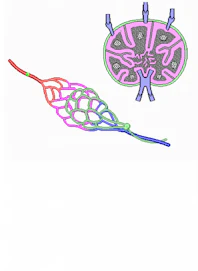
An artery is a strong, elastic vessel that is adapted for carrying blood away from the heart under relatively high pressure. Internally, the heart is divided into four hollow chambers, two on the left and two on the right. The upper chambers, called atria, have relatively thin walls and receive blood returning through the veins. The lower chambers, the ventricles, force blood out of the heart into the arteries to be carried back to the various sites throughout the body. Arteries divide into progressively thinner and thinner tubes and eventually become fine branches called arterioles and capillaries. Arteries parallel the courses taken by veins, which carry the blood back to the heart, and usually have the same names as their companion veins. For example, the renal artery parallels the renal vein; the common iliac artery parallels the common iliac vein, and so forth.

Copyright © Innerbody Research 1997 - 2025. All Rights Reserved.