Muscles of the Tongue

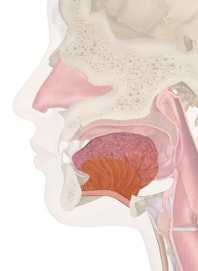
Anchored to the floor of the mouth and slung at the rear from muscles attached to a spiky outgrowth at the base of the skull, the tongue is a strong muscle with special areas that detect the flavor of food.
The tongue is made up of muscles covered by mucous membranes. These muscles are attached to the lower jaw and to the hyoid bone (a small, U-shaped bone, which lies deep in the muscles at the back of the tongue) above the larynx. The muscle fibers are heavily supplied with nerves, so it can manipulate food in the mouth and place it between the teeth for chewing - without being bitten in the process. The tongue also aids in the formation of sounds of speech and coordinates its movements to aid in swallowing.
Although the tongue may seen to be floating freely in the floor of the mouth, it is actually anchored in all directions by the four extrinsic muscle sets, which work together to move the tongue in virtually any direction. The movements they produce, however, are pretty coarse, and fine shape changes are the province of the intrinsic tongue muscles.
The extrinsic muscles are arranged in four groups. Contraction of one set of these muscles (on either side) makes the tongue stick out as its whole foundation is pulled forward. Another set passes from the side of the tongue down to one arm of the wishbone-shaped hyoid bone in the throat. Movement of these muscles pulls the sides of the tongue downward. Linking the sides of the tongue to the base of the skull through the bony styloid process, another set pulls the tongue backward and upward. Lastly, the palatoglossal arch and muscle are connected to the sides and back of the tongue and run to the rear of the palate to lift the sides of the tongue when they are contracted.
Intrinsic muscles within the tongue itself give this organ its fine articulations, and it is thanks to them that we can whistle a tune or speak a half dozen languages.

Copyright © Innerbody Research 1997 - 2025. All Rights Reserved.