Think Outside the BLOCK! - TaxBrain.com
  
 
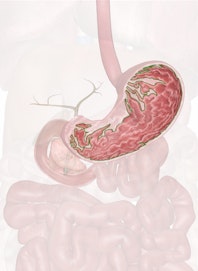
Diagram of Human Stomach and Gallbladder
See Also: Stomach Overview | Did you know?

Stomach

A hollow, sac-like organ connected to the esophagus and the duodenum (the first part of the small intestine), the stomach consists of layers of muscle and nerves that continue the breakdown of food which begins in the mouth. The gastric canal is formed by longitudinal ridges found on the interior of the lesser curve of the stomach. It has several other names, including "magenstrasse," "ventricularis," "ventricular canal," and "canal of stomach." Gastric folds are found on the interior of the stomach. Occasionally, with some diseases gastric folds become enlarged, thus providing indicators for disease. The stomach is also a storage compartment, which enables us to eat only two or three meals a day. If this weren't possible, we would have to eat about every twenty minutes. The average adult stomach stretches to hold from two to three pints and produces approximately the same amount of gastric juices every twenty-four hours. The stomach has several functions: (1) as a storage bin, holding a meal in the upper portion and releasing it a little at a time into the lower portion for processing; (2) as a food mixer, the strong muscles contract and mash the food into a sticky, slushy mass; (3) as a sterilizing system, where the cells in the stomach produce an acid which kills germs in "bad" food; (4) as a digestive tub, the stomach produces digestive fluid which splits and cracks the chemicals in food to be distributed as fuel for the body. The process of digestion is triggered by the sight, smell or taste of food, so that the stomach is prepared when the food arrives. Every time you pass a bakery shop or smell your mother's good cooking, the body begins a digestive process. If the stomach is not filled, these gastric juices begin eroding the stomach lining itself, so fill 'er up!