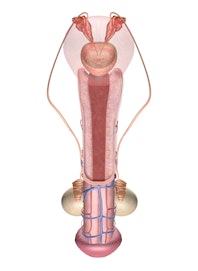
Penis (Cut View)
Viewing the Images |

Select a new image by moving the mouse over the image. As shown in the example above diamonds will appear called Pick Points on all areas that can be picked. An eye glass icon will appear along with the name of the item next to your pointer. Selecting the eye glass will display a new image. Selecting the text icon will provide information on the image you are viewing. To backup to the previous image, you will need to select the back command on your browser.
Layout
Insight Online is designed to provide instant logical flow between all of its related images. To make learning easier, the Insight program is divided into systems. They can be accessed at the main system menu or from the system listing page.
Selecting parts from the list
The item listing can be accessed at the bottom of the main frame display which shows each item currently contained in the image. This list will change every time a new image is displayed. Select the name of the item you want and the image will be displayed.
Control and Movement
You can use your back command on your browser to return to the main menu at any time. Scrolling down to the bottom of each image a menu will appear. You can access many features of the program from this location.
Help
If you are having trouble with this program click here.
Definitions, Pick Points, & Zoom:
Erectile Tissue
The body, or shaft, of the penis is composed of three columns of erectile tissue. These include a pair of "corpora cavernosa" near the back and a single "corpus spongiosum" below. These columns are enclosed by skin, a thin layer of subcutaneous tissue, and a layer of connective tissue. In addition, each column is surrounded by a tough capsule of white fibrous connective tissue. The corpus spongiosum, through which the urethra extends, is enlarged at the end to form a sensitive, cone-shaped "glans penis," which covers the ends of the corpora cavernosa and bears the urethral opening. Inside the glans penis, the corpus spongiosum is dilated and forms the "navicular fossa."
Dorsal Artery
The dorsal artery supplies blood to the dorsal aspect of the penis.
Cowper's (Bulbourethral) Glands
The bulbourethral, or Cowper's, glands, are two small structures about the size of peas, which are located below the prostate gland. They are composed of many tubes whose linings secrete a fluid that is released in response to sexual stimulation to provide some lubrication to the end of the penis in preparation for sexual intercourse. Most of the lubricating, however, is provided by the female reproductive organs.
Urethra
The urethra is a tube that conveys urine from the urinary bladder to the outside of the body. Its wall is lined with mucous membranes and contains a relatively thick layer of smooth muscle tissue. It also contains numerous mucous glands, called "urethral glands," that secrete mucus into the urethral canal. In females the urethra is about 4 cm long. It passes forward from the bladder, descends below the symphysis pubis, and empties into the labia minor. Its opening is located above the vaginal opening and about 2.5 cm below the clitoris. In males, the urethra, which functions both as a urinary canal and a passageway for cells and secretions from various reproductive organs, can be divided into three sections: the prostatic urethra, the membranous urethra, and the penile urethra.
Connective Tissue
An individual skeletal muscle is separated from adjacent muscles and held in place by layers of fibrous connective tissues call "fascia." This connective tissue surrounds each muscle and may project beyond the end of its muscle fibers to form a cordlike "tendon". Fibers in a tendon intertwine to attach the fibers of the muscle to the bone. In other cases, the fascia associated with a muscle may form broad, fibrous sheets called "aponeuroses," which may be attached to the coverings of the adjacent muscles. The layer of fascia that closely surrounds a skeletal muscle is called the "epimysium". Other layers of fascia, called the "perimysium," extend inward from the skeletal muscle and separate the tissue into small compartments which contain bundles of bones muscle fibers called "fascicles". Each muscle fiber within a fascicle is surrounded by a layer of fascia in the form of a thin, delicate covering; so, all parts of a skeletal muscle are wrapped in layers of fascia, allowing the parts to have independent movement. Many nerves and blood vessels pass through the layers as well. A skeletal muscle fiber represents one single cell of muscle. This fiber responds to stimulation and when it responds, it contracts and relaxes. Each skeletal muscle fiber is a thin, longish cylinder with rounded ends that are attached to fascia relative to the muscle. Just beneath the cell membrane or "sarcolemma," the fiber contains many threadlike "myofibrils" that lie along side each other and play a fundamental role in the process of muscle contraction. The fascia associated with the individual organs of the muscular system are part of a complete network of fascia that extends throughout the body. The part of this network that surrounds and penetrates the muscles is called "deep fascia." It is continuous with the "subcutaneous fascia" that forms the fascia covering organs in various body cavities as well as the cavities themselves.
Inner Dorsal Vein
The Inner dorsal vein drains blood from the deep dorsal surface of the penis.
Penis
The penis is the external sex organ of the male through which both urine and semen pass. It consists of three cylinder-shaped bodies of spongy tissue filled with tiny blood vessels, which run the length of the organ. Two of these bodies lie side by side in the upper portion of the penis. The third is a tube which lies centrally beneath the others and expands at the end to form the tip of the penis, which is called the "glans." The penis transfers sperm to the woman's body during sexual intercourse and is a duct for the disposal of fluid waste. The penis becomes erect during sexual excitement, because extra blood is pumped into spongy tissues, resulting in enlargement and hardening which allows penetration into the female organ. The "head" of the penis is called the "glans" and is normally covered with a protective, retractable skin or "hood." This skin is often cut off at birth, or "circumcised," and it is believed that its removal lessens risk of cancer and bacterial infections. At the center of the penis is a tube which carries urine from the bladder and semen from the prostate gland, called the "urethra." During sexual intercourse, reflexes prevent urine from entering this duct and alkaline solutions are produced and secreted to flush out any traces of urine from the urethra before semen is secreted.
Prostate Gland
The prostate gland is a solid, chestnut-shaped organ surrounding the first part of the urethra (tube which carries the urine and semen) in the male. It produces secretions which form a part of the semen. The prostate gland lies just under the bladder and in front of the rectum. It consists of two main zones: the inner zone, which produces secretions to keep the lining of the male urethra moist, and the outer zone, which produces seminal fluids to facilitate the passage of semen into the female. The "urethra" is a two-stemmed duct leading from the bladder and from the prostate gland into the penis. The word, "aphrodisiac," is derived from Aphrodite, the Greek goddess of love and sexual pleasure. The ancient Greeks thought honey would produce an increase in sexual powers and they believed the same of the hair from a wolf's tail and ground snake bones. The French used an "aphrodisia" which they called the "love apple" - actually a tomato. Today, the hope lies in oysters. Sadly, the fallacy that a ground rhinoceros horn will help in this plight has put this animal on the endangered species list. Actually, aphrodisiacs are in the mind and operate only by the power of suggestion - if at all.
Prostatic Utricle
The prostatic utricle is a section of the first portion of three which form the male urethra. The prostatic utricle forms a cul-de-sac about 6 mm. long, which runs up and back in the substance of the prostate behind the middle lobe. Some authors call it the "uterus masculinus," because it corresponds to the uterus and vagina in the female.
Skin
Skin is the outside covering of body tissue, which protects inner cells and organs from the outside environment. The skin is the largest organ of the body, and its cells are continuously replaced as they are lost to normal wear and tear. The skin totals between twelve and twenty square feet in area and accounts for 12%% of body weight. It is composed of three integrated layers: the epidermis, the dermis and the subcutis. The thickness of the epidermis and the dermis varies over different parts of the body. It is thickest on the palms of the hands and feet, where friction is needed for gripping, and it is thinnest on the eyelids, which must be light and flexible. The epidermis also grows into fingernails, toenails and hair. The dermis, or true skin, is thick, sturdy, rich in nerves and blood vessels and in sweat glands. It shields and repairs injured tissue. This layer consists mostly of collagen, which originates from cells called fibroblasts and is one of the strongest proteins found in nature. It gives skin durability and resilence. The subcutis, joined to the bottom of the dermis, is the deepest layer of the skin. It contains "lipocytes," which produce lipids for the subcutaneous tissue to make a fatty layer which cushions muscles, bones and inner organs against shocks, and acts as an insulator and source of energy during lean times. The skin registers sensation constantly and supports a teeming, unseen population of tiny organisms. Not only does the skin harden from use, but it molds into varied shapes, and it responds to the most delicate touch, becoming an organ of communication - sometimes more eloquent than words. So tough and durable is the skin that when a 2,000-year-old Egyptian mummy was fingerprinted, the ridges were perfectly preserved.
Superficial Dorsal Vein
The superficial dorsal vein drains blood from the superficial skin layers of the penis.
Urinary Bladder
The bladder is a hollow muscular organ that acts as a reservoir for urine. The adult bladder can hold a pint or more of fluid. It lies behind the pubic bone and is protected by the pelvis. The bladder walls are made up of muscle and an inner lining. At the back are two ureters which carry the urine from the kidneys. The bladder collects and stores urine until it can be expelled from the body.
Urogenital Diaphragm
The outlet of the pelvis is spanned by two muscular sheets - a deeper "pelvic diaphragm" and a more superficial "urogenital diaphragm." The pelvic diaphragm forms the floor of the pelvic cavity, and the urogenital diaphragm fills the space within the pubic arch. The muscles of the male and female urogenital diaphragm include the following: (1) "superficial transversus perinei," a small bundle of muscle fibers that pass along the back border of the urogenital diaphragm and assists other muscles in supporting the pelvic tissues; (2) the "bulbospongiosus" muscles, which are united and surround the base of the penis; (3) the "ischiocavernosus muscle," a tendinous structure that extends down to the margin of the pubic arch and assists the function of #2; and (4) the "sphincter urethrae" are muscles that arch around the urethra and unite with those on the other side. Together they act as a sphincter that closes the urethra by compression and opens it by relaxation to control the flow of urine.