Kidney Blood Filtering
Viewing the Images |

Select a new image by moving the mouse over the image. As shown in the example above diamonds will appear called Pick Points on all areas that can be picked. An eye glass icon will appear along with the name of the item next to your pointer. Selecting the eye glass will display a new image. Selecting the text icon will provide information on the image you are viewing. To backup to the previous image, you will need to select the back command on your browser.
Layout
Insight Online is designed to provide instant logical flow between all of its related images. To make learning easier, the Insight program is divided into systems. They can be accessed at the main system menu or from the system listing page.
Selecting parts from the list
The item listing can be accessed at the bottom of the main frame display which shows each item currently contained in the image. This list will change every time a new image is displayed. Select the name of the item you want and the image will be displayed.
Control and Movement
You can use your back command on your browser to return to the main menu at any time. Scrolling down to the bottom of each image a menu will appear. You can access many features of the program from this location.
Help
If you are having trouble with this program click here.
Definitions, Pick Points, & Zoom:
Afferent Arteriole
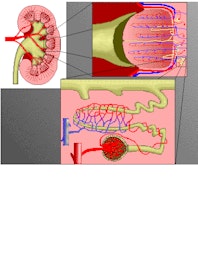
The afferent arteriole carries blood into the glomerulus of the nephron.
Suprarenal Artery
The adrenal gland is richly supplied by the circulatory system and is supplied by an artery called the suprarenal artery. Because the adrenal gland does secrete hormones, these hormones enter the blood stream quickly by way of the suprarenal vein where the hormone is rapidly transmitted to target organs where each hormone exerts its characteristic regulatory function through events occurring and at a cellular and molecular level.
Bowman's Capsule
A kidney contains about one million nephrons, the functional units of the kidney, and each of these consist of a renal corpuscle and a renal tubule. A "renal corpuscle" is composed of tangled clusters of blood capillaries called a "glomerulus," and a thin-walled, saclike structure, called the "Bowman's capsule," which surrounds the glomerulus. The Bowman's capsule is an expansion at the closed end of a renal tubule. It is composed of two layers of cells: an inner layer that closely covers the glomerulus, and an outer layer that is continuous with the inner layer and with the wall of the renal tubule. The renal tubule leads away from the Bowman's capsule and becomes highly coiled. The coiled portion is named the "proximal convoluted tubule." Several of the distal convoluted tubules merge into the renal cortex to form a collecting duct, which in turn passes into the renal medulla, becoming larger and larger as it joins other collecting ducts, the resulting tube is called the papillary duct.
Renal Medulla
The substance of the kidney is divided into two distinct regions: an inner medulla and an outer cortex. The "renal medulla" is composed of conical masses of tissue called "renal pyramids," whose bases are directed toward the convex surface of the kidney, and which apex to form the renal papillae. The "renal cortex" forms a shell around the medulla. Its tissues dip into the medulla between adjacent renal pyramids to form "renal columns." The granular appearance of the cortex is due to the random arrangement of tiny tubules associated with "nephrons," the functional units of the kidney.
Distal Convoluted Tubule
The distal convoluted tubule is the most distal portion of the nephron and is responsible for the reabsorption of sodium, water and secretion of hydrogen potassium.
Efferent Arteriole
The efferent arteriole carries blood away from the glomerulus. Because of its smaller diameter than the afferent arteriole, it creates some resistance to blood flow, producing the back-up of blood in the glomerulus which creates higher pressure in the glomerular cavity.
Urinary Tract
The structure of the urinary tract includes: the kidneys, two ureters, (tubes leading from the kidneys to the bladder,) and the urethra, a tube leading from the bladder to the exterior of the body. The urinary tract is a little like a plumbing system, with special pipes that allow water and salts to flow through them. The kidneys make up a filter system for the blood, reabsorbing almost 99%% of the fluid into the blood, and sending only two to four pints of waste (urine) into the bladder for storage until it can be disposed of. The kidneys allow the blood to keep glucose, salts and minerals after cleansing it of poisonous materials which will be passed out in the urinary tract. Urine is produced in the kidneys and trickles down twenty-four hours a day through two ten to twelve inch long tubes called ureters, which connect the kidneys to the bladder. The ureters are about one-fourth inch in diameter and their muscular walls contract to make waves of movement to force the urine into the bladder. The bladder is expandable and stores the urine until it can be conveniently disposed of. It also closes openings into the ureters so that urine cannot flow back into the kidneys. The tube through which the urine flows out of the body is called the urethra. Did you know that less than half of one single kidney can do all the work that two kidneys usually do?
Loop of Henle
The loop of Henle is the most inferior and middle portion of the nephron. It is responsible for the reabsorption of water, chloride and sodium.
Renal Pelvis
The outside surface of each kidney is convex, while the side toward the center is deeply concave. The resulting middle depression leads into a hollow chamber called the "renal sinus." The entrance to this sinus is termed the "hilum," and through it pass various blood vessels, nerves, lymphatic vessels, and the ureter. The superior end of the ureter is expanded to form a funnel-shaped sac called the "renal pelvis," which is located inside the renal sinus. The pelvis is divided into two or three tubes, called the "major calyces" (the singular is calyx), and they are divided into several (eight to fourteen) "minor calyces."
Proximal Convoluted Tubule
The proximal convoluted tubule is the most proximal segment of the renal tubular portion of the nephron. It is responsible for the reabsorption of glucose, amino acids, various ions and water.
Renal Artery/Vein
The renal arteries pass laterally from the abdominal aorta into the kidneys. Each artery then divides into several smaller branches within the kidney tissues. The renal veins pass out of the kidneys into the inferior vena cava.
Ureter
There are two uterine tubes that carry urine from the kidneys to the bladder. Each ureter is about ten to twelve inches long. Urine flows down partly by gravity, but mainly by waves of contractions which pass several times per minute through the muscle layers of the urethral walls. Each ureter enters the bladder through a tunnel in the bladder wall, which is angled to prevent the urine from running back into the ureter when the bladder contracts.