BetterHelp Review: Is BetterHelp's online therapy ideal for you?
Our expert review of BetterHelp will give you all the pros, cons, and pricing info — plus tips on choosing the best therapist.

Gone are the days when an expensive in-office session with a therapist was the only way to get the mental health care you need. Online therapy is now one of the top ways people receive individual, couples, and group counseling.1 Not only is it often more convenient, but it’s also a more comfortable and affordable method for many patients.
Therapy can be costly and difficult to fit into your schedule. Luckily, online platforms like BetterHelp can make it more convenient and accessible to find help. But is BetterHelp the right choice for you? Keep reading to find out how we evaluated it on the critical considerations for quality online therapy.
Our Findings
Pros
- Professional, licensed, and rigorously vetted therapists with at least three years and 1,000 hours of experience
- Flexibility in how live sessions are conducted — your choice of chat, phone, or video
- Routine live sessions with your therapist don’t cost extra
- It’s easy to switch providers anytime
- Helpful features such as guided journaling and group sessions
- Discounts and financial aid are available, as well as 20% off when you use our coupon code: INNERBODY
Cons
- Therapists can't prescribe medication; psychiatrists aren’t available
- Pricing isn't clear until after the intake questionnaire
- When switching therapists, your prior messages and worksheets disappear unless you save them manually (download them to your device) before switching
- Insurance is not accepted as payment
With greater access to live sessions in the format you prefer (video, phone call, or messaging), as well as supplemental features like guided journaling, BetterHelp online therapy manages to rival traditional, in-person therapy — often with a lower price tag. However, those seeking psychiatric services or those with insurance coverage for mental health care may find other services suit them better.
In this Review
Why you should trust us
Over the past two decades, Innerbody Research has helped tens of millions of readers make more informed decisions about living healthier lifestyles by conducting extensive research and hands-on testing of the products and services we review.
For this review of BetterHelp, our team spent over 90 collective hours researching and testing this online therapy provider. We also evaluated alternative services across the competitive landscape and pored over dozens of studies on the effectiveness of teletherapy. When reviewing products and services, we also evaluate them based on their adherence to current medical evidence and health standards. As the research evolves, our recommendations do, too.
Additionally, like all health-related content on this website, this review was thoroughly vetted by one or more members of our Medical Review Board for accuracy.
How we evaluated BetterHelp
Therapy is a deeply personal, individual experience. However, there are several factors that can contribute to making that experience more or less beneficial to you. When considering this, we determined four criteria that are most likely to impact this: ease of use, the quality of therapy, cost, and customer care.
Ease of use
The best therapy in the world won't be beneficial if it's not properly accessible. In fact, accessibility is often one of the greatest advantages of online therapy as compared to in-person therapy (especially for those who live in rural areas).2
In general, the BetterHelp app and website facilitate impressive service and therapy, with features and tools that are intuitive and simple to use. For most people, access should be easy, whether on your desktop browser or in the mobile app.
And, like competitor Talkspace, getting started is a straightforward process involving a questionnaire that only takes 10-30 minutes to complete. BetterHelp’s team uses this to match you to a therapist based on your answers. BetterHelp's interface also has easy-to-find options for quickly making changes in your service — like changing therapists, altering your plan, or canceling altogether.
For video sessions, all you’ll need is a reliable internet connection and a camera (a webcam or the camera of a smartphone or tablet). And, if you don’t have access to a camera, then sessions can be conducted over the phone or even via messaging.
Special Offer: 20% off using code INNERBODY
Quality of therapy
It’s completely natural to wonder about the quality of therapy that you might receive from an online session, especially since teletherapy didn’t really become as popular as it is until the past few years — for many people, the concept is completely new.
Research suggests that telehealth and traditional therapy are equally effective in treating a wide variety of mental health concerns in both adults and youth.3 4 5 (However, serious mental health conditions may benefit more from in-person treatment and interventions.)
Additionally, for many people, BetterHelp will be able to provide a wider and more diverse set of therapist options than you could reasonably access nearby in a traditional, in-person setting. And when it comes to qualifications, licensing, and experience, we find that BetterHelp sets a good, aggressive bar for its therapists to meet — they must be properly licensed and have at least three years of experience with 1,000 hours of clinical practice.
Cost
How much will BetterHelp therapy cost? Can benefits typically cover any of that cost? How do the costs compare to what you'd pay for competitors' services or for traditional, in-person therapy? Are there opportunities to get discounts or financial assistance?
BetterHelp’s base price is $90 per week, which is a fair amount less than the $100-$225 per session cost of in-person therapy.6 And BetterHelp also provides a couple of avenues you can take to lower the cost even further: a reduced rate plan and financial aid. (You can also save 20% if you use the promo code INNERBODY.)
Even at its highest baseline price of $90 per week, BetterHelp is also technically less expensive than some competitors, like Talkspace (which costs $99 per week for the comparable messaging and video option.)
Nonetheless, pricing information on the BetterHelp website is more opaque than we'd prefer; ordinarily, you wouldn't know your likely costs prior to completing the questionnaire unless you've read our review here first. To help clear up any confusion surrounding how much BetterHelp costs (and what discounts exist), we lay out the pertinent pricing details and factors in a dedicated section below.
Also, it’s worth mentioning that insurance coverage isn’t an option with BetterHelp. But, unless you have great insurance with a low deductible, the cost of BetterHelp will likely be more cost-effective compared to alternatives.
Customer care
Good, attentive service is a measure of a company's respect for its customers. So, how does BetterHelp stack up? Does it provide dedicated customer service professionals who offer prompt and effective help when problems arise? What measures does BetterHelp take to guard your sensitive information?
BetterHelp’s customer service team replies promptly to issues you raise — they promise to reply within 24 hours but, in our experience, reply in far less time than that. The representatives answer your questions with an appropriate level of personalized care.
If you feel more comfortable doing so, you can use a nickname or alias with your therapist. And, since BetterHelp doesn't work with insurance or employers, there isn't any information revealed to those companies.
What is BetterHelp, and who is it for?

Founded in 2013 and headquartered in Mountain View, California, BetterHelp is the largest online therapy platform worldwide. Factors such as lack of access, availability, cost, inconvenience, and fear can make in-person therapy challenging for many people. BetterHelp is one of the online therapy platforms aiming to bridge this gap by providing therapy you can access at home for a price that can be considerably less than in-person therapy.
The approach to therapy taken by BetterHelp and its competitors (like Talkspace, Cerebral, Thriveworks, and others) has been largely successful. The demand for online therapy has skyrocketed in the last few years. In 2021, the online therapy market was valued at around $2.6 billion — and current predictions are that it will grow by an additional $9.31 billion by the year 2026, with 42% of that growth coming from North America.7 8
According to the CDC, more than 20% of U.S. adults live with a mental illness. Additionally, about 4% of U.S. adults and 20% of young people between the ages of 13-18 live with a seriously debilitating form of mental illness.9 This widespread need for more accessible therapy services could be a major driver of teletherapy’s growth.
Even if you aren’t currently suffering from a mental illness, nearly all of us can find some benefit from talking with a therapist. Everyone faces obstacles in life that can get in the way of our happiness or become roadblocks to our goals. And sometimes, when goals themselves change, we need help navigating and coping with difficult emotions.
BetterHelp therapists are all highly qualified to help you as you seek to improve your life. The company also works with therapists who specialize in particular areas of concern, including but not limited to:
Who should look elsewhere for therapy?
While teletherapy appears to improve mental health care accessibility for many people, there are circumstances where it might not be ideal.10 Some people who may find more benefit from in-person therapy include:
- People with insurance that covers in-person therapy.
- Individuals in a crisis situation (if you’re having suicidal thoughts, text or call the National Suicide Prevention Lifeline at 988 for support).
- Those with serious mental health conditions requiring direct or in-person intervention.
Additionally, people seeking psychiatrists (not psychologists or counselors) may wish to look elsewhere, as BetterHelp currently doesn’t offer psychiatry. Some competing online therapy providers, such as Talkspace and Brightside, do provide this service.
Additional services
In addition to individual therapy, the BetterHelp homepage lists Couples and Teen counseling options. Each of these services sends you to a sister site when selected — Regain.us for couples and TeenCounseling.com for teens. Prices for these services are similar to BetterHelp, and all therapists meet the same high standards and undergo the same rigorous screening.
BetterHelp also has a separate website devoted to LGBTQIA+ counseling — Pride Counseling. Its services are just as affordable and structured similarly, but therapists with Pride Counseling specialize in providing therapy to individuals in the LGBTQIA+ community. (It’s worth mentioning that you can also find — and request — therapists who specialize in LGBTQIA+ concerns through BetterHelp itself; Pride Counseling simply serves as an alternative for the same service.)
Is BetterHelp legit?
Yes, BetterHelp is a legitimate company and a leader in online therapy, with over 34,000 therapists and over four million patients at the time of this review. Many people prefer it to traditional in-person therapy because of the flexibility and often lower costs. The company ensures:
- High professional standards for its therapists
- Greater affordability for some people, compared to in-person therapy
- A straightforward experience whether you use the website or the app
- The option of using a nickname or preferred name
BetterHelp’s online reviews
BetterHelp’s reviews on both the Better Business Bureau (BBB) website and Trustpilot are fairly impressive.
On its BBB page, BetterHelp has been accredited since 2015 and holds an A- rating with a 4.05 out of 5 review score. Customer reviews mainly focus on the company’s convenience, its polite staff, and positive outcomes from therapy. The complaints from customers are almost all about billing issues, with many being about confusion over how BetterHelp bills for its sessions per month instead of per week.
On Trustpilot, BetterHelp has 6,662 customer reviews and boasts a 4.5-star rating out of 5. The company has replied to 96% of negative reviews — almost all within 24 hours of them being posted. However, Trustpilot warns that the company may be using “unsupported invitation methods” to garner reviews. It’s unclear what these methods may be, but some examples of unsupported methods include giving discounts or other incentives in exchange for positive reviews.
Who are BetterHelp’s therapists?
The most important resource BetterHelp provides is its wide array of highly qualified therapists. Although it was acquired by Teladoc, Inc. in 2015, the company continues to employ the same rigorous therapist application process in order to vet therapists and maintain quality. BetterHelp reports that only 15% of therapists who apply to the platform are approved.
The therapist application process comprises:
- A review of each therapist’s background, experience, and references
- Verification of credentials
- A case study exam evaluated by a licensed clinician
- A video interview
- A platform skills test
- Therapists are also subject to ongoing quality improvement, monitoring, and client feedback throughout their tenure at BetterHelp.
All therapists have obtained, at minimum, a master's degree in their field and are experienced, accredited, and licensed as at least one of the following:
- Clinical Social Workers (LCSW)
- Marriage and Family Therapists (LMFT)
- Mental Health Counselors (LMHC, LMHP)
- Professional Counselors (LPC)
- Psychologists
In addition, BetterHelp’s therapists are qualified and licensed in their state; they have at least three years and 1,000 hours of hands-on experience prior to joining. Also, after joining BetterHelp, they regularly go through peer review, results monitoring, and ongoing training and support, and they each have a mentor to help guide them through the BetterHelp process.
BetterHelp sets high standards for therapists who take patients through its platform. While the company maintains that it's not responsible for patient-counselor interactions — BetterHelp simply acts as the liaison between you two — the company makes a good faith effort to ensure the therapists are not only accredited and experienced but highly rated as well.
How much does BetterHelp cost?
BetterHelp is often more affordable than traditional, in-person therapy — and this becomes even more true when you take into account the various ways BetterHelp offers assistance in covering the cost. Below, we cover BetterHelp’s standard pricing, the reduced fee discount, and the company’s financial aid program. We also delve into insurance, billing, and cancellation.
Standard pricing
Unless you're receiving financial aid, weekly rates on BetterHelp vary from $65 to $90. The reason for the range of potential weekly prices is that those who qualify for reduced fee discounting can save money each week.
Don't worry if you're confused — BetterHelp actually offers two ways to receive a lower price:
- Reduced fee discount
- Financial aid
If you don't know some up-front information about qualifying factors and aren't aware that these discounted payment options exist, you may miss your chance to get the discounted rate that you deserve. We've done the testing and research — here are all of the details.
Reduced fee discount
Depending on how you answer the sign-up questionnaire, you may be presented with a reduced fee discount, lowering the $90 cost to $65. For many people with financial hardships that create difficulty in affording therapy, this lower price makes BetterHelp an excellent deal.
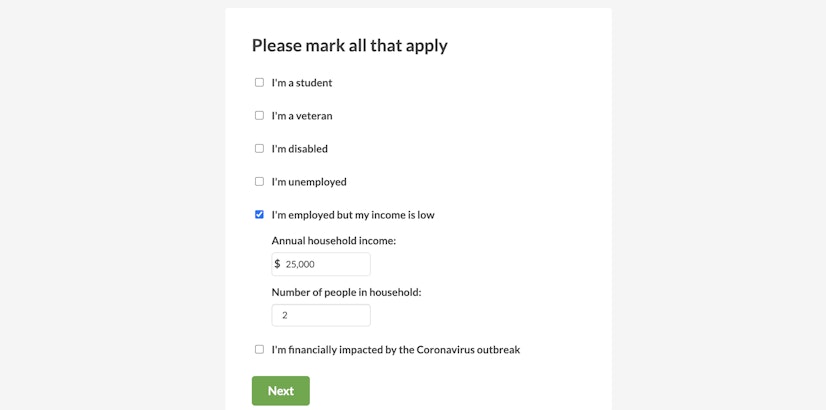
Simply by completing the questionnaire, many people will discover that they qualify for this reduced fee discount. Specifically, there are three subject areas in the questionnaire that qualify you for this assistance.
If you're unemployed and, subsequently, you consider your financial status to be either fair or poor, you'll likely qualify after explaining your circumstances. However, you can still qualify if you're employed and your financial status is not "good."
BetterHelp will give you the $65/week rate if you describe your financial status as fair or poor and further explain that you are:
- A student
- A veteran
- Disabled
- Unemployed
- Employed with a low income
- Financially impacted by the COVID-19 pandemic
Any one of these circumstances qualifies you for a reduced fee discount. When it comes to low income, you'll qualify for this reduced price if your household income is equal to, or less than, 200% of the federal poverty level (FPL). As an example, for single earners, this means less than $50,000 annually.
Additionally, applying your 20% discount using coupon code INNERBODY adds to those savings. In other words, if you qualify for a reduced fee discount and then apply our INNERBODY code on top of it, you can enjoy a low weekly rate of $52. That amounts to a 35% discount off the normal rate.
Financial aid
Suppose the aforementioned conditions for the reduced fee discount apply to you, but you feel you won’t be able to afford the lower fee of $65 per week (or none of the conditions apply, but you still can’t afford the $90 per week). In that case, you can click the button on the payment page at the end of the questionnaire, declaring, "I can't afford therapy."
At that point, BetterHelp will ask you if you'd like to check eligibility for financial aid. When you proceed, you're asked about your employment status, household income, number of dependents, race, and whether you live in a rural/non-rural area. Even if you characterized your financial status as "good" earlier in the questionnaire, it absolutely pays to check eligibility and answer these additional questions at the end; you can still qualify for as much as 40% off the standard weekly rate (as low as $48 per week). The amount of aid you ultimately receive depends on your circumstances. Also, you can apply for financial assistance at any time during treatment, even if you didn’t qualify for it during your initial sign-up.
Insider Tip: Keep in mind that BetterHelp financial aid expires after 90 days, which means you'll need to reapply for it after three months of therapy.
Insurance?
BetterHelp doesn't take insurance. However, the company tries to price its services to be competitive with — or more affordable than — what many patients pay out-of-pocket when factoring in co-pays, deductibles, and stringent coverage requirements that insurance providers set.
Payment frequency and cancellation
BetterHelp automatically charges your original payment method every four weeks (a month’s worth of sessions), but you can easily cancel at any time. Simply log in, go to “Your Account,” and select “Payment Settings.” You’ll see a link to change or cancel your plan. Click the link and answer a few multiple-choice questions about why you want to cancel or change your plan. The company will also ask you to indicate if you’d like the same therapist should you resume treatment in the future. You’ll receive an email that confirms your cancellation or plan change.
However, it’s worth noting that you’ll need to contact customer service to request a refund for any unused time — this doesn’t happen automatically upon cancellation.
Is BetterHelp worth it?
Therapy, in general, is very much "worth it". Most of us can benefit greatly from having someone to talk to, but in spite of this, many of us neglect our own mental health and emotional well-being. Therapy can greatly improve your quality of life. If you find that online therapy and live sessions are as helpful and productive for you as traditional, in-person therapy, then yes, BetterHelp is worth the money and a good value. (Research points to online therapy being just as effective, yet more cost-effective, versus in-person therapy.)13
BetterHelp can be significantly more affordable than what many people pay for traditional therapy, which often costs $100-$225 per session.6 Some highly sought-after therapists charge even more. These in-person sessions typically last 50 minutes, which accounts for part of the higher cost. However, you often lack the opportunity to interact with your therapist outside of your in-person sessions. One perk of BetterHelp is access to extras like guided journaling, webinars, and instant messaging with your therapist.
Like all therapy, though, the value comes when you find the therapist with whom you can develop a very productive and useful routine and working relationship. BetterHelp allows you to find and, when necessary, switch therapists quite easily. This makes your chances of worthwhile therapy very good.
Is BetterHelp an upstanding service?
All therapists abide by applicable state and federal laws, as would in-person therapists. You never have to provide your real name, even during sign-up. You can use an alias (a “nickname” in the system) the entire time with your therapist.
ClickMeeting (the webinar hosting platform used by BetterHelp) has your email when you register for a group seminar, also called a “Groupinar,” but no other personal information is revealed. For your comfort, BetterHelp shows your initials as your display name. It’s worth mentioning that recordings of each Groupinar may be available to BetterHelp, its affiliates, and session registrants, so just don't reveal any personal information during the groupinar.
If there is an instant message that you don’t want to remain in the Counseling section of your account, just click the trash can icon to the right of it. (However, having messages to revisit later can be beneficial in therapy, so we recommend using this sparingly.)
Because BetterHelp doesn’t work with insurance, no information gets revealed to those companies. And even though BetterHelp does accept HSA/FSA payments, only you and the company that administers your account card can view what you spend your funds on.
Getting started with BetterHelp
The BetterHelp sign-up process is relatively quick and easy, with clear guidance every step of the way. You’ll answer questions about yourself (your identity, lifestyle, physical health, mental health, and so on) and what you’re looking for in a therapist. Signing up takes anywhere from 10-30 minutes. Below, we’ll go into further detail on each step of the BetterHelp sign-up process.
Fill out a quick questionnaire
After selecting the type of therapy you’d like, you’ll be asked a series of questions about yourself, including your identity, spirituality, relationship status, health, and more. Equipped with your responses, BetterHelp learns more about you, identifies the areas you want to address in therapy, matches you with an appropriate therapist, and develops an understanding of your financial circumstances. You don’t need to provide your real name during the process — it’s okay to use a nickname or alias with BetterHelp.
Identify what you’re looking for in a counselor
Part of the questionnaire involves questions about your therapist preferences — including their gender, religion, race, age, and if they’re part of the LGBT community.
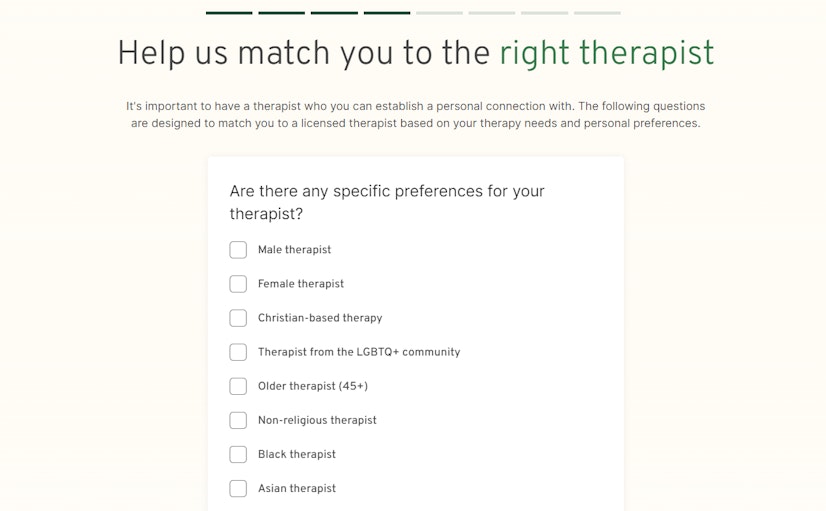
Then, select the areas in which you’d like your therapist to have experience or specialization, including anxiety, addiction, coping with life changes, relationship issues, career coaching, parenting, and more. You can also select how you’d prefer to communicate with your therapist: messaging, phone and video, or “not sure yet.”
Finally, give a brief description of what brings you to BetterHelp. This can help your therapist learn more about you and your goals before your first session.
Create your account
You can only sign up by using your email address and creating a password. Previously, BetterHelp allowed you to sign up using your Facebook or Google account, but it has since removed this option. After signing up, BetterHelp emails you an alphanumeric code to verify your account.
Get matched with a therapist
Based on all of the information you provide, BetterHelp’s algorithm matches you with a therapist who fits all or most of your requirements. It can take a day or two to receive a match, but you’ll get an email as soon as it happens.
While allowing BetterHelp to match you is a bit easier, the algorithm isn’t perfect. For instance, one of our testers was matched with a male therapist even though she indicated that she preferred a female. Fortunately, you can easily change your therapist at any time if it’s not a good fit.
Insider Tip: Though BetterHelp doesn’t make it obvious, you can choose your own therapist with this step-by-step process.
Confirm your plan and pay
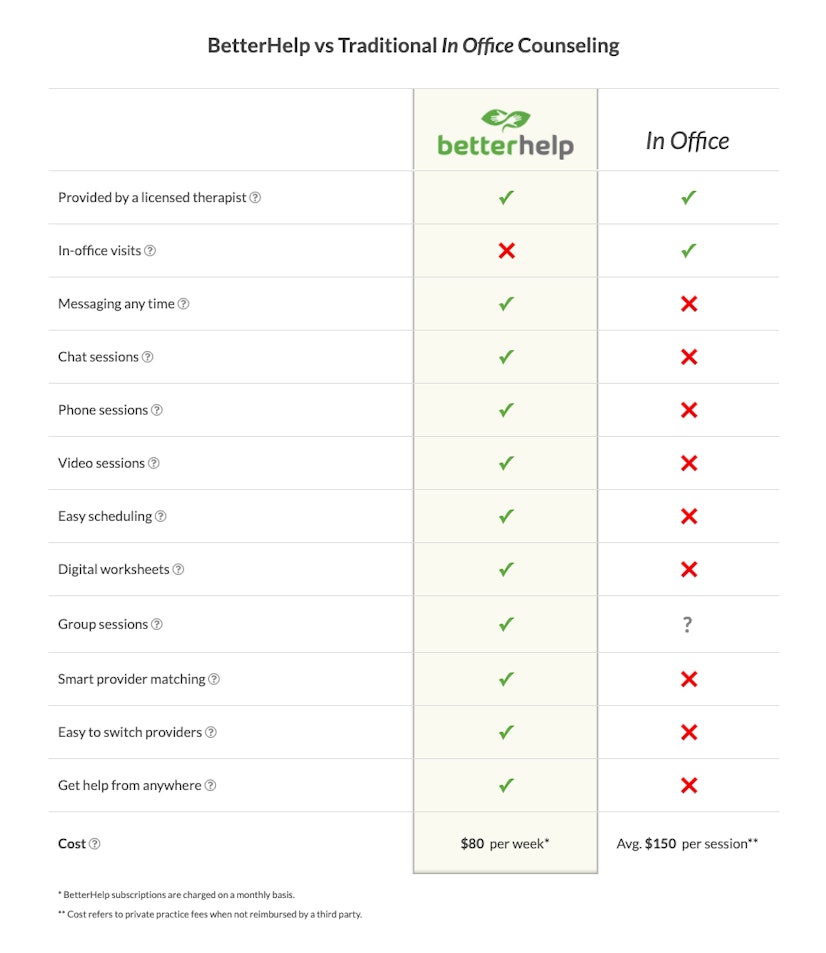
Once you complete your sign-up, you’ll arrive at the “Welcome to BetterHelp” page featuring more explanation of how therapy works, in addition to a chart of how BetterHelp compares to in-office therapy. This page is also where you’ll see your payment options (credit cards or Google Pay). Weekly rates ultimately vary from $48-$90 depending on whether you qualify for financial aid or a reduced fee discount. If you're interested in applying for financial aid, click the "I can't afford therapy" option at the bottom of the payment screen.
Once you start interacting with a therapist, your membership begins.
Begin communicating with your therapist
Once you receive your match, you’ll get an email from BetterHelp followed by an automated introductory email from your therapist with a link to view and reply in your exclusive chat room. We recommend scheduling your first live session right away using the availability listed on your therapist’s calendar.
Email communication and customer care after sign-up
You can expect a reasonable amount of email communication from BetterHelp — usually a few times per week. Serving to guide you through therapy and help you get the most out of the services, these useful emails include:
- Your membership summary, with a link to manage your account.
- Status updates confirming payments, notifying you when you get matched or switch therapists, and so on.
- Live session appointment reminders.
- Groupinar registration confirmations.
- Reminders the day before and a few hours before scheduled sessions.
- Verification checks (you’ll need to provide a verification code for the first few logins and any time you log in from a new device).
- Alerts that your therapist messaged you.
- Check-ins from BetterHelp to see how it’s working out with your therapist.
- Your personal referral link — if someone signs up via your link, both of you get a free week. (Your friend receives their first week for free, and you get a free week added to your account.)
There’s really only one way to get in touch with BetterHelp’s customer service team, even though there are technically two options on the “Contact Us” page. Both the contact form and sending an email to customer service result in continued communication via email. However, our testers found that BetterHelp’s customer service team is prompt (replying within 24 hours, often much sooner), and representatives provided personalized responses to our testers' questions.
What is BetterHelp therapy like?
To succeed in therapy, you should commit to it for at least four weeks (the pre-set term you pay for on BetterHelp), with one live session per week. It’s wise to continue therapy until you feel relief from the issues that made you seek help. Ideally, you should also feel confident to use your therapist's teachings and the tools from treatment if those issues resurface.
The time required to complete therapy varies based on the nature and severity of your concerns. For example, successfully treating post-traumatic stress disorder can take 15-30 sessions.14 And therapy for clinical depression might require 10-15 sessions before improvements are seen.15
BetterHelp’s talk therapy centers on conversations between the therapist and the patient. Most of the counselors take an eclectic approach (an approach that focuses on positive outcomes) or use cognitive behavioral therapy (CBT) that is custom-fit to each patient.16 They combine talk therapy with actionable steps to address your concerns. Your therapist will likely ask you to fill out simple worksheets to help them understand you and your goals. Therapists will also suggest behavioral adjustments that might help with your issues. Most use evidence-based therapy — psychotherapy methods proven to work for the predominating case in scientific studies.17
It’s also important to note that none of BetterHelp’s therapists can prescribe medication.
BetterHelp versus the competition
Most of BetterHelp’s competitors offer similar services but with some differences in ways that may help you determine which option is best for you. For example, if you’re looking for psychiatry, you ought to look somewhere other than BetterHelp. If you prefer therapy sessions over the phone, then you may prefer BetterHelp or Cerebral over the others.
We put together a chart of these differences to help you decide the best option for your mental health journey.
Below, we’ll delve further into the offerings from BetterHelp, including details from our testers’ personal experiences.
Live sessions
Like all therapy (in-person or online), a core part of your treatment depends on live one-on-one sessions. BetterHelp offers a simple, intuitive way to communicate with a therapist via the method you find most useful: chat, phone, or video. The method you choose depends on your therapist’s options (some only use chat for live sessions) and your preference. Since you can select your desired mode of communication each time you book a session, you’re not committed to one option only. We recommend trying all three to see what works best for you.
In our experience, a once-weekly live session with a therapist lasts 30 minutes. If you feel this is too short or too long, some therapists can vary the length and frequency of live sessions. We recommend asking your therapist early on if you have concerns about this standard length.
Of course, live sessions aren’t the only way to connect directly with your therapist. You’ll frequently be interacting via instant messaging and routine check-ins with your therapist as well.
Live chat
The primary advantage of communicating via live chat is that you’ll have a record of your conversation with your therapist available at your fingertips. Much like texting or a messaging app, the live chat option lets you use your mobile device or computer to message back and forth in real time with your therapist. Since you schedule it in advance, you know your therapist will be available and responsive to you during that time.
For people who like to review discussions after the fact or who are uncomfortable speaking or being on video, live chat is a fantastic method of communication. It allows many people to open up in a way that they find difficult on the phone or face-to-face. Live chat is also a great solution if you don’t have a reliable camera on your preferred electronic device for using BetterHelp.
Phone session
BetterHelp allows you to communicate with your therapist via a traditional phone call if you simply want to talk. Some people find chat too impersonal but face-to-face sessions too technologically burdensome. Others may be camera-shy or find a voice-only interface more comfortable. Phone calls are also beneficial at times when you’d rather talk with your therapist on the go, such as during a walk.
Video call
BetterHelp video sessions are conducted over its own video platform — but it should feel familiar if you’ve had video calls on any major video chat platform, such as Zoom, Google Meet, or FaceTime. You’ll need a reliable internet or data connection, which you can test before the live session. To see and speak with your therapist face-to-face, you’ll be asked to enable the camera and microphone on your computer or mobile device.
The video session is the closest option to an in-person therapy session. We recommend scheduling at least a few video sessions (one per week, ideally) right away so you can get a good feel for your therapist and how the two of you interact. Seeing each other’s nonverbal cues can be a helpful way to connect on a deeper level. Once you’re comfortable and have established a rapport, it’s easy to schedule a phone call or live chat instead if that’s most convenient for you.
Messaging with your therapist
In addition to your one-on-one live sessions, every BetterHelp plan includes convenient messaging. You and your therapist use a dedicated chat room (the Counseling tab’s main window) — a virtual venue for you to communicate with each other. You can leave messages for your therapist in this room whenever you think of something you want to tell them or if there’s something you want to remember to discuss in a live session. It’s also where your therapist leaves replies to you, asks you questions, and suggests worksheets for you to fill out. Messaging works through the website or mobile app so that you can review the conversation thread at any time.
When a message comes in, you’ll be alerted via email (and possibly a mobile notification, based on your settings), but you’ll need to log in to the site or app to read and reply to it. Much like email, you can include attachments, send video or audio files, and even flag a note as urgent.
It’s reasonable to expect your therapist to respond to your message (or messages) each day they work. Some therapists respond more frequently, while many aim for more of a daily cadence and address one or more of your messages in one detailed response. We encourage you to figure out what works best by setting clear expectations that work for both of you at the beginning of therapy. If you end up dissatisfied by the frequency or substance of their messages — which does occasionally happen — you also have the option of switching therapists.
But, again, it’s best to discuss your communication expectations upfront so you can avoid frustration and, ideally, have a long-standing relationship.
Group sessions
BetterHelp offers group sessions in the form of what it calls “Groupinars.” We recommend them to anyone who likes the idea of working through concerns with the assistance of several others. Groupinars are live, one-hour web presentations hosted by one of BetterHelp’s most popular therapists. There are several offered each week, ranging from 8 a.m. to 8 p.m. (Eastern Time). Groupinars cover topics including, but not limited to:
- Wellness
- Relationships
- Using BetterHelp
- Self-care
- Sleep
- Trauma
- Anxiety and depression
- Anxiety
- Skill building

You can attend as many Groupinars as you want. To register, navigate to the Groupinars tab in your dashboard and click on the “More Information” button under the description of the session that interests you, then click on “Register.” You'll receive two emails when you sign up to attend — a confirmation email with instructions on joining and a reminder email before the event.
If something comes up and you’re unable to attend, BetterHelp sends you a link to view the live webinar within seven days; after that, the link expires and no longer works. While some scheduled times are not ideal, especially morning sessions, you can still register and view the webinar later. The only downside is that you miss out on the group chat and the ability to ask the host questions.
The group chat window on the lower right corner of the webinar displays attendees’ initials rather than full names. Before a webinar begins, the host reminds everyone to refrain from revealing personal or identifying information. The host also reminds everyone that kindness toward one another ensures a pleasant and non-judgmental experience.
Journaling

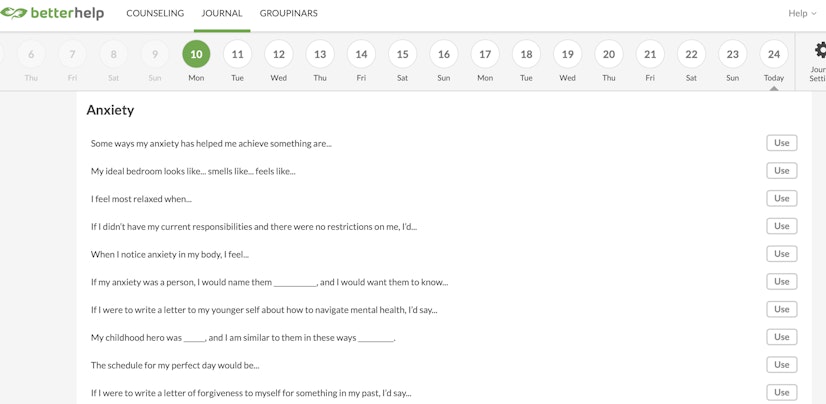
A valuable habit that promotes reflection and mindfulness, journaling requires as little as a few minutes to complete each entry. There are no actual rules to follow. Your journal is, by default, only viewable by you. You may choose to loop in your therapist to individual entries or all journaling. Click on “Journal Settings” to export your journal into a downloadable file so that you can retain a copy of it separate from the platform.
Many find it helpful to set reminders to journal on specific days of the week at specific times, such as every weekday at 9 a.m. and weekends at 1 p.m. You can journal using a freeform (self-guided) method or choose from hundreds of suggestions or prompts. Click “Shuffle” on your journal to get a random suggestion, or you can view all of them by clicking “Journal Suggestions” in the far upper right corner of the page.
What is BetterHelp's cancellation policy?
If you find that BetterHelp isn’t a good fit for you, then canceling your subscription is easy and can be completed online in just a couple of minutes.
Once you’ve logged in, navigate to your payment settings. You’ll see a link that allows you to change or cancel your plan. To cancel, simply click the link and answer a multiple-choice question about why you’re canceling. You’ll have the option to reveal the fact that you’re canceling with your therapist. Then, you’ll be asked if you’d like the same therapist in the event that you resume therapy in the future. Once you confirm the cancellation, you’ll receive an email with a cancellation confirmation.
Note: You’ll have to reach out to customer service to ask about refunds. This doesn’t happen automatically after cancellation.
BetterHelp vs. Talkspace
An abundance of therapy apps and websites have emerged in the past few years. As shown in the section above, they may share basic similarities — like messaging with a therapist, guided exercises, and usually a live session component — but there are also some key differences. Some focus primarily on talk therapy, while others offer consultations during which psychiatrists can prescribe medications they determine to be a valuable part of your treatment.
It’s crucial to seek therapy from reputable companies. Our other top recommendation, besides BetterHelp, is Talkspace. They both have several aspects in common, such as:
- A network of very qualified and experienced therapists.
- A subscription-based payment structure.
- An easy, straightforward way to switch therapists if you aren’t satisfied with your current one.
However, the two companies do differ in some meaningful ways. Let’s dive deeper into a few of the more significant differences:
Live sessions versus messaging
Though some of BetterHelp’s participating therapists don’t do live video sessions, most of them do. And the BetterHelp service is built more around establishing a cadence of live sessions that works well for both you and your therapist. The general “default” cadence is something like one live session per week. While messaging is valuable, we believe that it can’t replicate some of the value of face-to-face interaction between therapist and client. Anybody who has ever misconstrued a text message can likely understand why we feel this way.
Talkspace also facilitates live sessions, but there are three tiers to choose from: messaging only ($69 per week), video and messaging ($99 per week), and video, messaging, and workshops ($109 each week). To get a similar flexibility in your preferred therapy approach as BetterHelp, Talkspace requires a slightly higher investment. Currently, we believe BetterHelp has the better approach in this case.
Insurance coverage
As of the writing of this review, BetterHelp does not accept any insurance as payment for its services. On the other hand, Talkspace is partnered with several major insurance companies and accepts them as payment. Both companies accept HSA/FSA, however, along with debit and credit cards.
Psychiatry
Similar to the topic of insurance coverage, BetterHelp does not currently provide psychiatric services (such as prescribing medication). Talkspace offers psychiatric treatments for conditions such as anxiety, depression, insomnia, bipolar disorder, BPD, PTSD, OCD, and others. Unlike counseling sessions, psychiatry evaluations aren’t weekly but instead are sold in bundles of one, two, or four sessions — only an initial evaluation ($299) or packages including add-ons of one ($474) or three ($824) follow-ups.
You can learn more about the differences between BetterHelp and Talkspace in our full comparison of the two companies, and our 2023 online therapy guide gives more detail about other therapy providers.
BetterHelp compared to in-person therapy
BetterHelp and traditional, in-person therapy share commonalities, but there are also some differences. Some of these similarities and differences are obvious, while others are more subtle. Based on our testing and analysis, we broke down a few of the major similarities and differences, along with a chart from BetterHelp itself further below.
Here are a couple of the similarities between online therapy with BetterHelp and in-person, traditional counseling.
Range of treatment approaches
Whether you opt for BetterHelp or traditional therapy, you'll be able to access a range of therapeutic treatment modalities. You’ll be able to find providers who specialize in multiple approaches. Some of these include mindfulness-based therapy, cognitive behavioral therapy (CBT), dialectical behavior therapy (DBT), behavioral activation (BA), psychodynamic therapy, and many other forms of psychotherapy.
Qualifications of the therapists
BetterHelp's therapists are held to high standards in terms of their credentials and experience. A BetterHelp therapist will have, at minimum, three years and 1,000 hours of clinical experience prior to serving patients through the platform. All BetterHelp therapists have a Master's or Doctoral degree, along with accreditation as psychologists, marriage & family therapists, clinical social workers, or licensed professional counselors. You can rest assured that these therapists are as qualified as therapists you'd see in traditional therapy sessions.
And here’s a look at a few of the main differences between BetterHelp and in-person mental health counseling. Some of these differences may depend on your particular circumstances, such as your income or the area you live in.
Psychiatric care
Currently, BetterHelp does not offer psychiatric services (including the ability to prescribe medication). This means that you’ll have to seek out a different online mental health organization, such as Talkspace, or make an appointment with one in person.
Available therapists from which to choose
BetterHelp's platform gives you access to a massive variety of potential therapists (currently over 34,000 in total) who could help you. If you were to try to access a similar variety of therapists in your geographic area, you’d likely be traveling long distances to do so. This ease of access to so many therapists on BetterHelp can also be highly beneficial to those in more rural locations. Because finding the right therapist is a vital element for success, BetterHelp's wide selection (and quick therapist-switching process) can definitely help.
Cost
Relying on traditional, in-person therapy sessions, which can cost $100-$225 per session, is often considerably more expensive than using BetterHelp for online therapy.6 The route that is more economical for you depends somewhat on how much you hope to interact with a therapist for care. If you feel you’ll only need one monthly interaction, traditional therapy might be more cost-effective for you. If you desire more frequent interactions, then BetterHelp will very likely cost less.
Impact on your schedule
For most people, online therapy will be less disruptive to broader routines. Your scheduled sessions with BetterHelp happen at home (or another location of your choice) rather than commuting to an office. Live sessions can occur via voice, video, or messaging, meaning they can technically take place wherever you’re most comfortable. And the abundance of available therapists on BetterHelp means that, as long as you're willing to try a few therapists until you find the perfect one, you're highly likely to find a therapist whose availability meshes well with your own.
When in-person assistance is a must
While BetterHelp offers similar benefits to in-person therapy, it’s not an adequate substitute in every case. For instance, its therapists can’t prescribe medication or fulfill court-ordered therapy.
Online therapy is also not suitable for treating severe mental illness or any active emergency or dangerous situation. Seek immediate help if any of the following apply:
- If you or someone you care about are suicidal or contemplating self-harm, call or text the Suicide & Crisis Lifeline at 988. If it’s an emergency, call 911.
- If you are experiencing any kind of mental health crisis, Text “HOME” to 741741 to reach a Crisis Text Line counselor 24/7.
- If you’re a veteran experiencing a crisis, regardless of whether or not you’ve registered with the VA or enrolled for VA healthcare, you can call the Veterans Crisis Line at 988 and then press 1. Alternatively, you can send a text to 838255.
- If you’re an adult, youth, or older adult member of the LGBTQIA+ community who’s in need of support, the LGBT National Help Center offers several hotlines and other resources to help. The base hotline can be reached at 888-843-4564.
Getting matched to a therapist on BetterHelp
Even though BetterHelp, by default, matches you with a therapist the algorithm determines as a good fit for you, there is another (more obscure) way to find a therapist on the platform. Below, we’ll break down the process of each method, including how to find the elusive therapist search function.
If you sign up the traditional way, BetterHelp algorithmically matches you to a therapist using your questionnaire answers; this is nearly identical to how Talkspace matches you to a therapist. We recommend reading their profile right away to decide if the match seems right for you.
As we’ve tested BetterHelp over the past few years, it seems that its algorithm has become more sophisticated, though it’s not perfect. For example, one of our testers was matched with a therapist whose background did not include the tester’s primary concerns. However, if this happens, it’s easy to switch to a new therapist after being matched with one. Most of our testers switched therapists at least once — some even switched multiple times in one week. (You should never hesitate to change therapists if you feel it would benefit you.)
Choosing your own BetterHelp therapist
BetterHelp doesn’t advertise this option clearly, but it does offer a method that some of our testers found superior: choosing your own therapist. From our experience, we believe the best therapist-matching process for you is a matter of comfort and personal preference.
So, if you’d prefer more control over the matching process with BetterHelp, here are the details of this handy trick for selecting your therapist.
Step 1: Use a specific (and obscure) link.
Go to the BetterHelp website or mobile app and scroll down to the very bottom. In the footer section of the page, you will find a link that says, “Find a Therapist.” You can see the link in that location on the website whether you’re accessing it via phone, tablet, laptop, or desktop. Click this link.

Step 2: Browse your options to learn about the therapists.
Next, you’ll arrive on a page asking you to specify your geographic location by entering your city, state, or zip code into a search field. Scroll down if you’d rather choose from a list of major metropolitan areas or states. Once you provide (or select) your location, you'll see a list of therapists serving that area. Keep in mind that therapists can only provide therapy to those residing in their licensed state(s).
Step 3: Viewing more therapists.
The displayed list of therapists is limited to 15, though popular locations usually have more therapists available. To see more of them, refresh the page, and repeat as needed.
Step 4: Read therapist profiles.
Each entry in the therapist list will display a photograph and basic information about each provider. It’s worth reading their profiles, which include valuable information about their years of experience along with their descriptions of themselves and their approaches to therapy. The way they speak about themselves can reveal facets of their personality. Ask yourself: “Do their interests line up well with mine?” and “Does their personality and mode of expression feel relatable?” Answering “yes” to these questions can indicate that they’re a good match.
There is one potential drawback to choosing your BetterHelp therapist — unfortunately, you won’t know if the therapist you select has availability that works for you until after you click “Get Started.” This action takes you to the checkout page, where you must pay for your first four weeks. Of course, if it turns out that they aren’t available at times that work for you, you can switch therapists easily, but we wish therapist availability was clear before the checkout process.
Whether you opt for selecting a therapist or the default algorithmic approach, you may have to try one or two therapists before finding the best match — possibly even more. There is no limit to how often you can switch therapists on BetterHelp, so don’t stick it out if it doesn’t feel right. You may find the perfect fit immediately, but there’s no harm in switching whenever you think it will benefit you. We have a section dedicated to this important subject lower on this page.
How to tell if a therapist is a good match
The BetterHelp therapy team includes psychologists, marriage and family therapists, clinical social workers, and licensed professional counselors. They are all licensed in their state and have a minimum of a master’s degree in their field. To practice on BetterHelp, therapists must have at least three years and 1,000 hours of experience. The company ensures that every provider is appropriately licensed and remains in good standing.
Each therapist’s complete licensing information is on their profile. Therapist profiles also include their photo, years of experience, certification(s), availability, and approach to therapy. You’re likely to find some information about their personality and passions in life, too.
While rural areas might not have as many available therapists, we found a diverse range of therapists in most metro areas, and our testers found that having so many options presented a challenge of its own. To help you get the most out of treatment, a group of our experts (led by a licensed marriage and family therapist) put together a separate guide with seven tips to help you find your ideal BetterHelp therapist.

The “right” therapist for you depends on many factors, including personal preferences and your reason for seeking counseling. However, some basic, favorable behaviors to keep an eye out for in your therapist include good communication skills, availability, and a goal-oriented approach.
Good communication skills
Perhaps to an even greater extent than in-person therapy, online therapy relies on compatible communication styles between you and your therapist. Your therapist should be able to communicate via your preferred method during live sessions (chat, phone, or video). If you experience repeated scheduling problems or misunderstandings that interfere with your treatment, that could be a sign of incompatible communication styles. Any of these obstacles in communication can derail progress over time, and you deserve a beneficial therapy session.
Early on, it’s ideal to discuss your communication expectations — it’s important to ensure you’re both on the same page. You should be able to clearly understand when and how frequently your therapist will check and respond to your messages.
Even if therapists are busy, they should not regularly leave you waiting for an extended period of time when you’re expecting to hear from them. If this happens once or twice, it’s understandable, but if you’re consistently not hearing from your therapist during times when communication has been agreed upon, then it may be a red flag. (To prevent this, competitor Talkspace actually includes a “Guaranteed Response Time” feature that can be activated on your messages a few times per day, depending on the provider’s work hours.)
It’s also important to strike a nice balance between professional therapist-patient boundaries and interactions that are friendly and productive. Therapy inevitably gets uncomfortable at times, especially when you’re delving into complex or sensitive issues. But if you’re feeling unsettled because of your therapist’s tone — or if you feel judged, belittled, or dismissed — it could be a sign that your personalities aren’t meshing, and you may want to consider switching therapists.
Of course, the first few sessions can feel a bit strange as you get to know your therapist, but it’s also important not to dismiss your feelings.
Availability
On the calendar in your therapy chat room, you should be able to view your therapist’s availability to schedule a live chat, phone, or video session by clicking on one of the dates and times listed. If none of the listed times work for you, or you’re curious if they have any earlier openings or cancellations, you can message your therapist to ask. They’ll accommodate you if possible or clarify that there’s no availability beyond what appears on the schedule.
Insider Tip: Our testers discovered that some of the best therapists have limited availability because they’re in high demand. You may need to decide if it’s more helpful overall to have less frequent live sessions with your best match or, instead, have more frequent live sessions with a therapist who may not suit your needs quite as well.
Goal-oriented approach
Progress isn’t always the easiest thing to assess, but your therapist is there to help guide you and spotlight the improvements you make. Do they describe plans or set milestones? Do you have discussions about progress? Your therapist should, at least occasionally, raise the topic if it doesn’t come up naturally.
If you’re concerned about the rate of progress toward your goals, ask your therapist about the current approach. If you’re satisfied with the subsequent explanation, this can help lead to improvement (either initial or additional). But if you’re not happy, it may be a good idea to switch therapists.
Changing your therapist
BetterHelp makes it easy to change your counselor if you’re unsatisfied with your current match for any reason. If your therapist takes too long to reply to a message, the company suggests the option to switch therapists within your message thread. You can also do so through your account.
Insider Tip: Before switching therapists, be sure to review your existing therapy room for anything you’d like to copy, and save it into a file on your computer for later reference.
When is the right time to consider switching therapists? Here are a few major considerations.
Impersonal, shallow, or rote advice
When you're starting off with a therapist, don't be discouraged by the initial back-and-forth that feels a little impersonal. This kind of interaction at first is actually not uncommon when a therapist doesn't know much about you yet. The therapist is likely using rote, somewhat generic questions in order to get to know you. After some of this initial questioning, you should feel from the therapist a sense of deeper understanding and validation.
What may be a red flag is if the feeling of detachment or unsatisfying back-and-forth persists. If that's the case, you might be better off switching therapists.
Good rapport and comfort level
You're not looking for a best friend — in fact, it's important that there are boundaries in the professional relationship between therapist and patient. But it's also very important that you are fully comfortable and feel amiable. Therapy gets uncomfortable, of course, when you're delving into difficult or sensitive topics. That’s completely natural. But if you're feeling discomfort because of the tone of your therapist — or if you feel judged, belittled, or dismissed — it's a signal that a swap may be ideal.
Is therapy working?
Fundamentally, if you aren't sensing progress and improvement, then it could be time to switch. It can be difficult to assess your own progress in therapy, and this is one of many instances where your therapist can help you along the way. Do they describe plans or set milestones? Do you and your therapist discuss progress?
If you’re concerned about the rate of improvement (or frustrated by not feeling better), ask your therapist about the current approach. If you are satisfied by the therapist's explanation of the therapeutic approach — evidence of its efficacy, the rationale for using it in this instance, and what’s reasonable to expect from the approach at different stages — then this in itself could promote progress in your therapy because you'll be on the same page. But if you find the answers unsatisfying, then you might be better off with a different therapist who uses methods more to your liking.
Communication issues
Communication goes to the heart of effective therapy. If anything, online therapy relies even more fundamentally on compatible communication styles between you and your therapist. Success depends on being able to reach your therapist when you need help, receiving helpful and timely replies, and establishing an ideal cadence for weekly in-person sessions. If you prefer communicating via video for these sessions, but your therapist discourages it, that's not going to benefit you in the long run.
If you sense that you'd be better off with more frequent, shorter sessions as opposed to one hour-long session per week, it's not ideal if your therapist can't accommodate that. And if you experience repeated problems scheduling sessions or there are misunderstandings that interfere with your treatment, there could be serious communication issues. Any of these obstacles in communication can derail progress over time, and you don’t need to settle for a situation that isn't good for you.
If you request to change therapists, BetterHelp will ask why you’ve requested to make the change. You'll have the option of providing this feedback to your current therapist. It's your choice, though providing feedback is always valuable and a considerate thing to do for the therapist, as a professional, unless it makes you uncomfortable.
For instance, here's a step-by-step description of what one of our testers experienced:
Using the algorithmic matching approach (BetterHelp’s default method), our tester was matched with a therapist immediately after completing the sign-up process.
- Monday (10:49 a.m.): She received a generic welcome message from her counselor right away.
- Monday (12:24 p.m.): She replied with a detailed message explaining her goals for therapy.
- Tuesday (8:22 p.m.): She received a message from BetterHelp acknowledging that her therapist hadn’t responded and offering the option to change therapists.
- Tuesday (8:59 p.m.): She received a terse note from the therapist stating that he had hoped to speak soon, which was likely prompted by the company urging him to respond.
- Tuesday (10:09 p.m.): She requested to change therapists.
- Wednesday (9:09 a.m.): The company matched her with a new therapist.
In this case, her new therapist’s welcome message included a lot of detail about her availability and when she would respond. The response indicated that this therapist would cooperate to find a schedule and communication style that worked for our tester. In addition to being a better match for our tester's previously identified preferences, this therapist was very responsive, and their availability worked much better.
Your experience may be different, but BetterHelp makes changing therapists easy for a reason: finding the right therapist for you is one of the most important factors for your success. If anything doesn't seem right to you, don’t hesitate to make a change. This is how you'll get the most value from online therapy.
BetterHelp reviews from customers
In addition to our own testers' hands-on experiences, we interviewed several BetterHelp customers to find out what aspects of the services worked well (or not so well) for them. Out of respect, their reviews are credited to pseudonyms.
Customer review: "Mikka"
Question: Without getting into too much detail, why did you decide to try online therapy?
Answer: "So, I suffer from anxiety and depression. It's hard to open up to a stranger about these things. I think, looking back, I've been dealing with anxiety for a long time, like my entire life. Even when I was very young — not being able to deal with the fear I was feeling in some social situations. I've got depression related to the death of loved ones and don't want to get into that here. I was nervous about trying online therapy... I was almost sick about it. I don't open up to people easily, especially people I don't know."
Question: Why did you choose BetterHelp?
Answer: "I know people who do find help by talking with a counselor as part of a routine, sharing issues and thoughts. A couple of them are doing online therapy with BetterHelp, so I heard about it. I used to think I could manage things myself, but that's not a good approach for people."
Question: Overall, were your expectations met?
Answer: "My expectations were totally exceeded. I tried therapy as a child, and it didn't help me at all, really. I already journal and already meditate. So I was shocked, and I'm just so happy to find out that this process could be so good for me."
Question: What did you like most?
Answer: "My experience with the counselor I eventually worked with was just great in general. After I decided I needed to switch to a new counselor, the site made it easy for me to connect with one that's really ideal for me. So what hadn't worked out at the beginning turned out to be awesome, I just needed a different counselor."
"Also, there's this very cool journal where you can put in entries, share them with your counselor... It was quite helpful to have an online journal like that. I also liked the Groupinars — a couple of them really drove at some of my major tendencies!"
Question: What did you like least?
Answer: "I switched counselors because my first counselor, I just felt a sort of communication issue, you know? It wasn't her fault, but we just didn't communicate as well as I'd like. Like, immediately, she wanted to have a live session and then wanted it to be a live video session. I was surprised. Even if that's the best way forward, I felt like I was telling her how uncomfortable all of this makes me and my issues with opening up and all. And maybe she was just not picking up on that as much as I'd like, or I wasn't fully understanding the initial steps that are kind of required? There were other things, too, related to scheduling. We just didn't communicate the best way for each other. So I switched."
Question: If you had one piece of advice to give someone considering trying BetterHelp, what would that be?
Answer: "Probably, I'd say that you should just push aside whatever reservations you have or whatever doubts you might be feeling about whether it can help you. Because I can't recommend this highly enough... I just could not believe the difference in my confidence and how much more at peace I was with myself. I did not expect that. I had to switch counselors, but my second counselor was just amazing, and we really communicated well. She just understood me.
After several sessions, the difference for me was amazing. I was so surprised. I was afraid of therapy. I told myself I didn't need it — for years — probably because I was afraid. If you're like that, then my advice is to just do it. Ignore those excuses and try it."
Customer review: "Lana"
Question: Without getting into too much detail, why did you decide to try online therapy?
Answer: "During COVID, I felt like it was really important to work out issues with a professional. With any type of health situation, I mean. And mental health is no different. In the pandemic, online therapy is the way to go. I wanted help coping with stress and was overwhelmed by sadness, and so I wanted to give online therapy a try."
Question: Why did you choose BetterHelp?
Answer: "A couple of reasons... First, I had a friend who tried it and had a cool experience, so I could use her referral code to try it. That was how I first heard about BetterHelp. And then, because I'm on my parent's insurance, I didn't want to use insurance for this. So, with BetterHelp, I found out I was able to qualify for financial aid based on my situation — going to school, not making a lot in work, and stuff like that. I qualified for over a month for free, and during that time, I got 6 video sessions. This was super helpful."
Question: Overall, were your expectations met?
Answer: "BetterHelp was a great choice. Yeah, I had a positive experience. It's a little pricey, but honestly, it's way better than what I'd normally pay for therapy. And I was able to get financial aid too, which was a great service."
Question: What did you like most?
Answer: "For me, it wasn't just about the video sessions. I thought a huge pro of BetterHelp was how you could text or voicemail with the counselors whenever you want. To me, that was huge. If you were just doing normal therapy, you wouldn't get that ability. I used that a lot."
Question: What did you like least?
Answer: "I had a great experience, honestly. I'd recommend this to everybody, literally. The price is probably the trickiest thing, but like I said, it's more affordable than therapy the way we all used to do it. I feel like I got more for my money."
Question: If you had one piece of advice to give someone considering trying BetterHelp, what would that be?
Answer: "Make sure you can connect with your therapist. You need to be able to open up fully with them. If you can be open with this person, you'll get a lot of help. I found BetterHelp worked great for this — like for me, I'm not religious in any organized sense, but I am spiritual. I was able to convey this, and BetterHelp connected me with someone who really understood where I'm coming from."
Customer review: "Alaina"
Question: Without getting into too much detail, why did you decide to try online therapy?
Answer: "I've got a background where it was clear to me that I work well in online spaces — through work, through education, and socially. And I've sought out therapy in the past, just not online. So trying online therapy seemed like a natural course of action for me."
Question: Why did you choose BetterHelp?
Answer: "I actually tried a few different online therapy places. So it wasn't so much a matter of me singling out BetterHelp. I tried it as well as others like Talkspace. But I stayed with BetterHelp for a bunch of reasons. The counselor I found, the base plan, and what's included there — lots of reasons."
Question: Overall, were your expectations met?
Answer: "Yes. In some cases, BetterHelp went well beyond what I expected. I thought the sign-up process was really thorough and thoughtful. It felt comprehensive, and the end result — who I was connected with — was really good."
Question: What did you like most?
Answer: "The counselor I work with. She's very open, receptive, prompt in responding — she makes it a great experience. I have a great relationship with her and feel really fortunate that I found her here.
"Also, I thought the sign-up process was top-notch. It was pretty comprehensive, which I appreciated.
"Is it okay if I say three favorite things? My third thing: how easy it is to try different counselors. I switched three times. My fourth counselor was the keeper, and I love working with her.
"Okay, a fourth favorite: the worksheets. My counselor provided awesome worksheets — worksheets for nearly every subject we discussed. Meditation and breathing exercises, communication, codependency — these worksheets were really useful. Still are — I refer to them all the time."
Question: What did you like least?
Answer: "I didn't like that there was no way to pause service. It seems like this would be a useful thing for lots of people. If I can't pause it, then I guess I might need to end my service — and start over from scratch later? That, or I keep paying, it seems. The service is great, but I do think it would be good to be able to pause, if needed, and still keep your chosen therapist when you're ready to come back."
Question: If you had one piece of advice to give someone considering trying BetterHelp, what would that be?
Answer: "Keep switching counselors until you find the right counselor for you. It's easy, and I think it's the most important thing."
Customer review: "Ellie"
Question: Without getting into too much detail, why did you decide to try online therapy?
Answer: "In a word: COVID. I tried this during quarantine because it would have been difficult to find a face-to-face session with a therapist."
Question: Why did you choose BetterHelp?
Answer: "I chose BetterHelp specifically because I felt like it was important to me that a weekly video session was built into a plan."
Question: Overall, were your expectations met?
Answer: "I'd say my expectations were met, but my expectations were not terribly high because I knew there were positive and negative reviews about them."
Question: What did you like most?
Answer: "They allow for pretty robust messaging throughout the workweek in addition to the weekly live session. So you can message them basically at any time rather than texting friends who might freak out. You can send a message out of the blue. I think the messaging is a great experience. To me, it actually felt more personalized than going to see a therapist in person, once I found somebody who meshed well with me."
Question: What did you like least?
Answer: "I guess my least favorite thing about this service is that BetterHelp didn't prepare me for what to do if a counselor doesn't work well with me. I had never done this before, and it would've been useful to get a little guidance. I feel like I wasted some time and money with my first therapist, and more information up-front about my options would've been useful. They could onboard new clients better.
"My first counselor didn't tell me the live sessions would only be 30 minutes long, and I was surprised. She seemed like a great counselor, and they matched me well in many ways. But we could only do 30-minute sessions, and I just didn't feel like we could go into enough depth. I also thought, even though I'm sure she was great, her messaging wasn't ideal for me. It wasn't prompt, and at one point, her reply was kind of inadequate. After switching counselors, things were better."
Question: If you had one piece of advice to give someone considering trying BetterHelp, what would that be?
Answer: "Find the counselor who works best for you. Don't expect that BetterHelp will guide you there; be proactive, and if something isn't right, switch."
Frequently asked questions about BetterHelp
Sources
Innerbody uses only high-quality sources, including peer-reviewed studies, to support the facts within our articles. Read our editorial process to learn more about how we fact-check and keep our content accurate, reliable, and trustworthy.
Gangamma, R., Walia, B., Luke, M., & Lucena, C. (2022). Continuation of Teletherapy After the COVID-19 Pandemic: Survey Study of Licensed Mental Health Professionals. JMIR Formative Research, 6(6).
Watanabe, J., Teraura, H., Nakamura, A., & Kotani, K. (2023). Telemental health in rural areas: A systematic review. Journal of Rural Medicine: JRM, 18(2), 50-54.
Scott, A. M., Clark, J., Greenwood, H., Krzyzaniak, N., Cardona, M., Peiris, R., Sims, R., & Glasziou, P. (2022). Telehealth v. Face-to-face provision of care to patients with depression: A systematic review and meta-analysis. Psychological Medicine, 52(14), 2852-2860.
Greenwood, H., Krzyzaniak, N., Peiris, R., Clark, J., Scott, A. M., Cardona, M., Griffith, R., & Glasziou, P. (2022). Telehealth Versus Face-to-face Psychotherapy for Less Common Mental Health Conditions: Systematic Review and Meta-analysis of Randomized Controlled Trials. JMIR Mental Health, 9(3).
Orsolini, L., Pompili, S., Salvi, V., & Volpe, U. (2021). A Systematic Review on TeleMental Health in Youth Mental Health: Focus on Anxiety, Depression and Obsessive-Compulsive Disorder. Medicina, 57(8).
Guenther, J. (2021). How Much Do Therapists Charge in the U.S.? TherapyDen.
American Psychological Association. (2023). What psychologists need to know about online therapy services. APA.
Infiniti Research Limited. (2023). Online Therapy Services Market size to grow by USD 9.31 billion from 2021 to 2026. PR Newswire.
Centers for Disease Control and Prevention. (2023). About Mental Health. CDC.
Zhai, Y., Carney, J. V., & Hazler, R. J. (2023). Policy effects of the expansion of telehealth under 1135 waivers on intentions to seek counseling services: Difference-in-difference (DiD) analysis. Journal of Counseling & Development, 101(3), 277-292.
Centers for Medicare & Medicaid Services (n.d.). Behavioral Health Services. Medicaid.gov.
Centers for Medicare & Medicaid Services. (2023). Medicare & Your Mental Health Benefits. U.S. Department of Health and Human Services.
Catarino, A., Harper, S., Malcolm, R., Stainthorpe, A., Warren, G., Margoum, M., Hooper, J., Blackwell, A. D., & Welchman, A. E. (2023). Economic evaluation of 27,540 patients with mood and anxiety disorders and the importance of waiting time and clinical effectiveness in mental healthcare. Nature Mental Health, 1(9), 667-678.
American Psychological Association. (2017). How Long Will It Take for Treatment to Work? APA.
Cleveland Clinic. (2022). Clinical Depression (Major Depressive Disorder). Cleveland Clinic.
Zarbo, C., Tasca, G. A., Cattafi, F., & Compare, A. (2015). Integrative Psychotherapy Works. Frontiers in Psychology, 6.
Cook, S. C., Schwartz, A. C., & Kaslow, N. J. (2017). Evidence-Based Psychotherapy: Advantages and Challenges. Neurotherapeutics, 14(3), 537-545.
READ THIS NEXT



-new-upper.jpg?auto=format,compress&fit=max&w=262&q=75)


Copyright © Innerbody Research 1997 - 2025. All Rights Reserved.