BlueChew Review: Everything you need to know before you buy
Is BlueChew safe? Is BlueChew worth the money? Our medical experts thoroughly evaluate BlueChew ED medication and tell you what we think.

Photo by Innerbody Research
Erectile dysfunction (ED), the inability to get or maintain an erection of sufficient strength and duration for intercourse, likely affects at least a third of men. And half of all men with ED are younger than 60.1
BlueChew aims to help men treat their ED effectively and discreetly by providing treatment plans for the most potent prescription ED treatment on the market, which can be delivered to your door after you complete a free online consultation with BlueChew-affiliated physicians.
Is BlueChew right for you? We’ve thoroughly explored its services and treatment options and compared it to competitors. Here, we will share the pros, cons, and all other details to help you decide whether you should give it a try.
Our Findings
BlueChew gives men in nearly every state a very affordable and private way to access proven treatment without having to leave their homes at all — no trips to the doctor’s office or pharmacy. BlueChew provides a chewable and dissolvable combination of proven ED meds, specifically sildenafil and tadalafil (the same active ingredients in Viagra® and Cialis®) compounded alongside two other drugs — apomorphine and oxytocin — to create BlueChew Gold. Gold is undeniably the most potent ED medication combination on the market. The combination of convenience, potency, and pricing BlueChew offers is unmatched by competitors, even if certain monotherapies might be less expensive elsewhere.
Pros
- Easily allows you to get prescription ED medication online
- Gold attacks ED from three angles (blood flow, dopamine, mental health)
- Can start to work in as little as 15 minutes
- Affordable, reliable, and discreet service
- Chewable tablets can also dissolve under the tongue for faster onset
- Made in the United States
- Our readers get an exclusive discount on Gold: 10% off (up to $93.50 in savings) by following the links in this review
Cons
- Not available in SC, NC, ND, LA, or UT
- Currently does not accept health insurance
- Not available outside of the United States


In this Review
Why you should trust us
At Innerbody Research, we meticulously scrutinize every product and service we review, including ED medication providers like BlueChew. To provide this review of BlueChew, we spent over 1,300 hours testing and researching BlueChew’s treatments and services as well as investigating its competitor landscape and reading through all of the pertinent scientific literature.
We evaluated the entire customer experience, from registration to medical consultation and, ultimately, the treatment experience itself. We tested the mechanisms for changing or canceling service. We also reached out to the customer service team with questions people like you are likely to ask, and have explored all the same processes and aspects of service for BlueChew’s close competitors as well. And for a broader perspective, we rounded out our perceptions of BlueChew with reviews from customers — people with ED who provided honest answers to various questions we asked them about their experience with BlueChew’s services.
This content was also reviewed by members of our Medical Review Board for accuracy. Over the past two decades, Innerbody Research has helped tens of millions of readers make more informed decisions about living healthier lifestyles.
How we evaluated BlueChew
Our process for evaluating BlueChew has evolved alongside the company. As BlueChew has expanded, so has our consideration of its place in the ED telemedical landscape. To rate the company and its products, we held them up against the top offerings from comparable competitors like Rugiet, Hims, Roman, and others.
In doing so, we concentrated on key criteria that should matter most to men interested in trying BlueChew products. These include effectiveness, safety, cost, convenience, privacy, and customer service.
Let’s drill deeper into each criterion to see how BlueChew compares to its closest competitors.
Effectiveness
BlueChew’s flagship product is called BlueChew Gold, which offers a quartet of medications designed to tackle ED from three different angles. Before the company began offering such combination therapies, BlueChew had focused exclusively on monotherapies — one drug at a time — the effectiveness of which has been well-established in the scientific literature and varied only based on dose and a given patient’s responsiveness.
But now, with Gold, BlueChew has a product that could offer men something more effective than any monotherapy on its own or any combination therapy from close competitors. That’s because it combines two effective PDE5 inhibitors — specifically, the generic equivalents of Viagra and Cialis — with two other drugs offering distinct and complementary mechanisms of action for managing ED.
These two other drugs, apomorphine and oxytocin, can potentially help men with ED rooted in neurochemistry and mental health, respectively. Apomorphine is a dopamine receptor agonist typically injected in high doses in Parkinson’s patients.7 In its lower-dose oral form, its dopamine activity could potentially help men with neurogenic erectile dysfunction, or ED that has some neurogenic pathophysiology.23 Oxytocin, meanwhile, has research supporting its mood-elevating effects in both sexes, as well as its arousal-improving benefits in women.24 25 That could help the roughly 40% of men with psychogenic ED to overcome some of the depression or anxiety contributing to their dysfunction.26

Rugiet Ready is the closest comparable medication on the market, combining tadalafil, sildenafil, and apomorphine. But Rugiet does not offer a product containing those three medications alongside oxytocin, whereas BlueChew delivers either equivalent doses at each available step in the dosing tiers or slightly more sildenafil or apomorphine than Rugiet. BlueChew Gold is therefore the more effective choice.
Safety
For men who are considered suitable candidates for prescription ED medication, BlueChew is as safe as any of its legitimate competitors providing similar prescription ED medications, like Rugiet or Roman. As a provider of such prescriptions, BlueChew must offer medications that are therapeutically identical to Viagra, Cialis, and other drugs it offers generically, and its LegalScript Certification is evidence that its products meet this requirement.
As for the drugs themselves, decades of research have shown all four of the medications in Gold to be safe for most men, and their safety and side effect profiles are about the same with BlueChew as with any other provider. Only minor dose-based differences might separate them.
That said, it’s important to understand that these drugs do have specific potential side effects and contraindications, with PDE5 inhibitors like sildenafil and tadalafil sometimes causing back and muscle pain, headaches, GI disturbances, and vision changes.27
Compared to research into individual drugs, there’s also less robust safety data looking at how combining ED medications can affect safety. While some research has been positive, showing that common doses of sildenafil and tadalafil, when taken together, have the same side effect rates as seen when taken individually,28 this area requires much more study. Not to mention, the addition of apomorphine and oxytocin may further increase both side effect risks and potential contraindications.
Fortunately, like most telemedical outfits, BlueChew has a thorough intake process that can determine whether you’re a suitable candidate.
Cost
BlueChew doesn’t always have the lowest prices for chewable ED medications, but its flagship product, BlueChew Gold, only has one serious competitor in Rugiet Ready. And every available dose of BlueChew Gold is either less expensive for the same dose you’d get from Rugiet or the same price with a slightly stronger dose.
Here’s how that works out:
As you can see, Rugiet has four dose levels to BlueChew’s three, making it slightly more flexible. But when you compare the most similar dose tiers to one another, you can see that BlueChew either has the better price, the stronger dose, or both. And with BlueChew offering oxytocin in its Gold tablets, you get an extra mechanism for tackling ED that Rugiet lacks.
Of course, these are just the lowest costs per dose. There are also introductory costs to consider, which are lower with BlueChew and come down even further when you follow any of the BlueChew links in this review, which take 10% off on Gold plans, saving you up to $93.50 and unlocking free shipping.
Convenience
Telemedicine providers that offer ED medications tend to deliver on convenience. They have free or low-cost doctor consultations that often consist of little more than an intake questionnaire and a little messaging back and forth with a provider. But BlueChew was the first to extend this convenience into the delivery method of its drugs.
Instead of pills that most people need water to swallow and that many people find too difficult, BlueChew offers its medicines in chewable tablets.5 But compared to other chewables, like Hims Hard Mints, BlueChew Gold has the additional unique ability to dissolve under the tongue if you hold them there. That allows for a faster onset of action as the drugs absorb through oral membranes. And in our testing, BlueChew’s dissolving action actually outpaced both Roman’s and Rugiet’s lozenges.
Privacy
Given the sensitive, personal nature of these treatments, it’s paramount that any provider offer you as much discretion as possible; your ED prescriptions are nobody’s business unless you decide to tell someone.
This is an area in which most of the big names in online ED treatments excel. BlueChew, Hims, and Roman deliver their ED meds in packages that will not give away their contents. There’s typically no company name on the return address, and no distinctive markings on the box itself. We have received packages from Hims in recent years that bore the company name in the return address, but that company has become so wide-reaching in its offerings that there’s still no way a curious neighbor or delivery person would actually be able to guess what was inside.
We made an unboxing video that shows you exactly the kind of package you can expect to arrive from BlueChew if you choose to order:
As far as your data is concerned, any medical information is protected by HIPAA, which these companies must abide by if they’re doling out prescriptions. However, nonmedical data points — like cookies and statistics used for marketing — are fair game, though there are ways to opt out. BlueChew makes it pretty easy to submit a “Do Not Sell My Information” request, with a link at the bottom of its pages.
Customer service
Telemedicine providers generally do a pretty good job in customer service, offering at least one expedient way to answer your questions and offer you assistance. BlueChew, Hims, and Roman all once had outstanding phone support, with relatively short wait times and representatives who could answer most questions. But all three companies have done away with this service. Only Rugiet maintains a useful phone line, which we’ve used repeatedly for this and other reviews and guides we’ve written.
Hims and Roman have also done away with their chat support. BlueChew has maintained this support, though a relatively useless AI chatbot stands between you and answers to even the most basic questions. Fortunately, once you get past that chatbot, BlueChew reps are quick to respond with very thorough answers to even relatively complicated questions.
Once you’re a customer, the BlueChew portal is about as easy to navigate and use as anything its competitors offer, with responses to medical questions arriving well within 24 hours in our testing.
Taste
For chewable and dissolvable medications, it’s critical that you enjoy the way they taste — or, at least, that you can bear to consume them to get their effects. We’ve tried every major chewable and dissolvable ED medication on the market, and BlueChew’s products are consistently somewhere in the middle of the pack. They taste better than Rugiet Ready and Ro Sparks, about as good as Hims Hard Mints, and not quite as good as Ro Daily Rise Gummies.
Our testing team generally preferred the Black Cherry Pomegranate flavor of BlueChew Gold to most competing chews we tried, though they didn’t quite live up to the flavor of Ro Daily Rise. Fortunately, the fact that you can chew them if you’re not a big fan of the taste — rather than being forced to keep them dissolving in your mouth à la Rugiet or Ro Sparks — allows you to get through the flavor portion of the experience much more quickly.
What is BlueChew?
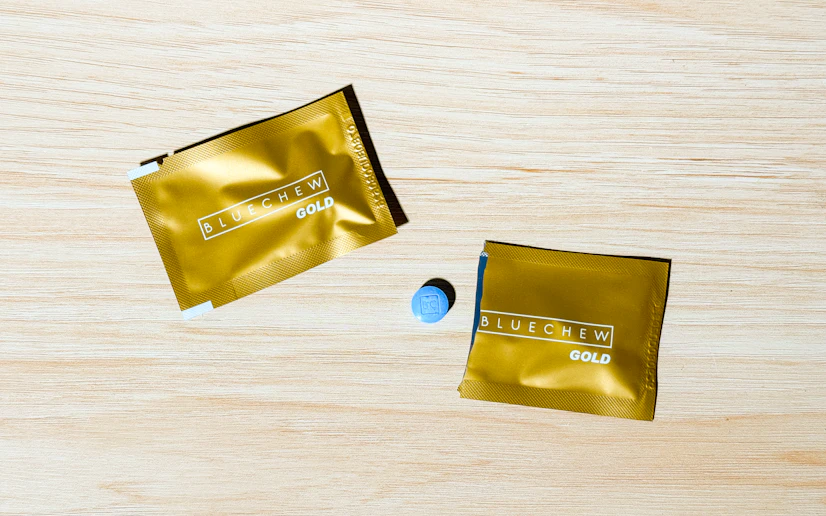
Photo by Innerbody Research
BlueChew is an online portal for men to get prescription ED treatment. The company is based in Illinois, and its medical treatments are made in the United States. It's not a pharmacy or a medical center but a telehealth website that connects you to affiliated medical professionals and enables the prescription and discreet delivery of ED medication. This level of convenience is understandably appealing to many people. Having tested the service regularly, we can say that it remains a smooth experience.
BlueChew’s latest evolution has been the development of a combination therapy — or multitherapy — that puts four prescription medications into a single dissolvable or chewable tablet. We’ll get into the specifics of this formula in our next section, but suffice it to say that BlueChew Gold is the most potent combination ED treatment on the market.
BlueChew isn't the only ED medication portal, of course, but it has stood out by pioneering the "chewable medication" movement. Other major companies have tried to catch up by offering compounded ED meds of their own — most notably, competitors Rugiet, Hims, and Roman. Rugiet offers combination ED lozenges, Hims now has its Hard Mints, and Roman has its Sparks and Daily Rise Gummies, but BlueChew was the first to compound these medications in a chewable format and deliver them to a wide audience. It’s also the first to develop a chewable tablet that can also dissolve under your tongue if you want it to kick in faster.
In terms of its geographic reach, BlueChew can deliver its Gold multitherapy to 45 states, excluding only North Dakota, North and South Carolina, Louisiana, and Utah. Our conversations with company reps lead us to believe the Utah restriction should soon lift, though the regulatory landscape for telemedicine is in constant flux. We regularly update the content here and across our site to keep availability information current.
BlueChew product lineup
BlueChew’s lineup has evolved over the years, increasing in strength and variety as its customer base has grown and shown an interest in stronger medications and combinations. At first, BlueChew only offered sildenafil and tadalafil, the generic equivalents of Viagra and Cialis, respectively. The company then added vardenafil, a sildenafil alternative and the generic equivalent of Levitra. After that, the company launched its daily tadalafil and MAX and VMAX combination medications.
Most recently, BlueChew’s catalog has coalesced around its most promising product, especially for men with treatment-resistant ED: BlueChew Gold. Gold combines four ED medications to tackle the problem from multiple angles.
Specifically, Gold contains:
- Sildenafil: A PDE5 inhibitor and the active ingredient in Viagra, sildenafil works in as little as 15 minutes and lasts up to eight hours.2
- Tadalafil: Another PDE5 inhibitor and the active ingredient in Cialis. Tadalafil kicks in after as little as 15 minutes and lasts up to 36 hours.3
- Apomorphine: A dopamine agonist that supports erectile performance by improving brain chemistry.36
- Oxytocin: The so-called “love hormone,” oxytocin can improve mental health markers like depression and anxiety, which can worsen or even cause ED.24
How does BlueChew Gold work?

Photo by Innerbody Research
For most men with ED, the combined ingredients in BlueChew Gold will be effective in treating erectile dysfunction.27 28 This means most men will be able to use it in order to achieve an erection of sufficient strength and duration for sex. BlueChew’s innovation on these traditional and effective medications is that it offers them combined as multitherapies able to dissolve under the tongue to start working even faster.29
Sildenafil (the active ingredient in Viagra) has been proven effective in numerous clinical studies, as has tadalafil (the active ingredient in Cialis).2 3
Sildenafil and tadalafil are classified as PDE5 inhibitors. By blocking a specific chemical — phosphodiesterase-5 — that normally signals to the body that it’s time for an erection to stop, the drugs effectively encourage blood flow to the genital region in order to allow normal, healthy erections of sufficient duration.31 For most men with ED, these prescription medications eliminate the hardships and frustrations of ED.
The other active ingredients in products like Gold— namely, apomorphine and oxytocin — can offer complementary benefits to PDE5 inhibitors that could make them superior choices for men with treatment-resistant ED or dysfunction that arises through multiple channels (e.g., neurochemical, psychological, etc.).
Let’s look more closely at BlueChew Gold’s medications to see how they can help men with ED achieve reliable erections.
BlueChew Gold ingredients
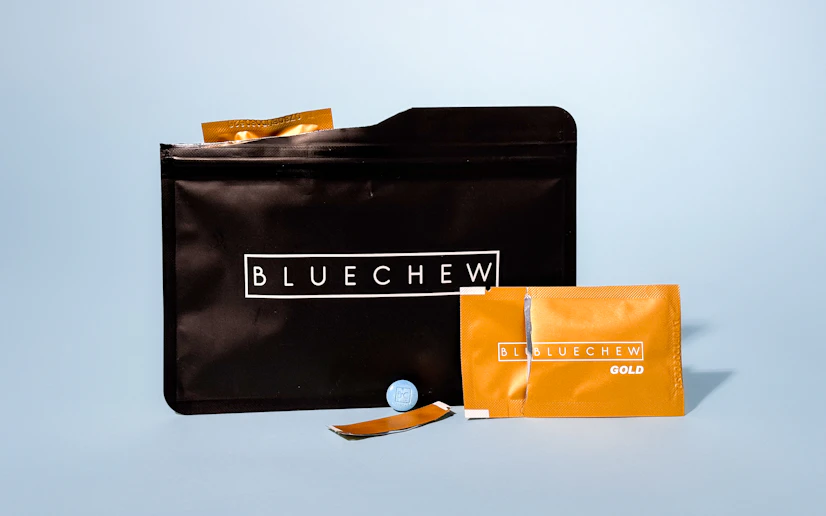
Photo by Innerbody Research
Because Gold contains tadalafil, it should last for up to 36 hours. But the effects of the sildenafil in Gold should wear off before then, meaning each dose would peak in strength around 15-60 minutes after consumption and remain at its peak for about 6-8 hours.3 2 30
Gold is BlueChew’s most ambitious product, a combination of two well-known and effective PDE5 inhibitors in sildenafil and tadalafil alongside two less common ED treatments, apomorphine and oxytocin. Apomorphine is a dopamine agonist that can potentially improve the neurochemical signaling involved in achieving and maintaining an erection, while oxytocin has been shown to improve symptoms of depression and anxiety, potentially thwarting mental health issues that can contribute significantly to ED.36 24
BlueChew offers three dose options for Gold, so you and your consulting physician can dial in the dose that works best for you. Here’s how each level is dosed:
| Sildenafil | Tadalafil | Apomorphine | Oxytocin | |
|---|---|---|---|---|
| Base Strength | 70mg | 18mg | 2mg | 160IU |
| High Strength | 90mg | 22mg | 3mg | 200IU |
| Extra Strength | 110mg | 22mg | 4mg | 240IU |
At the base strength, you get a solid middle-ground dose for sildenafil alongside a slightly higher-than-normal dose for as-needed tadalafil, which typically starts at around 5mg and tops out around 20mg in most research.32 33
That introductory dose also gives you 2mg of apomorphine, which is the lowest oral dose shown effective at treating ED.54 The 160IU oxytocin dose is harder to validate. Research into oxytocin’s use in depression and anxiety shows success at a dose of 24IU, but it’s important to remember that this was administered intranasally.26 BlueChew Gold’s 160IU, 200IU, and 240IU doses don’t have direct research related to sublingual administration. That said, sublingual administration should still provide better bioavailability than regular digestion, so these doses could and should be effective.
The High and Extra Strength doses reach even further with each medication. Let’s take a close look now at each ingredient in Gold, to better understand how they fight ED:
Sildenafil
Whether or not most men realize it, this is the most well-known medication for fighting ED; it’s the generic form of Viagra, the original little blue pill. Once it kicks in, which takes about 30-60 minutes, it lasts between four and six hours. BlueChew Gold sildenafil in 70mg, 90mg, and 110mg doses, with research generally using 25mg increments up to 100mg.32 That puts Gold consistently on the higher side of the range seen in both research and among competitors’ products.
Tadalafil
Tadalafil remains active in the bloodstream for a longer period; it can effectively combat ED for 24-36 hours.3 You can also take tadalafil daily and be ready for sex at any time. This added convenience is why both men and women have responded to study surveys that they generally prefer tadalafil over other PDE5 inhibitors, like sildenafil or vardenafil.35
However, Gold is only intended to be taken as needed, with the maximum monthly allotment from the company being just 24 doses.
Apomorphine
Unlike PDE5 inhibitors, which work to control enzymatic activities that influence blood flow, apomorphine works in the brain as a dopamine receptor agonist, which essentially tricks the brain into behaving as though there’s more dopamine present than there is in fact.36 Dopamine — a critical neurotransmitter — plays important roles in male sexual health and behavior, with imbalances in neurochemistry that contribute to ED earning their own designation as neurogenic erectile dysfunction.37 23
Including apomorphine in an ED treatment regimen can help offset neurochemical imbalances that might be contributing to — or even be the root cause of — ED. Low doses are common in this space, with BlueChew offering 2mg, 3mg, and 4mg apomorphine doses in Gold, alongside sildenafil, tadalafil, and oxytocin. And while some comparative studies show that a common sildenafil dose (50mg) can outperform a common apomorphine dose (3mg), other comparisons show similar performance and highlight apomorphine’s quick onset of action, even at just a 2mg dose.38 39
Oxytocin
Oxytocin is a hormone associated with social bonding to such an extent that some researchers have taken to calling it the “love hormone.”40 It’s been studied extensively in the context of women’s sexual health, but its potential to treat physiological causes of ED hasn’t been established. However, because around 40% of all ED cases are psychogenic, or psychological in origin, oxytocin’s potential to treat psychiatric issues makes it a prime candidate for ED treatment.26 24
This potential is further supported when you realize the complex interconnection between ED and mental health concerns like depression and anxiety.41 One can lead to the other, and either can make the other worse. Treating ED from both physiological and psychological perspectives may be the most efficacious pathway for most men.
Inactive ingredients
BlueChew’s tablets consist of more than just the active drugs they provide. To get those drugs into a convenient chewable or dissolvable form, the company compounds them with several inactive ingredients that allow the tablets to hold their shape, taste relatively good, and break down easily in the mouth. Those ingredients include:
- Sucralose
- Neotame
- Citric acid
- Magnesium stearate
- Sodium starch glycolate
- Crospovidone
- galenIQ™
- Silicon dioxide
- Cherry pomegranate flavor
- FD&C Blue #1
What causes erectile dysfunction?
As we mentioned at the top, ED isn’t some rare and shameful disorder; it affects about a third of all men. Of course, the prevalence of ED increases with age, but that doesn’t mean it’s unheard of among young men, either. About 5% of men under age 40 are unable to achieve an erection,6 and numerous medications can include ED as a potential side effect, including two popular hair loss treatments, finasteride and dutasteride.44
Other factors can contribute to ED, as well, including both physiological and psychological issues. These can play off one another to exacerbate ED the longer you suffer from it.
Ultimately, anything that can inhibit blood flow to the penis can be considered an organic cause, including:
But it’s just as likely that there are other factors at play, including:
- Depression
- Anxiety
- Stress
- Relationship troubles
- Medications
In fact, mental health concerns resulting in or contributing to ED — also known as psychogenic ED — account for around 40% of all ED cases. (To learn more, you can also visit our complete guide to erectile dysfunction treatments.)
At first glance, it’s clear that some men may overcome a few of these causes with lifestyle interventions such as quitting smoking, improving diet and exercise, or working to reduce stress. Those interventions are well worth pursuing but can take time, and there’s no harm in seeking prescription help from BlueChew in the meantime.
Who is BlueChew for?
Men who struggle with ED may be able to get an erection for a short duration, or they may not be able to become erect at all. For the many men affected by ED, the condition can be an unfortunate source of embarrassment and frustration. It’s important to remember that this is a very common health condition, and treatment options are available. BlueChew is worth exploring if you’ve noticed difficulty getting or keeping an erection in order to enjoy sex. Through the medical consultation, BlueChew will be able to determine if your underlying health makes you a good candidate for their prescription ED medications.
BlueChew should also be especially appealing to men who’ve had limited success with monotherapies in the past and would like to try a multitherapy like BlueChew Gold. This chewable and dissolvable tablet provides two PDE5 inhibitors in one treatment, alongside two additional medications intended to treat ED from different angles than traditional therapies.
Also, because BlueChew deals exclusively in chewable and dissolvable tablets, it makes a smart choice for men who aren’t keen on or capable of swallowing pills. Tablet forms of ED medications are typically pretty small, but problems swallowing medications of any size are very real, and chewables or dissolvables can make a big difference for those men.45
Who should not try BlueChew?
Some of the underlying causes of ED listed above — such as heart disease and high blood pressure — may ultimately mean that it isn't safe or advisable for you to try BlueChew. Whether you see a doctor in person or seek treatment via a telemedicine provider like BlueChew, be forthright about your medical history. If you’ve had a stroke or heart attack in the past or currently have high blood pressure, you must share those important details.
The BlueChew consultation process prompts you to share all important aspects of your history, and then, based on that history and underlying cardiovascular health, the prescribing medical professional affiliated with BlueChew will determine whether you’re a suitable candidate for ED medication.
Beyond that, it’s important to realize that BlueChew can’t cure ED; it can only make ED symptoms go away for a while. If you stopped taking medication from BlueChew, your symptoms would almost be guaranteed to recur. Should your ED be rooted in identifiable and treatable physical or psychological conditions, you could use BlueChew to improve your sex life now while working on those underlying conditions over time. Then, by successfully dealing with those underlying conditions, you might be able to stop using medications and resume normal, healthy sexual activity without medical assistance.
But there’s no shame in reaching for help from BlueChew while you work on those longer-term health goals.
Can BlueChew make you last longer in bed?
While more research is needed, and BlueChew’s medications are not prescribed or intended at all as treatments for premature ejaculation (PE), studies show that sildenafil and tadalafil can make you last longer in bed (increasing how long you last before climax). Using a score based on intravaginal ejaculation latency time (IELT) — basically, how long it takes a person to climax — researchers found that sildenafil, tadalafil, and vardenafil all allowed study participants to last longer than their baseline IELT assessments.
The study looking into sildenafil was the only one of the three not to reach statistical significance in its increase, but participants still reported increased ejaculatory control and confidence compared to placebo.10 That might lead men with both ED and PE to try vardenafil instead, as its study showed more dramatic improvement in IELT scores than sildenafil.11
The most improvement in IELT scores came from the tadalafil study, which could at least partially be a result of the drug’s daily routine compared to the other two medications’ as-needed use.12
However, in this review, we want to make it absolutely clear that you shouldn’t seek out ED medications just because you want to last longer in bed. For starters, doctors likely won’t prescribe them to you without an ED diagnosis, and even if they did, there’s some evidence connecting recreational ED medication abuse with increased rates of ED.13 That means you could start out without ED and then potentially develop it from taking ED meds when you don’t need them.
There are other effective products for PE — available over the counter or by prescription — that help men improve the duration of their sexual activity without introducing the risk of developing ED. (If that’s what you’re looking for, we’ve got reviews of several of them, including reviews of the best delay sprays and PE wipes on the market.)
Is BlueChew safe?
BlueChew is as safe as any typical prescription for ED, unless you happen to be sensitive to one of its few inactive ingredients. For the most part, those ingredients (listed earlier) are extremely common food ingredients, so their safety is well-known.
Any BlueChew prescription will be safe for most men who don’t have cardiovascular issues. That’s because these medications act as vasodilators, which lower blood pressure. If you already have low blood pressure or take medication that affects your blood pressure, adding a prescription PDE5 inhibitor from BlueChew or any other provider can be dangerous. After all, that’s why these medicines are available only with a prescription.
As with anything containing PDE inhibitors, these drugs aren’t perfectly selective for PDE5; other PDE enzymes may be affected. And when the medications do collaterally inhibit other PDE enzymes, you may experience certain side effects, including:
- Facial reddening
- Headache
- Diarrhea
- Nausea or stomach discomfort
More serious side effects could also occur, including:
- Priapism (an erection that lasts longer than four hours)
- Dizziness
- Vision changes
- Low blood pressure
Side effects of sildenafil
Sildenafil’s side effect profile is slightly more extensive compared with other as-needed PDE5 inhibitors, like vardenafil and avanafil (Stendra), mainly because those other drugs were developed later and have been designed to be more selective of the PDE5 enzyme.
In studies looking at adverse effects associated with sildenafil, the following were the most common:2
- Flushing (reddening of the skin and face)
- Headache
- Nasal congestion
- Heartburn
- Dyspepsia (stomach discomfort)
- Visual impairments, including problems with color perception
That last effect — visual disturbances — comes from the fact that sildenafil also weakly inhibits PDE6, which is associated with certain visual processing pathways.46 Men who experience this side effect typically switch to tadalafil or vardenafil with success.9 To learn more, please visit our comprehensive guide to BlueChew side effects.
Side effects of tadalafil
Tadalafil presents many of the same side effects as sildenafil, though at different rates of occurrence. In a side-by-side comparison with sildenafil, one of the most noteworthy observations is that tadalafil doesn’t pose a risk of visual disturbance.47 This is because tadalafil lacks the impact on PDE6 seen with sildenafil. There is, however, another enzyme tadalafil does inhibit in addition to PDE5, and that’s PDE11.8 As a result, tadalafil users sometimes report muscle pain — specifically, lower back pain.
All told, tadalafil’s most common side effects include:
- Headache
- Dyspepsia
- Nasopharyngitis (upper-airway symptoms of a common cold, like runny nose and sneezing)
- Back pain
Side effects of apomorphine
A lot of what we know about apomorphine’s safety and tolerability comes from studies in Parkinson’s disease patients, which is the cohort for whom the drug was initially developed. Some of the side effects seen in those studies were alarming, including nausea, vomiting, hallucinations, dizziness, and physical weakness.48 But these studies looked at subcutaneous apomorphine injections.
Fortunately, later research looked at the sublingual route of administration in Parkinson’s patients, and these found nausea to be the only persistent side effect.49 The effect was dose-dependent, with the 5mg dose causing much more nausea than the 4mg dose. The 3mg dose was well-tolerated.
And in an early human trial of sublingual apomorphine for ED, that 3mg dose performed about as well as the 4mg dose while being better tolerated.14
Side effects of oxytocin
As with apomorphine, we have some useful side effect information on oxytocin delivered in a format that differs from BlueChew Gold. In this case, it’s not subcutaneous injection, but rather intranasal administration. In a large review of such studies, researchers pointed out reactions like GI upset, soft stool, dizziness, lightheadedness, hallucinations, insomnia, and aggression.50
The good news is that another study that set out to compare intranasal and oral oxytocin described dramatic differences in action, implying that side effects from oral administration could be much less severe.51 Research hasn’t given us much to go on for dose response, either, so it’ll be up to you to monitor your reaction to BlueChew Gold and report to your doctor any specific side effects that occur.
Are combination therapies more dangerous?
In theory, combination therapies should be more dangerous than monotherapies, especially if they contain the same doses you’d normally take for an individual treatment. It makes sense: a greater variety of medications taken at the same doses and all at the same time should have a higher degree of risk associated with it.
The problem with supporting that claim is that most of the specific combinations of medications and doses seen in ED multitherapies haven’t been studied. So we’re left assuming, which is never the best place from which to make medical decisions.
However, we aren’t completely without good information here. There is some research looking at sildenafil combined with tadalafil that shows a comparable side effect profile to either on its own. Specifically, one combination study looked at adding 50mg of as-needed sildenafil to a regimen of 5mg daily tadalafil.28 Not only did the combination outperform monotherapies, but it had the same incidence of adverse events, showing no increase in risk.
Of course, this doesn’t take into account that BlueChew’s multitherapies are all intended for as-needed use only, or that the doses involved tend to be higher and include other medications, namely apomorphine and oxytocin.
Ultimately, it’ll be up to you and your consulting physician to determine whether you’re a good candidate for a multitherapy.
When to see your doctor
In most clinical studies, common side effects, like headaches and flushing, tended to go away with regular use. If these or other side effects persist for you, we suggest talking to your doctor about an alternative PDE5 inhibitor; you might end up switching from sildenafil to vardenafil or tadalafil, for instance.
If you experience any cardiovascular symptoms, especially those related to dangerously low blood pressure — lightheadedness, dizziness, confusion, or significant nausea — you should discontinue use and call your doctor to rule out your medication as a cause.
How much does BlueChew cost?
There are two important considerations most men will have when approaching BlueChew’s potential costs:
- What it costs to try BlueChew
- What it costs to use BlueChew long-term
Let’s look at each question individually, so you can get a firm sense of what you stand to spend.
Trying BlueChew Gold is relatively inexpensive, especially compared to similar multitherapies from companies like Rugiet. And Innerbody readers can follow any of the BlueChew links on this page to get 10% off their first order, knocking up to $93.50 off the cost of the top Gold tier.
Here’s what that looks like in practice at each dosing level, quantity, and shipping frequency:
Base Strength: 70mg sildenafil, 18mg tadalafil, 2mg apomorphine, 160IU oxytocin
| 6-pack | 12-pack | 18-pack | 24-pack | |
|---|---|---|---|---|
| Monthly cost | $79.00 | $149.00 | $215.00 | $269.00 |
| First month cost from links in this review | $71.10 | $134.10 | $193.50 | $242.10 |
| Savings | $7.90 | $14.90 | $21.50 | $26.90 |
| Quarterly cost | $154.00 | $289.00 | $420.00 | $525.00 |
| Quarterly cost from links in this review | $138.60 | $260.10 | $378.00 | $472.50 |
| Savings | $15.40 | $28.90 | $42.00 | $52.50 |
High Strength: 90mg sildenafil, 22mg tadalafil, 3mg apomorphine, 200IU oxytocin
| 6-pack | 12-pack | 18-pack | 24-pack | |
|---|---|---|---|---|
| Monthly cost | $119.00 | $229.00 | $329.00 | $419.00 |
| First month cost from links in this review | $107.10 | $206.10 | $296.10 | $377.10 |
| Savings | $11.90 | $22.90 | $32.90 | $41.90 |
| Quarterly cost | $229.00 | $439.00 | $629.00 | $799.00 |
| Quarterly cost from links in this review | $206.10 | $395.10 | $566.10 | $719.10 |
| Savings | $22.90 | $43.90 | $62.90 | $79.90 |
Extra Strength: 110mg sildenafil, 22mg tadalafil, 4mg apomorphine, 240IU oxytocin
| 6-pack | 12-pack | 18-pack | 24-pack | |
|---|---|---|---|---|
| Monthly cost | $139.00 | $269.00 | $389.00 | $479.00 |
| First-month cost from links in this review | $125.10 | $242.10 | $350.10 | $431.10 |
| Savings | $13.90 | $26.90 | $38.90 | $47.90 |
| Quarterly cost | $269.00 | $525.00 | $759.00 | $935.00 |
| Quarterly cost from links in this review | $242.10 | $472.50 | $683.10 | $841.50 |
| Savings | $26.90 | $52.50 | $75.90 | $93.50 |
As a point of comparison, the monthly cost you’ll see from Rugiet on a 24-pack of its High Dose formula is $419.04. Those four cents might seem minuscule, but remember that Rugiet’s High Dose has 10mg less sildenafil and no oxytocin. Throw in the discount for the first order when you follow the links in this review, and the difference jumps from $0.04 to $41.94, and that’s substantial.
After that initial discount on your first order, prices return to normal. But BlueChew offers better prices per dose as you purchase higher quantities of medication. These aren’t the prohibitively expensive five-month or one-year supplies required by competitors to unlock best prices. They’re typically just higher quantities within a single month’s supply, or quarterly shipping and billing rather than monthly.
Insider Tip: If you aren’t sure how sexually active you might be, you can easily use higher shipping volumes and pause your subscription until you need more. BlueChew doesn’t institute any fees or penalties if you choose to suspend future deliveries.
Getting started with BlueChew

Photo by Innerbody Research
While BlueChew branding is friendly and approachable, the company remains appropriately serious about doing its due diligence as a provider of prescription treatments. Our testers found that the affiliated medical professionals are diligent in their follow-up about your answers to the health questionnaire.
This is a strong signal of quality and trustworthiness — exactly what you should want in a company such as BlueChew. These ED medications are very safe when prescribed to people who don’t have underlying health conditions that would contraindicate them. In other words, to be safe, you need to be honest and thorough in providing information during the questionnaire. Meanwhile, BlueChew makes sure it has all of the necessary medical information to conclude that you’re a good candidate for the prescription medication.
While testing the service for this review, we found the process to be efficient, thorough, and fully trustworthy. SMS notifications let you know when there’s a need to address any question from the medical professionals. Logging in, you’ll easily find the prompt to address those questions. BlueChew gives you a user-friendly and clear interface that helps you keep the process moving forward.
Step 1: Create a free account.
You’ll first be asked to register an account with BlueChew, which involves providing your email address and the state where you’re located. BlueChew Gold is currently unavailable in a handful of states, namely North Dakota, North and South Carolina, Louisiana, and Utah.
Step 2: Provide some medical information for the BlueChew doctor.
After creating an account, you have to enter your medical information and complete a quick questionnaire. You’re then prompted to enter your name and date of birth as they appear on your ID, as well as your ID-verified birth date.
BlueChew then asks you:
- Why you’re choosing BlueChew products.
- If you’re already using any medication for ED or you’ve used any in the past.
- Some basic fitness questions, such as whether or not you can walk a mile in 20 minutes and how long it takes to climb two flights of stairs (questions that help to ensure that the medication won’t overwhelm your cardiovascular system and potentially lead to heart attack or heart failure).
- Detailed questions about supplements and medications that you’re taking (nitrates, for example).
- If a medical professional has ever told you that you’re not healthy enough for sex.
- A number of specific questions related to cardiovascular health — these questions help BlueChew understand your medical history as it relates to blood pressure, irregular heartbeat, previous episodes of fainting, blurry vision, bad headaches, chest pain, chest pressure, and energy levels. You’ll need to know whether you have been diagnosed with high or low blood pressure in the past.
Nearly all of these questions are yes/no or multiple choice. It’s important to make sure you provide accurate information during the questionnaire. When you’ve finished, click the Submit button in order to present your answers to BlueChew’s affiliate medical professionals and proceed to the next step.
Step 3: Specify payment and shipping information.
Enter your shipping and billing address, your credit card information, and your shipping preference. When it comes to the latter, you currently have three options, all of which were estimated at less than a week for our testers. All orders of BlueChew Gold get free shipping applied at checkout.
Step 4: Give proof of identification.
Like all telemedicine consultation companies, BlueChew must collect proof of identification to provide care. In this step, you’ll need to upload a file of your government ID or take a pic of your ID. Snapping a photograph of your ID is easy, whether you use a mobile device or a desktop webcam to do so. Whichever way you choose, BlueChew vows to protect your information.
Step 5: Undergo a BlueChew medical provider evaluation.
BlueChew’s affiliated licensed medical providers will review your information to make sure you’re a safe candidate for one of the prescription treatments. The consultation and approval generally happen within 24 hours, though you may need to wait 1-2 days for the company to complete its full process.
Our testers found the review process and responses to be prompt and efficient; within a few hours of creating an account, they received notifications about questions from the affiliated medical professionals. These questions focused on gaining more insight into health history and any concerns from the answers to the consultation questionnaire.
Keep in mind that if any of your questions lead to disapproval, this is in your best interest. BlueChew’s medications have a powerful effect on your cardiovascular system. If you’re not in suitable physical health, sildenafil, tadalafil, and other drugs can cause unwanted and, in some cases, unsafe side effects. That’s why a prescription is necessary.
Step 6: Receive your meds in the mail.
After the medical providers review your information and approve a prescription, the medication will be delivered to your door. To protect your privacy, BlueChew uses discreet packaging, with no branding.
How BlueChew compares to the competition
While BlueChew may have been the first to bring chewable ED meds to the market, plenty of competition has cropped up since then. Some of the providers we’ll discuss in this section make viable alternatives to BlueChew for certain medications, but none can compete with the pricing and potential efficacy of BlueChew Gold.
BlueChew vs. Rugiet
Like BlueChew Gold, Rugiet’s flagship product — Rugiet Ready — is a multitherapy combining sildenafil, tadalafil, and apomorphine into a sublingual lozenge. Their respective doses are somewhat similar, as are their prices. But BlueChew Gold is either slightly less expensive, stronger, or both less expensive and stronger at each comparable stop on these two companies’ dosing schedules.
You’ll recall that apomorphine acts as a dopamine agonist for specific dopamine receptors, the stimulation of which can help trigger an erection.14 Rugiet’s sublingual dose is either 2mg or 3mg, which enters the blood more slowly and is less than most injections, to begin with, yet still proves effective in most studies.15 BlueChew offers those two doses, as well as a 4mg dose in its strongest version of Gold, which may improve responses even further.
BlueChew Gold also includes oxytocin, an ingredient Rugiet Ready lacks. Oxytocin can potentially alleviate symptoms of depression and anxiety that contribute to psychogenic ED cases, making Gold a more comprehensive therapy for more men.24
Here’s a useful head-to-head comparison of BlueChew Gold and Rugiet Ready:
As you can see, even when Rugiet manages to roughly match BlueChew’s pricing and PDE5 inhibitor doses, BlueChew’s superior apomorphine dosing and oxytocin inclusion set it apart.
BlueChew vs. Hims
One of BlueChew’s biggest competitors, Hims, offers treatment for ED as well as a host of other conditions, like hair loss and PE.
In general, we at Innerbody Research find Hims to be an excellent telehealth option across its range of services. When BlueChew offered a full suite of monotherapies, the Innerbody discount made it something of a no-brainer for men new to ED meds to start with BlueChew instead of Hims. But with the evolution of BlueChew Gold as the company’s main product, men interested in monotherapies or those who only need weaker prescriptions at the outset might end up starting with Hims and graduating to BlueChew over time.
There are certain other circumstances when you’d likely find Hims’ ED options advantageous:
- Men who struggle with both ED and PE (or ED and hair loss) may find the single interface of Hims more manageable.
- Some men who’ve tried ED medication in the past want to stick with what has always worked; they don’t want to rock the boat at all. If what worked in the past was brand-name Cialis or Viagra, they sometimes want to stay the course with their trusted brand, even though it’s more expensive and there’s no evidence it actually works any better than a generic. Hims offers both brand names, while BlueChew doesn’t offer either of them.
- In addition to sildenafil and tadalafil (and their respective brand-name options of Viagra and Cialis), Hims offers another medication called Stendra, which is fairly expensive compared to the generics but less expensive than Viagra. It works similarly to sildenafil and tadalafil but takes effect faster, lasts longer than sildenafil, and carries an even lower risk of side effects such as headache and flushing of the face.52 For those who can afford the steep price, Stendra could be preferable.
- Hims occasionally combines PDE5 inhibitors with other, unrelated treatments, like medications for hair loss. If such a combination appeals to you, Hims is the better choice.
- Men who experience vision-related side effects from sildenafil may look to Hims for vardenafil. A thorough comparison of studies showed no meaningful differences in efficacy between vardenafil and sildenafil, but vardenafil is more selective in its PDE enzyme inhibition, and it doesn’t collaterally affect PDE6 to the extent that sildenafil does. That’s why vardenafil users won’t experience the same potential vision side effects that impact some sildenafil users.4 34 30
BlueChew vs. Roman
Roman — another online company offering prescription ED treatments — can prescribe sildenafil and tadalafil, as well as their respective brand-name versions (Viagra and Cialis). All of these are available from Roman in pill form, with a chewable daily tadalafil and a sublingual tablet combining as-needed tadalafil and sildenafil. However, Roman’s prices are on the high side, with most competitors’ offerings something similar for less.
Some men swear by the brand name, insisting that Viagra and Cialis work better for them than the active ingredients without the brand. These men will be willing to pay the higher prices for the brand names, which cannot be found at BlueChew. However, if that describes you, we’d recommend you choose Hims rather than Roman; if you’re willing to pay those very high prices for Viagra and Cialis, you could consider trying Hims’ Stendra, which might be preferable.
Roman also currently has no answer to BlueChew Gold, with its most complex combination therapy consisting of just sildenafil and tadalafil.
BlueChew vs. Viagra
Sildenafil is the active ingredient in Viagra and is commonly prescribed as its generic equivalent now that the patent for Viagra has expired. That patent expiration is also why BlueChew can include it in Gold for so much less than branded Viagra.
One big difference between branded Viagra and BlueChew is that BlueChew Gold contains not just sildenafil, but three other medications as well. Another difference is that BlueChew Gold is chewable, whereas Viagra requires a glass of water or exceptional swallowing skills to take. And a third major difference is that BlueChew’s doses come packaged individually in small pouches, whereas Viagra typically comes in a bottle that contains many pills, making it harder to keep handy when you’re out on the town.
If you can get branded Viagra or its generic equivalent through your primary care provider and have your insurance cover it, it might be preferable to BlueChew, even if you have to swallow a pill.
FAQ about BlueChew
Privacy considerations
When it comes to privacy, there are two big questions:
- Does BlueChew keep my medical information private?
- Does BlueChew’s delivery process respect my privacy?
Thankfully, the answers are “yes” and “yes.” BlueChew’s packages are very discreet, so the nature of your purchase will be your business alone (as it should be).
When you create your account with BlueChew, you are by default opted into receiving SMS notifications and marketing emails from the company. If you have a shared email account or if you just don’t want to receive such emails, you can opt out by visiting your Profile page. But we suggest you leave these default settings in place for the duration of the sign-up process.
BlueChew reviews from customers
To be as comprehensive as we can in our research and review process, we look at the broader landscape of customer reviews online. In this case, Trustpilot and the Better Business Bureau (BBB) were pertinent places to check reviews.
BlueChew boasts an A+ rating from the BBB, even as its customer reviews there tell a slightly different story. At the moment, BlueChew holds a 1.16-star rating out of a possible 5 stars. However, that’s from only 31 reviews dating back to 2023. We normally like to see many more reviews than that before we can assume statistical significance. And customer ratings on the BBB site always skew very negative.
The picture is a little clearer on Trustpilot, where more than 1,800 reviews render a 3.9-star rating out of the same possible 5 stars.
On both sites, most users’ complaints revolve around things like shipping errors in which a smaller amount than ordered was shipped, as well as some men finding the medications ineffective. But PDE5 inhibitors, while very effective, are not universally effective, so there are bound to be some men for whom certain monotherapies don't work. That’s where combination treatments like BlueChew Gold might make a difference.
There are also customer reviews displayed on BlueChew’s website itself. All of these current reviews are positive, with over 20% describing excellent customer service as a major factor in their positive experience. It may be noteworthy that nobody mentions anything negative in these reviews at all except in passing (a few statements about how the company quickly resolved a service issue); as a general rule, we always take a company’s own curated reviews with a grain of salt.
In developing this review and making it as thorough as possible, we tested all aspects of BlueChew’s customer experience that we could and also spoke with BlueChew customers to hear their reviews about the entire experience. This effort is all the more important to us in light of the lack of other reviews online.
We asked these customers what parts of the service and treatment worked well and what didn’t work as well. Those who shared their reviews had overwhelmingly positive experiences, except for a small fraction of people (about 10%) who complained that the chewables didn’t work and/or expressed frustration with telemedicine in general (but this would also apply across the landscape, not just to BlueChew). Those negative reviews were as realistic to us as the positive reviews, based on our copious research and broader experience; telemedicine isn’t a perfect fit for everybody, and prescription ED medications won’t work for all men.
We’ve curated a group of these BlueChew reviews below, chosen to reflect the overarching positive-negative breakdown and common themes and also because these particular reviews included advice or details that could be particularly helpful to people considering BlueChew. We protect anonymity using fake names.
Customer review: “David”
Question: “Why did you choose to try BlueChew?”
Answer: “My primary’s a woman, and I tried talking to her about it and just couldn’t. I came home that day and looked around online. I liked the idea of something chewable and convenient like that.”
Question: “How well does it work for you?”
Answer: “I was surprised, it worked pretty well out of the gate. I wasn’t useless in bed or anything before, but I had to work really hard to keep things going. With this, it was like my privates were on autopilot. Haha, like autoprivates.”
Question: “Did you ever have to work with customer service? If so, how was your experience?”
Answer: “Not yet. Things were pretty straightforward.”
Question: “What’s your favorite thing about BlueChew?”
Answer: “Well I mean, the fact that it works. Besides that, I actually don’t mind the taste. I know it’s probably not everybody’s favorite or whatever, but I think it’s pretty good.”
Question: “What was your least favorite thing, and why?”
Answer: “It’s cool that you can kind of choose whether you want it to dissolve if you chew it. But whenever I want to let it dissolve, I just end up chewing it. I can’t help it.”
Question: “Would you recommend BlueChew to friends?”
Answer: “If I had any!”
Question: “If you had one piece of advice for others who are about to try BlueChew, what would it be?”
Answer: “I guess, just be clear and open with the doc and try what you want to try.”
Customer review: “Cam”
Question: “Why did you choose to try BlueChew?”
Answer: “Can’t remember if I saw it online first or saw a commercial. I wanted something that worked after trying a while.”
Question: “How well does it work for you?”
Answer: “It’s the only thing that has worked for me so far. I wouldn’t go for anything else at this point.”
Question: “Did you ever have to work with customer service? If so, how was your experience?”
Answer: “Unless you mean the initial sign-up process, then no. Smooth sailing.”
Question: “What’s your favorite thing about BlueChew?”
Answer: “The speed and the strength.”
Question: “What was your least favorite thing, and why?”
Answer: “I had a couple headaches at first, but I’ve had that happen at the outset with Viagra in the past too. They stopped happening pretty quickly.”
Question: “Would you recommend BlueChew to friends?”
Answer: “Totally.”
Question: “If you had one piece of advice for others who are about to try BlueChew, what would it be?”
Answer: “Life’s short so don’t hesitate.”
Customer review: “Joey”
Question: “Why did you choose to try BlueChew?”
Answer: “I needed something and didn’t want hassle. Looking around Blue Chew seemed like the best option. I have no idea”
Question: “How well does it work for you?”
Answer: “Really well! I thought I would need meds for both ED and for lasting longer, but this took care of all of it for me somehow.”
Question: “Did you ever have to work with customer service? If so, how was your experience?”
Answer: “No experiences.”
Question: “What’s your favorite thing about BlueChew?”
Answer: “It solved things for me completely. Transformed my sex life.”
Question: “What was your least favorite thing, and why?”
Answer: “The taste. My gf says I’m really picky about flavors though so.”
Question: “Would you recommend BlueChew to friends?”
Answer: “I would if I knew how to bring up the topic.”
Question: “If you had one piece of advice for others who are about to try BlueChew, what would it be?”
Answer: “Try the ‘Base’ Gold first if you haven’t tried any combos. Even that is nice and strong, so it could be all you ever need. I saved money that way.”
Customer review: “Marcus”
Question: “Why did you choose to try BlueChew?”
Answer: “I wanted to do something about my love life and didn’t want a bunch of pills or doc visits.”
Question: “How well does it work for you?”
Answer: “It’s fantastic.”
Question: “Did you ever have to work with customer service? If so, how was your experience?”
Answer: “One time. I was getting a headache, and I normally don’t get those. I spoke with them and it was super chill and easy. Got me switched to the entry level Gold strength and that did the trick. Ever since then, it’s been pure gold, sorry had to do it.”
Question: “What’s your favorite thing about BlueChew?”
Answer: “It’s just so easy and effective.”
Question: “What was your least favorite thing, and why?”
Answer: “I guess it would be that very first experience with the headaches. Don’t know how people deal with headaches routinely, good lord.”
Question: “Would you recommend BlueChew to friends?”
Answer: “Yes, in fact I have already.”
Question: “If you had one piece of advice for others who are about to try BlueChew, what would it be?”
Answer: “First, stop waiting and try it. Second, if you have any side effect, share it with Bluechew. They’ll help solve you solve the issue.”
Customer review: “Andre”
Question: “Why did you choose to try BlueChew?”
Answer: “I think maybe I struggle with some kind of performance anxiety, when it comes to sex. That’s just my guess. This wasn’t something I dealt with in the past — in fact, if you told some of my old crew, they wouldn’t believe it. But I’m dealing with it now. So I probably could see a counselor to find out the deeper reasons for it, but BlueChew solves my problem, and it’s way cheaper than therapy!”
Question: “How well does it work for you?”
Answer: “It works really well. Worked from day 1 and continues to work well over a year later. I haven’t had to change my dosage or anything. I mean, before BlueChew, I could get an erection but had trouble keeping it. But now, I can literally go for an hour. It’s incredible.”
Question: “Did you ever have to work with customer service? If so, how was your experience?”
Answer: “I never had to, unless you’re talking about the consultation at the beginning? I had back-and-forth during the consultation, answering some medical questions beyond the ones they originally asked. Aside from that, I’ve just been getting the medication in the mail without a hitch each month.”
Question: “What’s your favorite thing about BlueChew?”
Answer: “It solved my problem, plain and simple. I don’t know why I have anxiety about sexual performance. I don’t feel like I have anxiety in other parts of my life. But now I don’t have to wonder as much because the treatment solved my problem.”
Question: “What was your least favorite thing, and why?”
Answer: “I don’t really have a least favorite thing, to be honest. I guess paying for something each month would be my least favorite thing, but that’s not exactly fair. The treatment costs money — that’s life!”
Question: “Would you recommend BlueChew to friends?”
Answer: “Yes. In fact, I’ve recommended it to someone already.”
Question: “If you had one piece of advice for others who are about to try BlueChew, what would it be?”
Answer: “Since it’s chewable, you might think you can save even more money by biting off half of a tablet at a time and making the supply last longer. But trust me, you should take the normal dose that you were prescribed — it probably won’t work for you if you bite it in half. I tried splitting one, and it just didn’t work. So not only did I have a bad experience because of that, but I wasted a normal dose. So rather than save money, I wasted some money. Just take the normal dose — don’t get cute!”
Customer review: “Ted”
Question: “Why did you choose to try BlueChew?”
Answer: “Well, I have ED. In my case, it’s apparently a mild type of ED, but it was making sex difficult, and I was embarrassed. I had tried various things before — supplements and creams. I tried horny goat weed. None of that seemed to make a positive difference, though. So, even though I was reluctant to do any prescription medications, I finally decided to try BlueChew. I could try it for free — that’s why I ended up saying, why not? It required no commitment.”
Question: “How well does it work for you?”
Answer: “It works really well. It was night and day, the difference between BlueChew and the stuff I had been taking before.”
Question: “Did you ever have to work with customer service? If so, how was your experience?”
Answer: “I’ve never had to reach out to them for anything, no. I have paused my service, though. I had to leave town on business for several weeks and knew I wouldn’t be having sex. Pausing it saved me over $300! And it was really easy, just switching a setting in my account.”
Question: “What’s your favorite thing about BlueChew?”
Answer: “Besides the fact that it actually works? I think my favorite thing is how convenient and private the whole experience is. I hate going to the doctor’s office.”
Question: “What was your least favorite thing, and why?”
Answer: “Probably the taste, at first — it’s kind of a sweet, medicinal taste that I didn’t love. But I got over that pretty fast, and now I associate the flavor with being unencumbered in bed. So I love it now.”
Question: “Would you recommend BlueChew to friends?”
Answer: “If they have ED, absolutely. It turned my life around.”
Question: “If you had one piece of advice for others who are about to try BlueChew, what would it be?”
Answer: “Just try it. You can try it basically for free. So whatever reluctance you’ve got about doctors or prescriptions, don’t wait. Life’s too short to wait. It works, I had no side effects at all, and they make it affordable.”
Customer review: “Paul”
Question: “Why did you choose to try BlueChew?”
Answer: “Okay, so my father-in-law recommended it, which I know sounds weird, but he’s cool. And my mother-in-law was blushing like crazy when he said it, like she couldn’t even look at me. So I figured it might work.”
Question: “How well does it work for you?”
Answer: “It’s great! Seems to work fast. I could always get it up, but I couldn’t really keep it up, so I felt confident taking it pretty close to show time.”
Question: “Did you ever have to work with customer service? If so, how was your experience?”
Answer: “I actually got sent the other Max, the one with vardenafil, by mistake. They replaced it immediately and sent a message to my doc on the site to see if it would be safe for me to take it, which it was. So I kept it and used it. Super helpful.”
Question: “What’s your favorite thing about BlueChew?”
Answer: “I liked that there were these combination treatments. I’d tried Viagra and Cialis before, and they were okay, but the combination was clearly better for me.”
Question: “What was your least favorite thing, and why?”
Answer: “I guess I’d be perfectly happy spending less on a pill version, but I do also like the chewability, so I don’t know.”
Question: “Would you recommend BlueChew to friends?”
Answer: “Definitely.”
Question: “If you had one piece of advice for others who are about to try BlueChew, what would it be?”
Answer: “Maybe make sure to tell your partner you’re taking it? My wife was not expecting me to perform like that. A pleasant surprise, but she later said her first thought was that I’d been cheating and I was thinking of someone else. I had to show her the torn packaging in the bathroom trash!”
Customer review: “CJ”
Question: “Why did you choose to try BlueChew?”
Answer: “I’ve had ED for quite a while, I guess, but not at a level where it really ruins my sex life, until recently. I found BlueChew online, decided to give it a try. It seemed like a convenient way to deal with it.”
Question: “How well does it work for you?”
Answer: “The chews didn’t work. Not well enough, anyway.”
Question: “Did you ever have to work with customer service? If so, how was your experience?”
Answer: “Yeah, when the initial shipment didn’t do anything. Company was responsive, as any of this type of thing is, but IMO just can’t compare to getting help from a doctor you trust and see in person. I went this route trying to save time, but feel like, in the end, it was more of a hassle. I wasted time rather than saving it because the first try didn’t work at all, and then the 2nd one they gave me didn’t do enough. Frustrating, you know? This kind of thing seems like it’ll be convenient, but never is.”
Question: “What’s your favorite thing about BlueChew?”
Answer: “I guess it’s the fact that I could try the first chews for almost no money. Certainly wasn’t the taste or how well they worked.”
Question: “What was your least favorite thing, and why?”
Answer: “I can’t get the time back — the back and forth, waiting for shipments and stuff, trying to decide whether to opt for a different approach. This is my life. Maybe this would’ve happened anyway if I’d gone in to see a doc, but I don’t think so. Nowadays, I think more likely I would have waited like a month to be seen, but then would’ve gotten to the bottom of my problem faster.”
Question: “Would you recommend BlueChew to friends?”
Answer: “No — I’m over the online doctors thing; this was the last straw. It’s not for me, I guess.”
Question: “If you had one piece of advice for others who are about to try BlueChew, what would it be?”
Answer: “Go see somebody in person who is sitting there, able to examine you. None of these online folks care about me — why should they? They don’t know me, I don’t know them. You probably don’t care what I’m telling you, either. So I’d ask other guys with ED issues, do you really think online doctors care about you the way your regular doctor does? I don’t think so. It’s not good, people!”
Customer review: “Henry”
Question: “Why did you choose to try BlueChew?”
Answer: “I’m in my mid-40s and started noticing that things were changing. I wasn’t waking up with erections anymore. And I also would sort of go soft during sex, just out of the blue. I didn’t know why I didn’t have the stamina, and that freaked me out. A friend of mine had been getting healthcare online for hair loss, and I happened to notice there were ED treatments available online too. Long story short, I shopped around a bit and found BlueChew.”
Question: “How well does it work for you?”
Answer: “It worked really well once I got the dosage right.”
Question: “Did you ever have to work with customer service? If so, how was your experience?”
Answer: “I only had to work with BlueChew when it became clear my initial dosage wasn’t quite working out for me. Thankfully, when we upped the dose to 9mg, things were perfect. It was easy working with them. I’ve been using 9mg for a year now and could not be happier.”
Question: “What’s your favorite thing about BlueChew?”
Answer: “I think my favorite thing is how easy it’s been to get this treatment. I never had to go anywhere. It arrives right at my door like clockwork. I live kind of out in the sticks, so delivery is a huge bonus.”
Question: “What was your least favorite thing, and why?”
Answer: “Generally speaking, I’m not a person who likes to take medication. I take as little as possible and see doctors as little as I can. I just feel like I’m better off without putting many chemicals into my body. But I made one exception in this case, and I’m still taking tadalafil because it was totally worth it.”
Question: “Would you recommend BlueChew to friends?”
Answer: “I would. This would be an easy recommendation — I do my homework, and this is a good deal. If somebody needed ED medicine, BlueChew is the best first step in my book. Glad I found it.”
Question: “If you had one piece of advice for others who are about to try BlueChew, what would it be?”
Answer: “My advice would be: if you find BlueChew isn’t giving you the results you need, don’t give up. Talk with them because it’s possible you’re like me and just need a higher dose.”
Customer review: “Kevin”
Question: “Why did you choose to try BlueChew?”
Answer: “I started using BlueChew close to six months ago. I had been getting generic Viagra from the pharmacy up to that point, but it was getting really expensive for me. I had no coverage for the ED medicine and honestly wondered if I’d have to choose between having sex and paying the bills. So when I discovered BlueChew, I realized it cost a fraction of what I had been paying at the pharmacy. It was an easy decision.”
Question: “How well does it work for you?”
Answer: “BlueChew works just as well as the stuff I’d get from the pharmacy. I never had an issue with how the pills worked, but it was the cost that really became problematic for me. BlueChew is affordable for me, which is fantastic.”
Question: “Did you ever have to work with customer service? If so, how was your experience?”
Answer: “No, the consultation was the only time I’ve talked with anyone.”
Question: “What’s your favorite thing about BlueChew?”
Answer: “The price! You know I used to be embarrassed when I couldn’t keep an erection. But nowadays, I’m only embarrassed that I had been spending much more money than I needed to.”
Question: “What was your least favorite thing, and why?”
Answer: “That’s a tough one. I guess I’d say the $5 shipping. I think it would be even cooler if they allowed for a free-shipping option. But that’s getting greedy — seriously, no complaints. They’re way more affordable than the pills I used to get.”
Question: “Would you recommend BlueChew to friends?”
Answer: “Definitely.”
Question: “If you had one piece of advice for others who are about to try BlueChew, what would it be?”
Answer: “If you’re like me and you try an ED medication and end up getting a headache, talk with the medical experts. They can help you get your dosage right. I was so relieved when it was clear that I could get good treatment for this without dealing with headaches.”
Alternatives to prescription ED medication
Earlier in this review, we examined how BlueChew compares to other telemedicine providers that offer prescription ED medications, including:
- Viagra
- Cialis
- Stendra
- Sildenafil
- Tadalafil
- Vardenafil
- Apomorphine
In these comparisons, BlueChew fares quite well overall. But there are many men out there who would prefer to try something other than a prescription-strength solution at the outset, especially if their ED is only mild or sporadic. These men still have plenty of options, though many will likely end up using a prescription at some point, if for no other reason than reliability and convenience.
Let’s take a look at several of the most common nonprescription options men have for addressing ED, exploring how likely they are to help you as compared to BlueChew.
Mental health care
As we discussed when addressing BlueChew’s decision to include oxytocin in Gold, up to 40% of all ED cases are psychogenic. And ED itself can cause anxiety and depression in men who suffer from it. That’s why mental health care can potentially be a solution for men whose ED is deeply rooted in their psyche.
Fortunately, you don’t have to leave home in search of good mental health care any longer. Numerous online providers now offer telehealth mental health appointments for talk therapy and psychiatry, and many take insurance.
You can read more about them in our guide to the best online therapy.
Nutritional supplements
The supplement industry has been trying to help men improve their performance in the bedroom for decades. As the science and manufacturing processes have evolved, some even appear as though they could make a real difference, at least in milder cases of ED. However, there are some serious caveats to consider before trying a natural ED supplement, as many cause similar cardiovascular side effects as BlueChew’s prescription options but have been less rigorously studied.
If you’re thinking about reaching for a supplement because it seems safer, you might want to reconsider. There’s much more credible research into the exact doses of BlueChew’s ED medications than there is into any one ED supplement ingredient, let alone the blends that contain them.
Nutritional supplements that may help with ED are generally divided into three subcategories: male enhancement pills, testosterone boosters, and volume pills. Let’s take a quick look at each category to understand it a bit better.
Male enhancement pills
These are the most likely to make a difference for men with mild ED, though that likelihood is still relatively small. They contain ingredients like L-arginine, ginseng, and horny goat weed, studies into which are often inconclusive or statistically insignificant, even if they show promise for erectile performance.17 18 If you’re a candidate for BlueChew, we believe you will be better off trying BlueChew than these supplements.
Testosterone boosters
Since low testosterone can contribute to ED, taking a supplement with ingredients that have boosted testosterone in studies might help.19 Some also include ingredients that can help with erectile performance, like the maca in Innerbody Labs Testosterone Support.
Volume pills
Volume pills are as connected with fertility as they are with ED, and many are advertised as being able to increase the quantity and quality of your ejaculate.
Caffeine
Fatigue is a known contributor to low libido and ED. Regular caffeine consumption is also associated with a decreased risk of ED.42 43 If a little bit of caffeine can give you an extra jolt of confidence and alertness when you need it most, it could be worth considering, especially if you need that boost earlier in the day, when a little extra caffeine won’t be as likely to disrupt sleep.
Certain vitamins and minerals
It’s also worth noting that some vitamins and minerals have been associated with ED and occasionally even been shown to help treat it. For example, a 0.1mg dose of vitamin D3 is was shown to improve the performance of 5mg tadalafil in a study comparing tadalafil with vitamin D to tadalafil without vitamin D.21 And a 500mcg dose of folic acid was successful in a recent study looking at its effect on peripheral and penile homocysteine levels, which have been associated with cardiovascular issues often resulting in ED.22
We research, test, and review these various products separately. When we drill down into the ingredient lists and associated studies of products in the first three categories listed above, a common theme emerges. The vast majority of ingredients appear in doses far below those shown effective in studies. That makes it particularly hard to recommend many of them as potential replacements for BlueChew’s prescription ED medication.
Some companies do better than others in providing you with reasonable doses, and the combination of ingredients should theoretically bolster their efficacy compared to studies of a single ingredient. Ultimately, you’ll need to consider the potential risks and benefits of these ingredients and talk to your doctor before adding them to your regimen or choosing them rather than more thoroughly studied treatments from companies like BlueChew.
Here are our top recommendations for each category, with links to our full reviews comparing the best options in those subcategories:
- Best male enhancement pill: Performer 8
- Best testosterone booster: Innerbody Labs Testosterone Support
- Best volume pill: Bird & Be Male Fertility Power Pack
Knowing which kind of supplement you should take in your particular circumstance can be tricky. For example, having trouble getting an erection doesn’t necessarily mean you have low testosterone. (To that point, specifically, you can test your testosterone levels with convenient at-home kits that are incredibly accurate and relatively inexpensive compared to trying a bunch of supplements that might not work.)
Penis pumps
Penis pumps have been misrepresented in the media over the years to imply that they exist to enlarge a man’s penis. Some less reputable pump manufacturers have jumped on this misconception and have decided to perpetuate it in the hopes that it will help with sales. But pumps are not designed to make a penis any bigger — they’re a treatment for ED.20
Penis pumps work as you might imagine. You insert your penis into a tube that seals against your body. A pump of some kind — often manual, but sometimes automatic — progressively draws air out of the tube, creating a gentle vacuum. That vacuum pressure causes blood to rush to your penis, resulting in an erection when successful. For increased comfort and efficacy, many pumps are designed to be used with water in the vacuum chamber.
For most men, penis pumps are too cumbersome, too difficult, and too inconvenient for practical use, especially for those with active sex lives. Compared to popping a pill (or chewing a BlueChew tablet) each day or around an hour before you expect to have sex, you have to set aside the time to use the pump — often in the shower — which can put a damper on the mood. You’ll also experience varying degrees of effectiveness with a pump, especially as you’re just starting out. But there’s very little guesswork with prescription medication.
If you’re interested in pumps, we generally recommend those made by Bathmate, as its HydroMAX line boasts a great balance of cost, build quality, and effectiveness. We have a review of the best penis pumps if you want to learn more.
ED Rings
ED Rings are extremely simple devices that apply pressure around the base of the penis to help maintain an erection. They do so by constricting the blood flow out of the penis. The great thing about ED rings is that they’re one-time investments without the potential side effects associated with prescription medications.
As such, we would recommend ED rings for men whose cardiovascular health precludes them from trying PDE5 inhibitors like those from BlueChew. But ED rings and PDE5 inhibitors aren’t mutually exclusive either. There’s anecdotal evidence that ED rings increase sexual pleasure, and some are even available with vibration functions. You may find that a combination of BlueChew and an ED ring works best for you.
Lifestyle adjustments
No one likes to be told that their problems can be solved with diet and exercise. And life doesn’t always permit us to eat our healthiest and exercise regularly.
But those two things — diet and exercise — can sometimes play a big role in erectile function. Increased body fat tends to cause constrictions in blood flow, which directly affect erectile health. A stronger heart pumping blood through less constricted vessels should improve your erections.
There are other lifestyle adjustments you can make to help address erectile dysfunction, as well. For example, we know that stress can cause ED, so reducing stressors, meditating, and even seeking talk therapy can help treat ED at the root.
Fatigue is another potential root cause of ED. Getting proper sleep is the first step to addressing fatigue, but the other considerations discussed here — diet, exercise, stress — can all influence your fatigue levels, as well.
If you drink too much, you can cut back. If you smoke, you should stop. Most of the things you could do to improve your overall health and quality of life will also have a positive effect on erectile function.
Many of these approaches are interconnected; like the ED rings discussed above, they aren’t mutually exclusive to the prescriptions you get from BlueChew. Ultimately, you can use BlueChew to treat your ED while also seeking more holistic treatments that could reduce your reliance on BlueChew’s medications in the long term.
Final takeaway
After hundreds of hours of research absorbing scientific journal articles, comparing BlueChew with its competitors, testing the customer experience with BlueChew and the rest of the field, and considering any viable alternatives, we believe that BlueChew is one of the best avenues for ED treatment available to men in need. BlueChew is safe, reliably effective, affordable, discreet, and convenient, with medical professionals who will evaluate your condition and prescribe you appropriate medication to recover your erectile function.
Sources
Innerbody uses only high-quality sources, including peer-reviewed studies, to support the facts within our articles. Read our editorial process to learn more about how we fact-check and keep our content accurate, reliable, and trustworthy.
Gerbild, H., Larsen, C. M., Graugaard, C., & Josefsson, K. A. (2018). Physical Activity to Improve Erectile Function: A Systematic Review of Intervention Studies. Sexual Medicine, 6(2), 75-89.
Hatzimouratidis, K. (2006). Sildenafil in the treatment of erectile dysfunction: an overview of the clinical evidence. Clinical Interventions in Aging, 1(4), 403-414.
Coward, R. M., & Carson, C. C. (2008). Tadalafil in the treatment of erectile dysfunction. Therapeutics and Clinical Risk Management, 4(6), 1315-1330.
Doggrell S. A. (2005). Comparison of clinical trials with sildenafil, vardenafil and tadalafil in erectile dysfunction. Expert Opinion on Pharmacotherapy, 6(1), 75–84.
Forough, A. S., Lau, E. T., Steadman, K. J., Cichero, J. A., Kyle, G. J., Serrano Santos, J. M., & Nissen, L. M. (2017). A spoonful of sugar helps the medicine go down? A review of strategies for making pills easier to swallow. Patient preference and adherence, 12, 1337-1346.
Mulhall, J. P., Luo, X., Zou, K. H., Stecher, V., & Galaznik, A. (2016). Relationship between age and erectile dysfunction diagnosis or treatment using real-world observational data in the United States. International Journal of Clinical Practice, 70(12), 1012.
Lees, A. J. (1993). Dopamine agonists in Parkinson's disease: a look at apomorphine. Fundamental & clinical pharmacology, 7(3-4), 121–128.
Kayık, G., Tüzün, N. Ş., & Durdagi, S. (2016). Investigation of PDE5/PDE6 and PDE5/PDE11 selective potent tadalafil-like PDE5 inhibitors using combination of molecular modeling approaches, molecular fingerprint-based virtual screening protocols and structure-based pharmacophore development. Journal of Enzyme Inhibition and Medicinal Chemistry, 32(1), 311-330.
Morales, A. M., Mirone, V., Dean, J., & Costa, P. (2008). Vardenafil for the treatment of erectile dysfunction: An overview of the clinical evidence. Clinical Interventions in Aging, 4, 463-472.
McMahon, C. G., Stuckey, B. G., Andersen, M., Purvis, K., Koppiker, N., Haughie, S., & Boolell, M. (2005). Efficacy of sildenafil citrate (Viagra) in men with premature ejaculation. The Journal of Sexual Medicine, 2(3), 368–375.
Aversa, A., Pili, M., Francomano, D., Bruzziches, R., Spera, E., La Pera, G., & Spera, G. (2009). Effects of vardenafil administration on intravaginal ejaculatory latency time in men with lifelong premature ejaculation. International Journal of Impotence Research, 21(4), 221–227.
Ozcan, L., Polat, E. C., Onen, E., Kocaaslan, R., Otunctemur, A., Cekmen, M., Eraldemir, C., & Ozbek, E. (2017). Effects of Tadalafil 5 mg Dosed Once Daily in Men with Premature Ejaculation. Urologia Internationalis, 98(2), 210–214.
Harte, C. B., & Meston, C. M. (2012). Recreational use of erectile dysfunction medications and its adverse effects on erectile function in young healthy men: the mediating role of confidence in erectile ability. The Journal of Sexual Medicine, 9(7), 1852–1859.
Altwein, J. E., & Keuler, F. U. (2001). Oral treatment of erectile dysfunction with apomorphine SL. Urologia Internationalis, 67(4), 257–263.
Stief, C., Padley, R., Perdok, R., & Sleep, D. (2002). Cross-Study Review of the Clinical Efficacy of Apomorphine SL 2 and 3 mg:: Pooled Data from Three Placebo-Controlled, Fixed-Dose Crossover Studies. European Urology Supplements, 1(3), 12-20.
Mondaini, N., Ponchietti, R., Muir, G. H., Montorsi, F., Di Loro, F., Lombardi, G., & Rizzo, M. (2003). Sildenafil does not improve sexual function in men without erectile dysfunction but does reduce the postorgasmic refractory time. International Journal of Impotence Research, 15(3), 225–228.
Rhim, H. C., Kim, M. S., Park, Y. J., Choi, W. S., Park, H. K., Kim, H. G., Kim, A., & Paick, S. H. (2019). The Potential Role of Arginine Supplements on Erectile Dysfunction: A Systemic Review and Meta-Analysis. The Journal of Sexual Medicine, 16(2), 223–234.
Lee, H. W., Lee, M. S., Kim, H., Alraek, T., Zaslawski, C., Kim, J. W., & Moon, D. G. (2017). Ginseng for erectile dysfunction. The Cochrane Database of Systematic Reviews, 2017(5).
Rajfer, J. (2000). Relationship Between Testosterone and Erectile Dysfunction. Reviews in Urology, 2(2), 122-128.
Lin, H., & Wang, R. (2013). The science of vacuum erectile device in penile rehabilitation after radical prostatectomy. Translational Andrology and Urology, 2(1), 61-66.
Demirci, A., Çakan, M., & Topçuoğlu, M. (2021). Whether Adding Vitamin D to Tadalafil 5 mg Treatment Is Useful in Patients with Erectile Dysfunction and Vitamin D Deficiency?. Urologia Internationalis, 105(5-6), 514–519.
Elshahid, A. R. M., Shahein, I. M., Mohammed, Y. F., Ismail, N. F., Zakarria, H. B. A. E., & GamalEl Din, S. F. (2020). Folic acid supplementation improves erectile function in patients with idiopathic vasculogenic erectile dysfunction by lowering peripheral and penile homocysteine plasma levels: a case-control study. Andrology, 8(1), 148–153.
Thomas, C., & Konstantinidis, C. (2021). Neurogenic Erectile Dysfunction. Where Do We Stand? Medicines, 8(1), 3.
Kagizman, S. C., & Hocaoglu, C. (2023). Oxytocin in the Treatment of Psychiatric Disorders. Medeniyet Medical Journal, 38(3), 218.
Behnia, B., Heinrichs, M., Bergmann, W., Jung, S., Germann, J., Schedlowski, M., Hartmann, U., & Kruger, T. H. (2014). Differential effects of intranasal oxytocin on sexual experiences and partner interactions in couples. Hormones and Behavior, 65(3), 308-318.
Pakpahan, C., Agustinus, A., & Darmadi, D. (2021). Comprehensive Intersystemic Assessment Approach to Relieve Psychogenic Erectile Dysfunction: A Review. Open Access Macedonian Journal of Medical Sciences, 9(F), 189–196.
Huang, S. A., & Lie, J. D. (2013). Phosphodiesterase-5 (PDE5) Inhibitors In the Management of Erectile Dysfunction. Pharmacy and Therapeutics, 38(7), 407.
Cui, H., Liu, B., Song, Z., Fang, J., Deng, Y., Zhang, S., Wang, H., & Wang, Z. (2015). Efficacy and safety of long-term tadalafil 5 mg once daily combined with sildenafil 50 mg as needed at the early stage of treatment for patients with erectile dysfunction. Andrologia, 47(1), 20-24.
Bahraminejad, S., & Almoazen, H. (2025). Sublingual and Buccal Delivery: A Historical and Scientific Prescriptive. Pharmaceutics, 17(8), 1073.
Rubio-Aurioles, E., Porst, H., Eardley, I., & Goldstein, I. (2006). Comparing vardenafil and sildenafil in the treatment of men with erectile dysfunction and risk factors for cardiovascular disease: a randomized, double-blind, pooled crossover study. The Journal of Sexual Medicine, 3(6), 1037–1049.
Dean, R. C., & Lue, T. F. (2005). Physiology of Penile Erection and Pathophysiology of Erectile Dysfunction. The Urologic Clinics of North America, 32(4), 379.
Meuleman, E., Cuzin, B., Opsomer, R. J., Hartmann, U., Bailey, M. J., Maytom, M. C., Smith, M. D., & Osterloh, I. H. (2001). A dose-escalation study to assess the efficacy and safety of sildenafil citrate in men with erectile dysfunction. BJU International, 87(1), 75–81.
Brock, G., Ni, X., Oelke, M., Mulhall, J., Rosenberg, M., Seftel, A., & Barry, J. (2016). Efficacy of Continuous Dosing of Tadalafil Once Daily vs Tadalafil On Demand in Clinical Subgroups of Men With Erectile Dysfunction: A Descriptive Comparison Using the Integrated Tadalafil Databases. The Journal of Sexual Medicine, 13(5), 860.
Potempa, A., Ulbrich, E., Bernard, I., & Beneke, M. (2004). Efficacy of Vardenafil in Men with Erectile Dysfunction: A Flexible-Dose Community Practice Study. European Urology, 46(1), 73-79.
Gong, B., Ma, M., Xie, W., Yang, X., Huang, Y., Sun, T., Luo, Y., & Huang, J. (2017). Direct comparison of tadalafil with sildenafil for the treatment of erectile dysfunction: A systematic review and meta-analysis. International Urology and Nephrology, 49(10), 1731.
Heaton J. P. (2000). Apomorphine: an update of clinical trial results. International Journal of Impotence Research, 12 Suppl 4, S67–S73.
Melis, M. R., Sanna, F., & Argiolas, A. (2022). Dopamine, Erectile Function and Male Sexual Behavior from the Past to the Present: A Review. Brain Sciences, 12(7), 826.
Pavone, C., Curto, F., Anello, G., Serretta, V., Almasio, P. L., & Pavone-Macaluso, M. (2004). Prospective, randomized, crossover comparison of sublingual apomorphine (3 mg) with oral sildenafil (50 mg) for male erectile dysfunction. The Journal of Urology, 172(6 Pt 1), 2347–2349.
Perimenis, P., Markou, S., Gyftopoulos, K., Giannitsas, K., Athanasopoulos, A., Liatsikos, E., & Barbalias, G. (2004). Efficacy of apomorphine and sildenafil in men with nonarteriogenic erectile dysfunction. A comparative crossover study. Andrologia, 36(3), 106–110.
Carter, C. S. (2021). Oxytocin and love: Myths, metaphors and mysteries. Comprehensive Psychoneuroendocrinology, 9, 100107.
Xiao, Y., Xie, T., Peng, J., Zhou, X., Long, J., Yang, M., Zhu, H., & Yang, J. (2023). Factors associated with anxiety and depression in patients with erectile dysfunction: A cross-sectional study. BMC Psychology, 11, 36.
Chao, C. H., Chen, H. J., Wang, H. Y., Li, T. C., & Kao, C. H. (2015). Increased risk of organic erectile dysfunction in patients with chronic fatigue syndrome: a nationwide population-based cohort study. Andrology, 3(4), 666–671.
Lopez, D. S., Wang, R., Tsilidis, K. K., Zhu, H., Daniel, C. R., Sinha, A., & Canfield, S. (2015). Role of Caffeine Intake on Erectile Dysfunction in US Men: Results from NHANES 2001-2004. PLoS ONE, 10(4), e0123547.
Fertig, R. M., Gamret, A. C., Darwin, E., & Gaudi, S. (2017). Sexual side effects of 5-α-reductase inhibitors finasteride and dutasteride: A comprehensive review. Dermatology Online Journal, 23(11), 13030/qt24k8q743.
Radhakrishnan, C., Forough, A. S., Y Cichero, J. A., Smyth, H. E., Raidhan, A., Nissen, L. M., & Steadman, K. J. (2021). A Difficult Pill to Swallow: An Investigation of the Factors Associated with Medication Swallowing Difficulties. Patient Preference and Adherence, 15, 29.
Ausó, E., Gómez-Vicente, V., & Esquiva, G. (2021). Visual Side Effects Linked to Sildenafil Consumption: An Update. Biomedicines, 9(3), 291.
Montorsi, F., Verheyden, B., Meuleman, E., Jünemann, K. P., Moncada, I., Valiquette, L., Casabé, A., Pacheco, C., Denne, J., Knight, J., Segal, S., & Watkins, V. S. (2004). Long-term safety and tolerability of tadalafil in the treatment of erectile dysfunction. European Urology, 45(3), 339–345.
LeWitt, P. A., Ondo, W. G., Van Lunen, B., & Bottini, P. B. (2009). Open-label study assessment of safety and adverse effects of subcutaneous apomorphine injections in treating "off" episodes in advanced Parkinson disease. Clinical Neuropharmacology, 32(2), 89–93.
Heaton, J. P., Morales, A., Adams, M. A., Johnston, B., & el-Rashidy, R. (1995). Recovery of erectile function by the oral administration of apomorphine. Urology, 45(2), 200–206.
Sawares, A., Olver, J., Morcos, M., & Norman, T. (2024). Oxytocin in old age psychiatry: A systematic review of the safety of using intranasal oxytocin in older adults. Australasian Psychiatry, 33(1), 33.
Kou, J., Lan, C., Zhang, Y., Wang, Q., Zhou, F., Zhao, Z., Montag, C., Yao, S., Becker, B., & Kendrick, K. M. (2021). In the nose or on the tongue? Contrasting motivational effects of oral and intranasal oxytocin on arousal and reward during social processing. Translational Psychiatry, 11(1), 94.
Warli, S. M., Steven, S., Kadar, D. D., Prapiska, F. F., & Siregar, G. P. (2023). The Efficacy and Safety of Avanafil During a Treatment of Male Erectile Dysfunction: A Systematic Review and Meta-Analysis of Randomized Controlled Trials. Therapeutics and Clinical Risk Management, 19, 629.
Melnik, T. (2012). The psychological effects of recreational PDE5 inhibitor use. Nature Reviews Urology, 9(9), 479-480.
Mulhall, J. P., Bukofzer, S., Edmonds, A. L., George, M., & Apomorphine SL Study Group (2001). An open-label, uncontrolled dose-optimization study of sublingual apomorphine in erectile dysfunction. Clinical Therapeutics, 23(8), 1260–1271.
READ THIS NEXT





Copyright © Innerbody Research 1997 - 2025. All Rights Reserved.