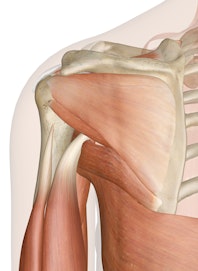
Deep Muscles of the Shoulder (Posterior View)
The muscles of the shoulder bridge the transitions from the torso into the head/neck area and into the upper extremities of the arms and hands. For that reason, and because of the dexterity of the shoulder joint itself, the musculature of the shoulder is complex, ranging from massive prime mover muscles to finer stabilizer and fixator muscles.
The shoulder (or humeroscapular) joint is formed by the articulation of the head of the humerus with the scapula. It is a ball-and-socket joint and the most freely movable joint in the body. The shoulder joint is protected superiorly by an arch, which is formed by the coracoid process of the scapula, the acromion process of the scapula and the clavicle. It is an extremely mobile joint, in which stability has been sacrificed for mobility. The bones of the pectoral girdle (clavicle and scapula) provide increased mobility to the shoulder joint by allowing it to move in all directions.
Although three ligaments protect and surround the shoulder joint, most of its stability comes from the powerful muscles and tendons of the rotator cuff. The rotator cuff consists of four muscles: supraspinatus, infraspinatus, subscapularis, and teres minor. Each of these muscles has its origin on the scapula and inserts around the head of the humerus. The tendons of these muscles surround and support the humerus while the contraction of the muscles rotates, adducts, or abducts the humerus.
Surrounding the rotator cuff muscles are many groups of muscles that work together to produce the various movements of the shoulder. Located superior to the shoulder joint, the deltoid muscle works with the supraspinatus to abduct the arm at the shoulder. On the anterior side of the shoulder, the coracobrachialis, serratus anterior, pectoralis major, and pectoralis minor muscles work as a group to flex and adduct the scapula and humerus anteriorly toward the sternum. The latissimus dorsi and teres major on the posterior side extend and adduct the arm towards the vertebrae of the back. Working on the pectoral girdle, the trapezius, rhomboid major, and levator scapulae muscles of the back elevate the scapula to shrug the shoulders and move the scapula posteriorly (as in reaching back behind the body).
Although the joint is held together by these extensive ligament and muscle attachments, certain types of forces can weaken the shoulder easily. The shoulder joint is vulnerable to dislocations from sudden jerks of the arm, especially in children before strong muscles have developed. Because of the weakness of this joint in children, parents should be careful not to force a child to follow them by yanking on their arm. Dislocation of the shoulder is extremely painful and may require surgical repair or even cause permanent damage. Repetitive or sudden stress can cause tears in the tendons of the rotator cuff and lead to pain and instability of the shoulder joint.

Copyright © Innerbody Research 1997 - 2025. All Rights Reserved.