Superficial Muscles of the Hand and Wrist (Posterior View)
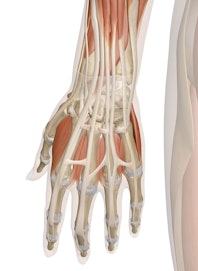
The hand is an intricately complex structure that is adapted to permit an unequalled array of movement. There are over sixty different muscles in the hand to accomplish this. Flexion and extension of the hand and phalanges or fingers are accomplished by extrinsic muscles of the hand (or those of forearm). Precise finger movements that require the coordination of abduction and adduction with flexion and extension are functionally the task of the small intrinsic muscles (those inside) of the hand. The intrinsic muscles of the hand are further divided into thenar (concerning palm on the thumb side) and hypothenar (concerning palm next to the little finger), and the intermediate groups.
The bridge between the hand and the forearm is the wrist (or carpus), a collection of eight small bones fitted together in a cobblestone network and bound in place by strong ligaments. The fingers are mostly controlled by strong muscles in the forearm. These muscles may connect with tendons at the wrist, which help both the wrist and the hand to articulate. Or they attach to tendons that extend along each finger and are embedded in long sheaths on the palm side of the hand. When the forearm contracts it pulls on the tendon and the sheath to bend the finger. A disk within the wrist allows the 180 switch of the top for the bottom of the hand that is called pronation and supination.
Each of the four fingers on each hand behaves similarly to the others and has similar musculature, but the thumb is somewhat unique. The thumb is extremely important to the hand's flexibility because it opposes the other fingers, which means we are able to pinch a small object between the thumb and finger to pick it up. It is the opinion of most anthropologists that the human thumb is responsible for man's superiority to the lower primates. Our thumb gives us dexterity to build tools and to record history.

Copyright © Innerbody Research 1997 - 2025. All Rights Reserved.